
Meloni: ‘Tax relief on contract renewals will be confirmed in the next budget’
The Prime Minister addressed the trade union conference following Bombardieri’s speech: this is the first time since Prodi in 2006. A willingness to introduce tax incentives to encourage business mergers

Key points
- A Prime Minister’s first time in twenty years
- Dialogue with the social partners makes all the difference
- ‘A fair wage is a victory for all workers’
- ‘No more handouts’
- Combating bogus contracts
- The future of Italy? ‘Working women’
- Capolarato: the policy is ‘zero tolerance’
- The introduction of incentives to encourage mergers
- Points-based driving licence: ‘ready to discuss changes’
- ‘My door is always open to discussion’
“I have already discussed this with Minister Calderone and with the person in charge of the purse strings, namely Minister Giorgetti: the Government is taking on board the request from the UIL and the social partners to ensure that the tax exemption on contract renewals can be confirmed in the next Budget Bill as well”. Giorgia Meloni announces the return, for 2027 as well, of the 5 per cent tax on pay rises provided for in the previous budget, “because it strengthens the link between productivity and wages and helps to restore the central role of collective bargaining: it is an effective measure, to which we wish to provide continuity and stability’.
A prime minister’s first time in twenty years
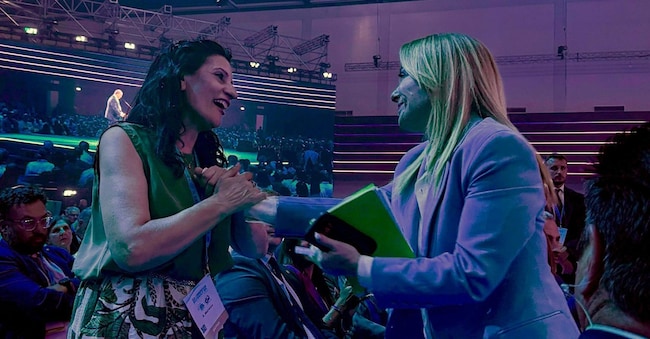
The Prime Minister addresses the 19th National Congress of the UIL currently taking place at the Padua Exhibition Centre, attended by 3,000 delegates (who welcomed her with applause), over a thousand guests and anticipation surrounding the reappointment ofPierpaolo Bombardieri as general secretary. This is the first time in twenty years that a Prime Minister has returned to the stage at the trade union’s congress: the last occasion was at the end of June 2006, when Romano Prodi, who had recently been re-elected, addressed the gathering. This time, a humanoid robot is there to greet her, a symbol of the artificial intelligence for governance for which the UIL is proposing ten points in a document addressed to the Government.
Dialogue with the social partners makes all the difference
Before her speech, whilst Bombardieri paid tribute to Luana D’Orazio, the young woman who died on 3 May 2021 after being crushed by the warping machine at the textile factory where she worked, the Prime Minister rises from her seat in the front row and rushes to embrace Luana’s mother, Emma Marrazzo. Her opening remarks, however, were a tribute to the trade unions and the congress, a ‘great exercise in democracy and participation’, and to the joint platform signed by the UIL together with the CGIL and CISL on representation and collective bargaining – the starting point for negotiations on the agreement with the employers’ organisations: ‘I believe I am the only Prime Minister to have attended the congresses of all three major trade union organisations, and I think this shows just how much dialogue with the social partners has been, and continues to be, a defining feature of this Government’s work and convictions. We believe it is the ability to listen that makes the difference.’
‘A fair wage is a victory for all workers’
On the issue of fair pay – another of the UIL’s demands that has been taken up by the Government – the Prime Minister emphasised: ‘Bombardieri pointed out that this was a demand made by the UIL; I believe it was a victory for all workers and for the nation as a whole’. Meloni defends the Labour Decree: “We have set out in black and white a principle that had never before been recognised in Italia, namely that collective bargaining – high-quality collective bargaining – is the most effective tool at our disposal for improving protections, defending rights and boosting workers’ pay.”
‘No more handouts’
Meloni calls for incentives to be tied to fair pay: ‘We are well aware that for years the State has been handing out money indiscriminately to everyone, even to those who relocated their businesses and those who failed to comply with safety regulations. Here too, we have courageously chosen to say ‘enough is enough’, because the money the state distributes is not its own; it is money collected from taxes and the sacrifices of this nation’s workers, and it must be spent fairly, responsibly and with the aim of improving people’s living conditions in the labour market.”


