
Meloni to trade unions: 100 euro bonus in January, two-year relief for hiring young people and women
The EUR 100 allowance is for employees with a total income not exceeding EUR 28,000 with a spouse and at least one dependent child, or for single-parent families with only one dependent child

4' min read
Key points
4' min read
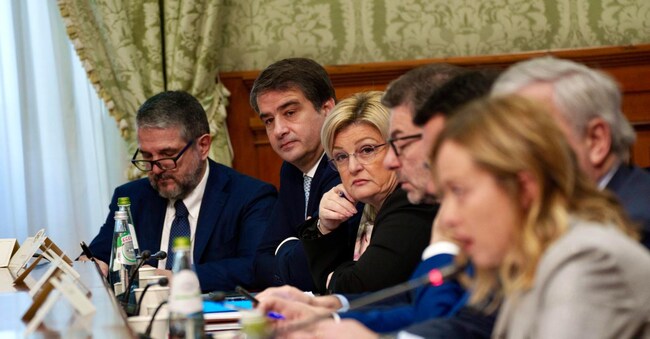
Bonus for hiring young people, women and disadvantaged workers, with relief for two years. And an allowance of 100 euro next January for employees with incomes up to 28,000 euro. Prime Minister Giorgia Meloni together with half of the government presented in the afternoon to the trade unions the upcoming news on labour and taxation, which will go to the Council of Ministers on Tuesday 30 April, on the eve of Labour Day. Putting on the table a new May Day decree - as it has already been renamed - after last year's regulations on inclusion were approved on that date, with the farewell to the citizenship income, on the grounds for fixed-term contracts and on cutting the tax wedge by up to 7 points. Now the new measures are contained in the Cohesion decree, which reforms the relevant policies, and in a legislative decree, as part of the implementation of the tax delegation, which will be examined by the Cdm tomorrow. The objective, as Meloni emphasised at the table with the trade unions, is to continue to support employment growth, the reduction of unemployment and the inactive, i.e. those who do not have a job and are not even looking for one, in order to get them back into the market. And also to defend the purchasing power of families and workers, 'especially those most exposed'.
€100 bonus in January
"Tomorrow we will bring to the Council of Ministers, as part of the implementation of the tax delegation, a legislative decree that will allow us to provide, in January 2025, a allowance of 100 euros in favour of employees, with a total income not exceeding 28,000 euros with a spouse and at least one dependent child, or for single-parent families with only one dependent child," announced the premier. An allowance already referred to by some as the 'Befana bonus'.
Meloni: two-year relief for hiring young people and women
Meloni also made it official that the Cohesion decree with which the government aims to accelerate the implementation of cohesion policies, which provide Italy with EUR 75 billion, of which EUR 43 billion in European resources, will be approved by the Cdm. European funds that are allocated to the country every seven years. And which must be spent, allocating them to labour, social and business support policies. In detail, Meloni explained, there is a reduction in the contribution burden for new hires for two years. Alongside the measures to support employees, there are specific provisions to encourage the start-up of new activities, separate for the centre north and the south of Italy.
There are also specific regulations for the university and research sector to support research and innovation, with particular reference to the energy and digital transition sectors. For education, measures are coming to support the extension of full-time education. For the environment, measures for the redevelopment of industrial areas, with interventions for the production of energy from renewable sources. The decree law also includes measures to upgrade and secure Italy's cultural heritage.
Coming measures to retrain workers from companies in crisis
The 'employment support measures' contained in the decree on cohesion policies 'are accompanied by actions to retrain the workers of large companies in crisis in order to encourage the matching of labour supply and demand'. "Specifically," Meloni added, "we intend to support the creation of new businesses in the south and centre-north through a measure dedicated to people who are currently unemployed. The objective is to continue to support employment growth, the reduction of unemployment and inactives. Our line of action is clear: we support those who are looking for work, those who are hiring, and those who intend to set up their own business, starting with the categories that find it most difficult to find work today'.

