The budget

Meloni, the thousand days with a parachute aiming for a record

Spread and public accounts are good, but tariffs, industry and growth are of concern. Caution dominates, even with Trump

by Barbara Fiammeri and Manuela Perrone

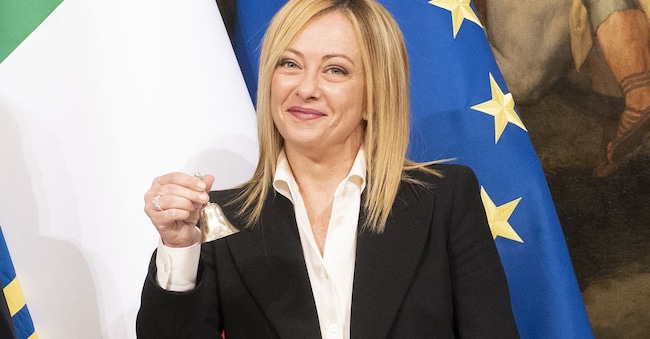
Prima premier donna. Giorgia Meloni ha giurato come presidente del Consiglio il 22 ottobre 2022, entrando ufficialmente in carica. (Imagoeconomica)

7' min read

7' min read

One thousand days at the helm of the same government in Italy is an eternity: Giorgia Meloni will cross that milestone today. Before her, only Silvio Berlusconi, Bettino Craxi and more recently Matteo Renzi succeeded, but in a fortnight' time she will be overtaken by the first woman Premier of the Italian Republic. Meloni's goal is well-known: to complete the legislature (and then return to Palazzo Chigi after winning the political elections).

But beyond the numerical data that photograph the longevity of the current executive, what characterises Meloni I are the particular circumstances that determine its solidity. Certainly, the Prime Minister's leadership has a significant specific weight and this is confirmed by the high approval rating for her and the further growth of Fdi, always at the top of the polls. Not to mention the distance separating Meloni's popularity from that of her deputies, Antonio Tajani and Matteo Salvini, as well as the leaders of the other centre-right parties.

Loading...

But further strengthening the Fdi founder's tenure at the helm of Palazzo Chigi is above all the weakness of a fragmented opposition, with parties in dispute with one another. A reassuring picture for the Prime Minister in a dramatic geopolitical context, amidst multiplying conflicts and the search for a new international order. Hence the parachute-throwing metaphor used by Meloni to explain the challenge of leading the country. An image that recalls both the fear of making mistakes and the need to use the utmost prudence.

Proof of this is the positive management of public accounts, the fall in the spread and the axis that he has wanted to build with Brussels since his arrival at the helm of the executive. A caution that also applies, however, in a negative sense, as demonstrated by the absence of an industrial policy that is decisive for Italy's survival, even before competitiveness: no record on employment can sweeten the reality of asphyxiated growth. A prospect that is destined to worsen when we can no longer count on the NRP treasury.

1 - The Economy

.

Labour records do not save growth

The Prime Minister has repeatedly claimed records on the employment front, and indeed the latest figures testify to the creation of more than one million jobs in two and a half years of government, which has led to an all-time high of more than 24.3 million employed. Yet despite these numbers, domestic demand remains weak and industrial production continues its inexorable descent (-1.2% from the beginning of the year to May, with the automotive sector taking a thud). Production is already being tested by the high cost of energy - with excise duties remaining the highest in Europe and the decoupling promised in the election campaign never implemented - and put even more at risk by the tariffs announced by the US.

This means that the increase in employment contracts is not enough to ensure growth (not by chance halved in the government's estimates for 2025 at +0.6%), especially since it is employment in significant part linked to services, with wages that, despite some signs of recovery in the last year, remain well below the levels of the main OECD countries. This is indirectly confirmed by the steady increase in the number of qualified young people expatriating. A haemorrhage that the government has so far failed to address (indeed, Renzi's bonus for returning brains has been severely curtailed) and that also weighs on an already desperate demographic outlook. A crisis to which the answer cannot continue to come from the policy of bonuses, however substantial.

2 - The Public Accounts

.

Spreads and weapons, caution as a golden rule

It is the flagship of the government: when Meloni walked through the door of Palazzo Chigi on the day she was sworn in, the spread was hovering around 230 basis points; yesterday it was just above 90. A result that the Prime Minister rightly claims and to which the prudent management of public accounts wanted by Meloni and the Minister of the Economy, Giancarlo Giorgetti, has contributed, also to mitigate the catastrophic effects of the 110% Superbonus put on hold from the start. Italy is still in the infringement procedure for excessive deficit, but will come out of it early next year. The shift from the deficit at 7.2% of GDP two years ago to the current 3.3% is the result of this prudence.

The shingle remains that of public debt, which has returned to over 135% of GDP and is expected to rise until at least 2027. And this is why, despite the commitment to increase defence spending by 5% over ten years, made at the NATO summit in June, the executive does not intend to accelerate immediately. Nor does it want to avail itself for now of the national safeguard clause in the Stability Pact, which Italy is calling for to be changed after the Trump tsunami. The litmus test will come in the autumn with the opening of the budget session.

3 - The tariffs war

.

Meloni between Europe and the US: bridger or balancer? 

To understand Giorgia Meloni's strategy, one only has to look at the routes of her travels. The first ever was on 3 November 2022. Destination Brussels: to welcome her at the Berlaymont Palace, Ursula von der Leyen, with whom she established a relationship of mutual esteem (and convenience), consolidated thanks to the Commission president's visits to Lampedusa and the flooded Emilia-Romagna. A relationship that lasts to this day. With her first trip, the PM immediately wanted to send a clear message: no Euroscepticism and full support for the EU executive.

To seal the Euro-Atlantic line without hesitation, the full support for Ukraine declared since the invasion by Russia, when Meloni was still in opposition and Mario Draghi was at Palazzo Chigi. A line that has earned the Prime Minister a strong relationship with the US administration, first with Joe Biden - an affinity immortalised by the famous kiss on the forehead on the occasion of his first visit to the Oval Office - and then with Donald Trump, to whom she is above all linked by her right-wing affiliation. This political affinity has counted and still counts on von der Leyen herself, who recognised from the start the difference between Meloni and the leaders of European sovereignty, from Orban to Le Pen.

This bridging role repeatedly claimed by Meloni herself is being put to the test by the trade war unleashed by Trump. A position that forces her into balancing acts that are not without risk. Even in these days, the Prime Minister, together with von der Leyen and German Chancellor Merz, is advocating the line of dialogue, recalling that the exclusive competence of the negotiations lies with the Commission and trusting that in the end the tycoon will reach a 'reasonable agreement' by 1 August. Agreement which, in Meloni's view, means tariffs of no more than 10%. If this is not the case, the danger of a heavy backlash, even to his leadership, is not peregrine.

4 - Immigration

Migrants, Mattei Plan, energy: pact with Africa 

The flag of hard and pure sovereignism, which in opposition saw her promise a naval blockade, has been lowered. But not the identity banner against irregular immigration, which has been the subject of the government's most controversial decree-laws since their inception, from the one that struck down the NGOs to the Cutro Decree with the tightening of criminal sanctions against human traffickers, up to the Albania operation that has found backing in the main European leaders, starting with von der Leyen herself.

The numbers say that the landings have indeed dropped, thanks in part to the control of the Tunisian chaos through the pact with Kais Saied signed in Tunis two years ago, in which von der Leyen was also present. Now it is Libya torn apart again by the struggles between warlords that is the new emergency, much more complicated to manage, not least because of the direct interest of Russia, which has made it its new base in the Mediterranean.

A complexity, that of relations with Africa, which Meloni has chosen to tackle not only by rejections at the borders and repatriations, but above all by favouring legal flows and making agreements with the countries of departure and transit of migrants. This is the heart of the Mattei Plan. From Algeria to the Congo, from Eritrea to Ethiopia, the ambition is to build political and, above all, economic relations in which the protagonists are the large Italian groups, starting with Eni, in the footsteps of its founder Enrico Mattei. A goal that is still to be built: to make Italy the energy hub of Southern Europe, all the more so after the break with Moscow.

5- The Recovery Plan

.

Pnrr goes, but boomerang risk is feared

So far the Prime Minister has been able to claim Italy's 'record' in advancing the NRP, with 100% of the planned targets achieved by 30 June 2025, all the instalments collected up to the seventh of 18.3 billion (140 billion, 72% of the total endowment), and the eighth of 12.8 billion already requested. But the last step linked to the ninth and tenth tranche of 41.2 billion in total is the most complicated: the government must overcome the hurdle of the long negotiation with the EU Commission in order to bring home the new maxi revision proposed to be able to rid the Plan of the projects that cannot be implemented by June 2026, including Transition 5.0.

Always taking into account the knot of actual expenditure: on paper, Italy should spend 120 billion in less than two years. An unlikely target, the failure to cut which, however, could negatively affect the growth forecasts that take the Plan's investment effect for granted. Not to mention the uncertainty that surrounds the future after the 2026 deadline, also in light of the new European budget and the cut in cohesion funds to support the increase in resources for defence.

6 - Reforms

.

Premiership and autonomy at the pole, justice passes

Even the Meloni government could not miss the chapter on reforms, with each party in the majority ready to sponsor its own: the premierate, for Meloni 'the mother of all reforms', as well as differentiated autonomy for the League. But in reality the only one that seems to be heading towards the goal at the moment is that of justice with the separation of careers dear to Forza Italia. The others are languishing.

And the reason, net of the positions taken by the Supreme Court, the Constitutional Court and jurists, is political: the premierate can only go ahead if federalism also marches ahead, which, however, by the admission of the Lega Nord minister Giorgetti himself, is currently difficult to implement due to the costs that would require compliance with the Lep. Meloni does not despair. She does not consider the idea of taking the Italians before politics to the referendum. The ghost of Renzi's defeat still hovers in Palazzo Chigi. It will be discussed again if, and especially when, the encore comes. The only obstacle separating Meloni from the primacy of premier of the longest government in the Republic is the early vote. But she alone will decide this.

Copyright reserved ©
Loading...

Brand connect

Loading...

Newsletter

Notizie e approfondimenti sugli avvenimenti politici, economici e finanziari.

Iscriviti