
Mensch, CEO of Mistral Ai: 'European telcos invest in large data centres'
The co-founder of the French company, a European leader in the Ai field, urged companies not to use only US technologies whenever possible
by correspondent Luca Salvioli
3' min read
3' min read
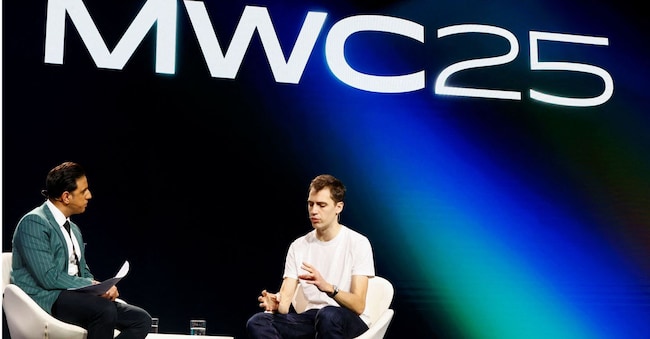
BARCELONA_ Arthur Mensch, CEO of Mistral, the French company that has established itself as Europe's leading expertise in the field of generative artificial intelligence, was highly anticipated at the Mobile World Congress. Indeed, Mistral has a key position in an area where Europe has decided to invest, after the Paris summit, in order not to lag behind the United States and China.
In front of a specialised audience, operators in particular, he insisted on the need for European telcos to invest in building large data centres. 'There has definitely been a general wake-up call in Europe with the beginning of 2025,' he said, 'particularly to reduce dependence on the big US technology groups. There is a growing discussion and ambitions in Europe are growing. Europe can offer a lot, telcos have the opportunity to invest in big data centres. We are doing that, we are building our datacenter in France. The Ai revolution is also an opportunity to decentralise the cloud and have more players, not just the Americans'.
Mensch has an engineering degree from École Polytechnique and Télécom Paris, then a PhD in computer science; he worked three years at DeepMind before co-founding Mistral. In his speech, he insisted on the need to collaborate with all European industry.
"We are working with telecoms, because Ai will have consequences for the characteristics of the networks, with very customised information. It will change the architecture, we are working on this with Orange," he stressed.
He called generative Ai a 'very horizontal' technology, which at '90 per cent is the same as a product for both consumers and companies', but what changes is the information used by the models, the data. The collaboration of European companies in the adoption of these agents is important to realise the specifications, which for finance are different from HR, to give an example.


