
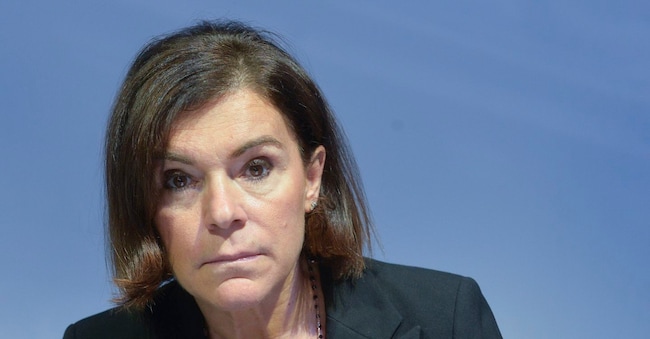
MEP Gualmini leaves Pd and goes with Renew Eu: no political agibility
Justice and foreign policy among the divisive topics. Also on the doorstep is Delrio, who is working on a Margherita 4.0 to mark the centre of the wide field
by Emilia Patta
Key points
"Is there still a place for us reformists of liberal-democratic culture within the PD?" asked MEP Pina Picierno during last Friday's party leadership meeting at which leaders and militants were asked to support belly-to-belly the reasons for the No vote in the referendum on justice on 22 and 23 March. For some time now, the reformist docs, those who did not want to follow Stefano Bonaccini in joining the majority in support of Schlein, have been in trouble and speak of 'unbreathable air' in a party that in their opinion has swerved all to the left, losing the founding reasons for the meeting between the country's different reformist cultures (liberal, Catholic and socialist).
European MP Gualmini's farewell and move to Renew Eu
And just in these hours the party founded by Walter Veltroni is witnessing a weighty exit, wondering if it is the first of others: MEP Elisabetta Gualmini will announce on Monday her passage to the Renew Eu group to which Action and Italia Viva also belong, but which in 2024 did not exceed the bar threshold remaining outside the Euro Chamber. Like Picierno, Gualmini is among the Dems who have come out in favour of the separation of the careers of magistrates and only a few days ago she had bitterly criticised the video on the party network's social media in which those who vote Yes in the referendum were equated with Casapound: "So those who supported Martina's motion at the 2019 congress and the 2022 PD programme were fascists...".
Justice and especially foreign policy among the divisive issues
But there is not only justice. Far more important for the reformists is international positioning, starting with the defence of Ukraine and investment in a common European army. Lorenzo Guerini, president of Copasir and point of reference, together with Giorgio Gori, of the group of reformists who have remained in Schlein's opposition, has been repeating this for days: 'What is needed is a clarification within the centre-left on international politics'. That is, a clarification with the M5s and Avs, the allies who have been voting against sending arms to Ukraine for years now: how is it possible - the question is - to put together a credible coalition with such divergent positions?
"For us, there is no more political viability within the PD"
As for Gualmini - a political scientist, former president of the Carlo Cattaneo Foundation and vice-president and welfare councillor of the Emilia Romagna region - she also makes it a question of political agility: she stops appearing in television debates and also stops speaking in the Europarliamentary Chamber. In short, for those who do not think like the Schlein majority - is the accusation - it has become impossible to do politics. "A very painful but very convinced choice," writes Gualmini herself, announcing her decision to her 'current' comrades via chat. The very little, if any, solidarity she received for her inclusion in the Qatar Gate investigation certainly played a role (Gualmini, unlike Alessandra Moretti, was however 'saved' by the vote of the European Parliament, which confirmed her immunity due to the very little and dubious evidence against her).
Delrio and the centrist project (with Prodi and Ruffini?)
For the reformists, however, Carlo Calenda's Action with its third-party strategy is not a solution. Just as the 'reformist house' project launched by Matteo Renzi is not a solution at the moment. Even those who appear to be more on the fence, such as former minister Graziano Delrio - the victim of a defeat for having presented a Ddl on anti-Semitism that took up the definition of the International Holocaust Remembrance Alliance (IHRA) - are rather thinking of a larger container, a sort of Margherita 4.0 that remains within the broad field by marking the centre of politics. A debate, that on the centrist project, which has recently been fuelled by the news of a meeting in Bologna between former Prime Minister Romano Prodi, the founder of the Più Uno committees Ernesto Maria Ruffini, the mayor of Milan Giuseppe Sala, Delrio and MP Paolo Ciani, secretary of Demos. 'An exchange of good wishes in person and also some opinions on the country, the world and the centre-left,' Ciani then played down.


