Hypersuv

Mercedes-AMG GT SUV: everything you need to know – performance and features

The first electric SUV designed and developed entirely by AMG incorporates new technologies and specifications, in addition to those it shares with the battery-powered GT Coupé 4 hypercar, to optimise efficiency and dynamism

5' min read

Translated by AI
Versione italiana

5' min read

Translated by AI
Versione italiana

AMG is really getting into its stride and continuing its journey as an independent manufacturer by adding the GT SUV to the GT Coupé 4 range. In other words, the model with which it has entered the electric era in its own unique way and, above all, true to its DNA. In fact, the two models bear no resemblance to those of parent company Mercedes, which AMG has heavily reworked by boosting power outputs and integrating specific technologies.

Just like the GT 4 Coupé, the GT SUV also boasts styling and features that are entirely ‘made by AMG’, including innovative technologies for the world of electric supercars.

Loading...

Mercedes-AMG GT SUV: three versions that also feature petrol engine sounds

The first SUV designed entirely by AMG is based on the 800-volt AMG.EA architecture, which made its debut in the GT Coupé 4. This architecture also incorporates the MB.OS supercomputer, which is integrated with AI and manages all the car’s functions by coordinating the various electronic systems and digital features.

The in-house developed Amg.Ea platform enables the GT SUV to take its place amongst the hyper-SUVs, with three powerful all-wheel-drive variants. At the bottom of the range is the 53, featuring a dual-motor system with radial-flow motors that delivers 544 cavalli and 800 Nm of torque. The other versions, however, are powered by a three-motor system – one on the front axle and two on the rear – comprising sophisticated axial-flow units that are very compact, lightweight and more efficient than their radial counterparts, with the rear pair ensuring precise control of drive torque to each wheel and, therefore, highly precise torque vectoring. The GT SUV 55 delivers 816 cavalli and 1,800 Nm of torque, whilst the top-of-the-range 63 version unleashes a staggering 1,169 cavalli and 2,000 Nm of torque. Naturally, it is the highest-performing of the lot, reaching 270 per hour and 100 per hour in 2.5 seconds. The stated average energy consumption ranges from just over 20 kWh/100 km for the 53 to 24 kWh/100 km for the other two versions.

For the most die-hard petrolheads, the GT SUVs offer technology that realistically emulates the sound of a V6 engine in the case of the 53 version, and that of an AMG twin-turbo V8 in the more powerful models. When set to the AMG Force Sport+ mode, the system modulates the soundscape according to throttle input and simulates the gear changes of a nine-speed automatic gearbox – which can also be operated using the steering wheel paddles – through instantaneous changes in torque that reproduce the kickback felt during upshifts and downshifts. Furthermore, the sensations evoked by these functions are enhanced by vibrations synchronised with the frequencies of the simulated internal combustion engines, generated by actuators integrated into the seats.

Mercedes-AMG GT SUV: efficiency and dynamism inspired by Formula 1

The GT SUV is set to feature two batteries with NCMA chemistry and silicon anodes, comprising cylindrical cells which – to ensure a constant delivery of maximum power – are individually cooled using an electrically non-conductive oil via a system derived from that used in Mercedes-AMG Formula 1 single-seaters. One, already used in the GT Coupé 4, has a capacity of 106 kWh and can be charged with direct current at up to 600 kW, allowing up to 380 kilometres of range to be added in ten minutes. The same time is also required to add a range of 450 kilometres with the new 128 kWh battery, which can be charged with direct current at up to 710 kW; in the case of the GT SUV 63, this promises a range of up to 700 kilometres. In all three versions, efficiency is optimised both by decoupling the front motor when it is not required to provide a boost or deliver traction, and by the two-speed gearbox coupled to the rear powertrain. The former aids acceleration and manoeuvring in traffic, whilst the latter is suited to higher speeds. Of course, aerodynamic design also plays an important role, thanks to active elements integrated into the bodywork and underbody that modify airflow to optimise both efficiency and dynamism in one fell swoop.

The first SUV designed by AMG offers seven trim levels, including the Race, Eco and Individual, as well as the Race Engineer, which allows for precise customisation of the powertrain response, handling dynamics and rear-axle torque distribution. Furthermore, this model marks the debut of the latest evolution of the adaptive air suspension system, which also features 48-volt active roll control to optimise handling, keeping the GT SUV’s 2.6-tonne weight in check when cornering. The reliability of the handling is also supported by the low centre of gravity imp

Mercedes Amg Gt Suv, le foto del nuovo hypersuv elettrico

Photogallery11 foto

powered by the battery in the underbody, the rear-wheel-steering system and the carbon-ceramic braking system.

Loading...

Mercedes-AMG GT SUV: muscular styling combined with active aerodynamics

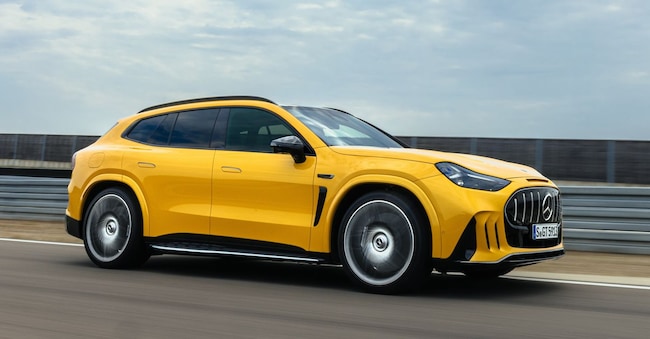
This AMG is not one of those high-performance electric models that aim to impress with an unconventional look. In fact, the GT SUV’s styling simply conveys the potential of its technological features through the muscularity of its bodywork, defined by a classic design that aligns with Mercedes’ most elegant standards and draws inspiration, in terms of proportions, from petrol-powered grand tourers. Visually, the sporty styling cues and aerodynamic features blend harmoniously into the smooth, rounded surfaces of the bodywork, whose profile is reminiscent of a coupé, whilst eschewing any excessive ‘wow factor’. At the front, the bonnet – unusually long and muscular for an electric car – and the Panamericana grille, a feature of all AMG models, stand out; however, it is, of course, a closed panel incorporating the radar sensors and cameras for the ADAS systems.

Mercedes-AMG GT SUV: the interior is a luxurious and intelligently designed high-tech lounge

The GT SUV is a large model. In fact, it is 5.08 metres long, 2 metres wide, 1.65 metres high and has a wheelbase of 3.04 metres. These dimensions, combined with the body design, are reflected in the interior, creating a very spacious cabin and a boot with a minimum capacity of 610 litres, plus a 78-litre front frunk.

The interior design creates an environment that blends refinement, sportiness and high-tech features. The interior, crafted from premium materials with meticulous attention to detail, features a dashboard dominated by the MBUX system interface – complete with Google Gemini and ChatGPT AI – facing the driver’s seat. It comprises a combination of the highly customisable 10.2-inch instrument cluster display and the 14-inch infotainment screen, which also provides access to specific AMG menus for the most extreme use of the GT SUV, including on the track. A third display for the front passenger is also available as an option. This digitalisation is complemented by the inclusion of numerous physical controls that ensure ergonomic usability, including the rotary controls on the centre console between the seats for the Race Engineer system and those on the steering wheel for quickly adjusting vehicle configurations and suspension settings.

Copyright reserved ©
Loading...

Brand connect

Loading...

Newsletter

Notizie e approfondimenti sugli avvenimenti politici, economici e finanziari.

Iscriviti