
Mercedes-Benz, sales fall back. But CEO Källenius is the highest paid in the Dax
Minus sign for the three-pointed star, while rival BMW impresses. In the meantime, the Swedish manager tops the list of German listed companies

3' min read
Le ultime da Radiocor
Borsa: agosto magro per Milano (+0,9%), ma riscossa di oro (+12%) e bitcoin (+24%)
### Tlc: si apre nuova partita su frequenze, interessa soprattutto operatori Fwa -FOCUS
***Edison: Qatarenergy estende forza maggiore ad altri 5 carichi Gnl
3' min read
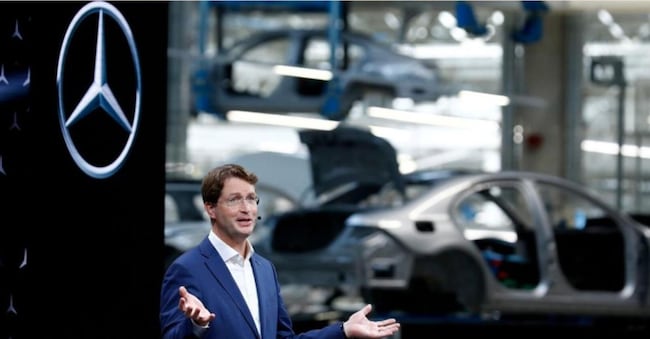
Paid more than all peers on Germany's main stock exchange list, the Dax, while the results of Mercedes-Benz Group cause some concern. CEO Ola Källenius, 54, earned EUR 12.74 million in 2023, the 'richest' among colleagues at Germany's largest listed companies. The Swedish manager overtook Deutsche Börse chief Theodor Weimer, 64, who took home 10.60 million, and Belen Garijo, 63, of the chemical-pharmaceutical giant Merck (10.53 million). According to an analysis by the Reuters agency, these CEOs are the only three to exceed the ten million threshold in Germany. Both Källenius and Weimer mainly benefited from the fact that they received bonuses from previous years last year.
Still nothing, to say the least, compared to the 36.5 million of Carlos Tavares, number one of Stellantis, record remuneration that did not convince shareholder funds. Tavares boasts a superior stock market performance (+54% versus +11% over the past 12 months) but a lower price-earnings ratio: 4.7 versus 5.5. Stellantis ended 2023 with a net profit up 11% to 18.6 billion (Mercedes -1% to 14.5 billion) and a slightly positive adjusted operating profit, in contrast to Mercedes. Equivalent operating margin close to 13%. Dividend +16% (EUR 1.55) for Stellantis versus +2% (but at EUR 5.30) for the German group.
Källenius, therefore, cannot be completely satisfied with the results of the group he has led since May 2019. In his opinion, the three-pointed star's electric cars would win almost any technical comparison, as the manager explained at the beginning of March, when Chancellor Olaf Scholz visited the largest Mercedes plant at the historic Sindelfingen site. 'We are way ahead of the Chinese,' Källenius emphasised in summary, as Handelsblatt reports. The problem is the market: a few weeks ago the Stuttgart-based company revised its strategic targets: 50% electrics produced by 2030 instead of 100%. In 2023 Mercedes sold fewer Bevs (battery electric vehicles) than planned. And in the first quarter of 2024, deliveries of fully electric vehicles decreased by 8% (47,500). Mercedes will put revised versions of the Eqs and Eqe models on the market from the end of April.
Overall, sales in the first quarter reached 463 thousand units (-8%), but -17% in Germany and -12% in China. Pure electric vehicles accounted for 10% of total sales and 19% including plug-in hybrids (+6%).
Germany's rival in the premium sector, Bmw , on the other hand, showed more resilience in the overall result (+1.1% to 595,000 units) and surprised with electrics: deliveries to customers of battery-powered models such as Bmw's i4, iX1 and i7 were up 41% in the three months to March compared to the same period last year. In all, sales of electric cars were up 28%. These results contrast with the marked slowdown in demand for EVs, particularly in Europe, where battery-powered cars have shrunk as a share of overall sales after governments, starting with Berlin, withdrew incentives.


