
Mercedes C-Class facelift: how the saloon and estate have changed, now with artificial intelligence on board
The facelifted C-Class, which now offers a new electric version alongside the petrol and diesel models, features updated design, engines and technology. Mb.Os makes its debut with an MBUX system that integrates ChatGPT, Bing and Google Gemini

Key points
The Mercedes C-Class has been updated without overhauling a formula that has resulted in over 12 million units sold since 1982. Following the launch of the electric version, the German manufacturer is unveiling a facelift for both the saloon and the estate, featuring the most extensive technical update yet for the current generation. The changes mainly concern the electronics, driver-assistance systems and powertrains, whilst the aesthetic updates focus on the front end, lighting units and detailing. Orders are already open in Germany, with prices starting at around 49,000 euros for the C 200 saloon. Prices in Italia have not yet been announced but are expected to start at around 50,000 euros.
Mercedes C-Class facelift: how the exterior has changed
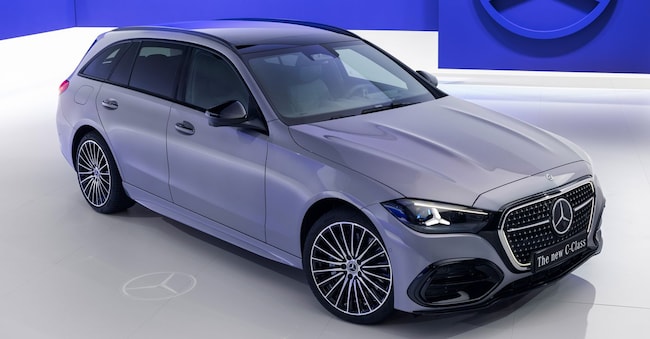
The proportions remain those of the current C-Class, whilst the front end has been redesigned around the new grille. The chrome surround incorporates an LED light strip and, depending on the market, the central star may also be illuminated. The headlights have been updated and are recognisable by their new star-shaped light signature, a motif echoed in the saloon’s rear light clusters. A glossy black element visually links the grille and headlights, whilst new bumpers have significantly altered the lower section of the front end.
The range of wheels includes sizes from 17 to 19 inches, with a new 18-inch design and two additional 19-inch AMG options.
For the first time, the C-Class is also available in the AMG Line Plus version, which adds specific exterior and interior features compared to the AMG Line. In the estate version, boot capacity is 490 litres in the five-seat configuration and up to 1,510 litres when the 40:20:40 split rear seatbacks are folded down.
Interni: Mb.Os launches with ChatGPT, Bing and Google Gemini
Inside the cabin, the overall layout remains largely unchanged. In front of the driver is the 12.3-inch digital instrument cluster, flanked by the 11.9-inch vertical central display. The multifunction steering wheel has been updated, reintroducing physical controls for certain functions, including a switch for the speed limiter and Distronic, and a dedicated volume dial. Capacitive surfaces with haptic feedback also remain. The main innovation lies in the electronic architecture. The C-Class adopts Mb.Os, Mercedes’ operating system with an architecture that links infotainment, vehicle functions and driver assistance systems, and enables over-the-air software updates. The fourth generation of MBUX uses an architecture that integrates ChatGPT, Microsoft Bing and Google Gemini, selecting which system to use based on the request. The voice assistant retains the context of the conversation thanks to a short-term memory and allows you to ask follow-up questions without having to repeat the previous request each time. Integration with Google Maps also allows users to search for points of interest, car parks and charging stations via voice command. MBUX Surround Navigation combines turn-by-turn directions with a three-dimensional representation of the surroundings and road users detected by the sensors. The system can feature up to ten external cameras, five radar units and twelve ultrasonic sensors, all connected to a control unit capable of performing up to 254 trillion operations per second.

