
Mercedes EQS, technology update for the electric flagship
A slight restyling hides many innovations that raise the bar in terms of efficiency, range of up to 925 kilometres, digitisation and comfort. And steer-by-wire, which also manages the steered rear axle, also arrives.

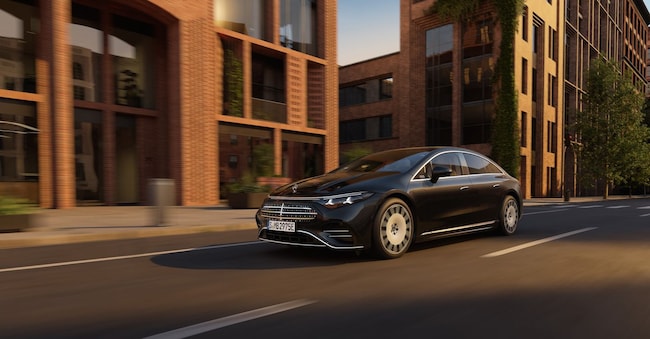
The dense programme of renewal and expansion of the range launched by Mercedes at this time also involves the EQS. The electric flagship has been renewed not so much aesthetically as by the redesigning of a quarter of its technologies, partly inherited from the new EQ series that debuted with the GLC suv soon to be joined, as announced, by the first battery-powered C-class.
.jpg)
Mercedes EQS, outside changes in front, inside for new technologies
The aesthetic changes do not alter the original EQS to any great extent, as they are concentrated mainly on the front, where the new LED-studded grille stands out more than anything else and is separated from the headlights, which, however, are digital and project light beams up to 600 metres, and in the Art Line trim in which the star, illuminated at night, reappears above the bonnet lid. It only disappears in the case of the AMG Line trim in which a large illuminated 'star' also stands out in the specific grille. Inside, the new EQS only stands out when the traditional steering wheel is replaced by the optional steer-by-wire cloche. On the dashboard there is still the Mbux Hyperscreen system, which covers the front of the dashboard with two 12.3" and one 17.7" screen, now, however, with the latest MB.OS operating system with Ai, while at the rear there are two 13.1" displays.
.jpg)
Mercedes EQS, 800 V architecture, batteries with more capacity and new powertrain
The revamped EQS is still based on the EVA2 platform developed for the large electric native models but now has an 800 V architecture that allows a range of 320 kilometres in 10 m and DC recharging up to 350 kW of the batteries. In addition, the system splits the battery pack in two to recharge it at 175 kW with the most common 400 V columns. The new range adopts new batteries with high energy density thanks to cells with silicon oxide anodes mixed with graphite. Thus, they retain the dimensions of those of the previous EQS but have more capacity. That of the new rear-wheel-drive 400 base version with 367 horsepower is 112 kWh, while those of the rear-wheel-drive 450+ with 408 horsepower, which promises a range of 925 kilometres, and the all-wheel-drive 580 4Matic twin-engine with 585 horsepower, are 122 kWh. From the CLA EQ and GLC EQ, the new EQS range inherits the two-speed gearbox: a short one for spurts and ripreae and a long one for constant speed to reduce consumption. This is also the aim of the front engine disconnection in certain driving situations in the 580 4Matic. The braking energy recovery system has been upgraded to 385 kW.

