Test Drive

Mercedes GLB Hybrid: a test drive of the mild-hybrid SUV that performs almost like a full hybrid

5' min read

Translated by AI
Versione italiana

5' min read

Translated by AI
Versione italiana

The second generation of the GLB takes Mercedes’ 48-volt hybridisation technology a step further. It is a technology with which the German manufacturer is launching an offensive in the mid-to-large-sized car segment, positioning it as an alternative to fully electric models. The GLB is the third Mercedes to adopt the 48-volt powertrain, described as a ‘mild hybrid’ but which, in reality, often functions as a full hybrid, propelling the car using electric power alone. The system supports the GLB’s great versatility, which is further emphasised by the functionality of the interior, which can be configured as a seven-seater on request.

Mercedes GLB Hybrid: its powertrains allow it to run on electric power alone

Loading...

Developed, like the CLA and GLA, on the Mma modular multi-energy platform – which will soon also underpin the new GLA crossover range – the GLB also features the MB.OS supercomputer, which incorporates AI. The platform optimises human-machine interaction by ensuring that every component of the car works together seamlessly to enhance performance, efficiency, dynamism, comfort and digitalisation, tailored to the driver’s style and driving conditions. Like the CLA saloon and Shooting Brake, it is available in three versions featuring 48-volt hybrid technology and an eight-speed dual-clutch gearbox developed for electrified models. All feature a 1.5-litre turbocharged petrol engine with the Miller cycle, available in different power outputs: 136 cavalli for the 180 version, 163 cavalli for the 200 and 190 cavalli for the 220. Inside the gearbox is an electric motor delivering 30 cavalli and 200 Nm of torque, bringing the total power output of the three GLB models to 156 cavalli, 183 cavalli and 211 cavalli respectively. The electric motor, powered by a 1.3 kWh lithium-ion battery, provides additional thrust in certain driving situations or enables the GLB to operate solely on electric power when manoeuvring, in traffic and for short journeys at moderate speeds, for both the front-wheel-drive variants and the 4Matic models with mechanical all-wheel drive, available on the more powerful versions.

Mercedes GLB Hybrid: the boxy-car design is that of a proper SUV

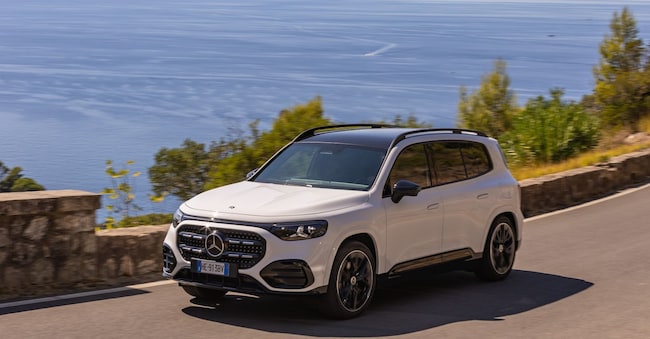
Amidst the proliferation of SUVs that seek to emulate coupés – which, ultimately, are pleasing to the eye but lack practicality – the new GLB makes its debut, retaining the angular lines accentuated by the vertical profile of the previous model’s rear end, albeit slightly softened by its larger dimensions. In fact, its appearance is more closely aligned with that of the G-Class than with that of Mercedes’ other SUVs; it is 4.73 metres long, 1.86 metres wide, 1.69 metres high and has a wheelbase of 2.89 metres. The balance between design and dimensions results in a harmonious, muscular silhouette with a classic off-road character. This personality is defined by the flat flanks, the sculpted lower bodywork and the ground clearance, which create approach, breakover and departure angles suitable for demanding off-road use. The front end incorporates the design language of Mercedes models based on the MMA platform, combining the light signature linking the headlights – including Matrix LED units – with the prominent grille, whilst the rear is characterised by the inverted U-shaped design of the tail lights that run across the tailgate.

Mercedes GLB Hybrid, le foto della prova

Photogallery12 foto

The Mercedes GLB Hybrid: a spacious, high-tech compact car, but with a few shortcomings

The interior of the new GLB is truly very spacious, well-designed and high-tech. The attractive styling of the interior follows that of the CLA and, more generally, that of the latest Mercedes models. The cabin is dominated by the advanced digitalisation provided by the MBUX Superscreen system, which combines the 10.25-inch configurable instrument cluster display with the 14-inch infotainment display, to which a further 14-inch display for the front passenger can be added. The infotainment system, powered by MB.OS with Google Gemini AI and ChatGPT 4 to support voice commands, leaves the controls for the most frequently used functions clearly visible. However, incredibly for a model sold at anything but bargain prices, the controls for the rear windows are missing from the driver’s side; to operate them, you must switch the function of the front windows using a separate switch. Furthermore, it is also surprising that the large panoramic roof – which comes as standard on all GLB models – is not paired with a sliding sunblind to shield the cabin from light and, above all, from the heat when the sun is beating down.

The interior, featuring a wealth of practical storage compartments, allows up to three people to sit comfortably in the rear, particularly by making use of the adjustable seat-backs and the sliding bench seat, which enables the space to be adapted to prioritise passenger comfort or maximise boot capacity. When the interior is configured for five seats, the boot offers a capacity ranging from 540 to 1,715 litres.

Mercedes CLA Shooting Brake Hybrid: how does the 220 4Matic perform?

In terms of dynamic performance, the top-of-the-range GLB offers consistently reliable handling, excellent manoeuvrability and a high level of comfort, thanks in particular to the cabin being well insulated from aerodynamic noise and tyre noise. Furthermore, the suspension set-up effectively absorbs road irregularities, whilst preventing the 1,900 kg kerb weight from causing body roll when cornering, which could otherwise negatively affect handling. Ultimately, this GLB handles with ease.

Loading...

The powertrain, with a total output of 211 cavalli, propels the 220 4Matic to 212 all’ora and to 100 orari in 7”5, whilst achieving an average fuel consumption of 6.7 l/100 km, which works well with the all-wheel drive system whether operating as a pure electric vehicle or when the two engines are working together. In these situations, power delivery is always smooth. However, when vigorous acceleration is required – and, strangely enough, not always, when switching from pure electric power to the point where the petrol engine—with 162 cavalli and 300 Nm of torque—needs to kick in, the slowness with which the dual-clutch gearbox selects the correct gear interrupts the smoothness of power delivery, causing slight jolts. Once this transition is over, gear changes return to being smooth. Overall, the 48-volt hybrid system proves convincing in terms of fuel economy, as in our test covering around a hundred kilometres, the average fuel consumption was not far off the manufacturer’s figure: 7.5 litres per 100 kilometres.

Mercedes GLB Hybrid: trim levels and prices

The range comprises the Advanced, Advanced Plus, Premium and Premium Plus trim levels across all versions, all of which include ADAS systems for advanced Level 2 semi-autonomous driving. However, features such as the electrically adjustable driver’s seat and dual-zone climate control – which are also available on lower-priced models – are only included in the Premium trim levels. Prices range from 50,000 to 65,000 euros.

Copyright reserved ©
Loading...

Brand connect

Loading...

Newsletter

Notizie e approfondimenti sugli avvenimenti politici, economici e finanziari.

Iscriviti