
Mercosur, internal EU tensions slow down signing of trade agreement
The Danish presidency is pressing, among the countries still uncertain are France and Italy. The hypothesis of a postponement of the signing does not please those who fear damage to the European Union's image
from our correspondent Beda Romano
 Aggiungi Il Sole 24 Ore
ai preferiti su Google
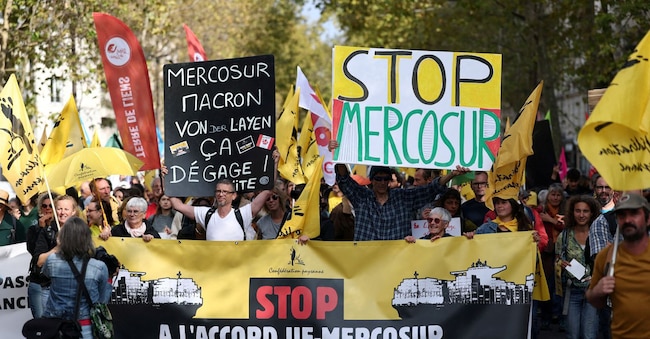
BRUSSELS - The European rigmarole leading up to the signing of the trade agreement with Mercosur, scheduled for next week, is full of institutional junctures and political difficulties. Some countries continue to clamour, while on Tuesday 16 December the Parliament is expected to give its green light to the safeguards proposed by the European Commission to reassure the agricultural world. The hypothesis of a postponement of the signing does not please those who fear image damage for the European Union.
The Danish presidency would have liked to put its signature to the vote of the member states already yesterday, but preferred to postpone the appointment in view of the uncertain positions of some countries, in particular France, Poland, Romania, and also Italy. Yesterday here in Brussels, the Italian Minister of Agriculture Francesco Lollobrigida said: 'We believe that our interests, like those of other countries, must be protected (...) We are not there yet.
The vote of the member states will be by qualified majority; Italy could play a major role in helping to move the needle of the scales, given the opposition of important countries such as Poland and France. To give its approval, the French government demands safeguards for the agricultural sector, the adoption of mirror clauses by the Mercosur countries and specific controls on imports from Latin America.
Our gaze runs to the 16 December plenary vote in Strasbourg. On that occasion, the Parliament will have to approve its negotiating position on the safeguards presented by the European Commission (see Il Sole/24 Ore of 9 October). Subsequently, the traditional negotiation with the Council should take place, as this is a legislative text. It should be noted, however, that according to the text the safeguards would come into force temporarily even if the trialogue is not concluded.
France is in a difficult position. It has to take into account its noisy agricultural sector. At the same time, it cannot afford to be in the minority, should the majority of countries be in favour of the agreement. Such an eventuality would be very embarrassing for Sébastien Lecornu's government and for President Emmanuel Macron, because it would contradict the domestic rhetoric that Paris has a leading role in shaping the Union in France's image.


