
Fusion accelerates: investments almost trebled in one year, first power plants planned by 2035

The fusion industry is attracting more and more capital: in the twelve months leading up to July 2025, more than USD 2.6 billion in investments were recorded, according to the Fusion Industry Association (Fia) report. With an increase of 178% over the previous year, this is the second highest result ever recorded after 2022.
The increase in funding for fusion, a sign of the industry's evolution, stands out even more against a global backdrop that is not very favourable for technology investment. The investor base is also broadening, which now includes venture capital companies, large industrial groups and state or parastatal capital. In particular, government support is growing strongly: contributions of this kind have risen by 84% in the past year and more than one in three of the companies surveyed said they were involved in a partnership with the public sector.
Technological advances pave the way for power generation on an industrial scale
On the commercialisation front, 78% of companies plan to build a pilot plant capable of generating power between 2030 and 2035; by the same date, 68% also aim to integrate it with the distribution network and start selling electricity. Fusion offers numerous advantages: it is a safe, highly efficient process - it produces about four million times more energy per kilogram than coal - the reactions involved do not emit CO2 and make use of abundant or potentially producible fuels. Furthermore, unlike solar and wind power, it ensures a constant supply of energy, which also has great advantages in terms of logistics.
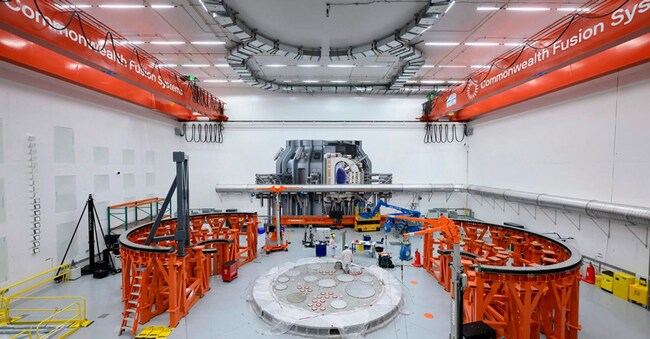
Technologically, the most popular approach in the private sector (49%) is magnetic confinement machines. As the name suggests, this type of machine uses powerful magnetic fields to confine and control the reaction within the plant. Technological advances in recent years have been significant. In 2021, Commonwealth Fusion Systems (CFS), the largest private company in the industry, successfully tested the world's most powerful high-temperature superconducting magnet, a decisive step towards building more compact and efficient plants.[12] The company is now developing SPARC , the first demonstration reactor, which will serve as the basis for ARC , the first fusion power plant operating on an industrial scale. In December 2024, the site where the plant will be built was announced: Chesterfield County, Virginia (USA). The aim is to have it operational within the first few years of the next decade.
Eni, one billion agreement for the purchase of decarbonised energy
A sign of the rapid evolution of the sector does not only come from growing investments: in recent years, the first commercial partnerships have been signed for the purchase of energy from future fusion plants. The most recent involves Eni, which in September announced an agreement with CFS, worth over $1 billion, for the supply of decarbonised electricity generated by the ARC plant. It is the second such contract signed in just three months, but this deal has particular value: Eni was among the first investors in the US company when it was set up as a spin out of the Massachusetts Institute of Technology (MIT) in 2018, and has since accompanied its growth by participating in subsequent funding rounds. Eni also has a historical scientific collaboration with MIT itself, dedicated to the development of advanced materials, superconducting technologies, fuel management and plasma control.
In 2023 CFS and Eni signed a technological cooperation agreement aimed at the development of fusion energy, which includes operational support, exchange of design methodologies and know-how.
The newly signed Power Purchase Agreement (PPA) demonstrates Eni's interest in the commercial prospects of fusion, and follows on from CFS's last financing round last August worth $863 million, in the context of which Eni participated by consolidating its investment in CFS. These agreements further confirm the company's promising path towards commercialisation on an industrial scale.
"This strategic collaboration, with a tangible commitment to energy procurement, marks a turning point in which fusion becomes an effective industrial prospect," commented Claudio Descalzi, Eni's CEO, underlining how the company supports this technology "as a new energy paradigm capable of producing clean, safe and virtually inexhaustible energy.
From research to market, Eni's support for fusion
Eni's commitment is part of a strategy guided by the principle of technological neutrality, which considers all the options available for the energy transition on the basis of effectiveness and context of use. In addition to its participation in Commonwealth Fusion Systems, the company is collaborating with the United Kingdom Atomic Energy Authority (UKAEA) on the construction of the largest and most advanced facility for managing the tritium cycle - a key fuel in the fusion process - which will be completed in 2028.
In Italy, Eni is participating in the DTT (Divertor Tokamak Test facility) project of the National Agency for New Technologies, Energy and Sustainable Economic Development (ENEA), being carried out at the Frascati research centre. The aim is to build a machine to test the components that will have to handle the large amounts of heat generated inside the fusion chambers. The company also collaborates with a large network of Italian universities and research institutes, and to support these institutions, it has made available the computing power of HPC6, the world's most advanced supercomputer for industrial use. This powerful machine will contribute to solving the complex problems associated with the issue of plasma stability in the field of fusion energy.
On the education front, Eni is funding numerous PhD programmes and recently set up the Master's degree programme "Next-gen Nuclear Power on Fusion and Advanced Reactors" at the Politecnico di Torino dedicated to next-generation nuclear technologies. Now in its second year, the Master's degree is an academic specialisation course that provides for the students' employment with a Higher Education and Research contract for the duration of the programme.

