The guide

Meta: 'Pay or we will use your data for advertising'. How to protect our privacy on Facebook and Instagram

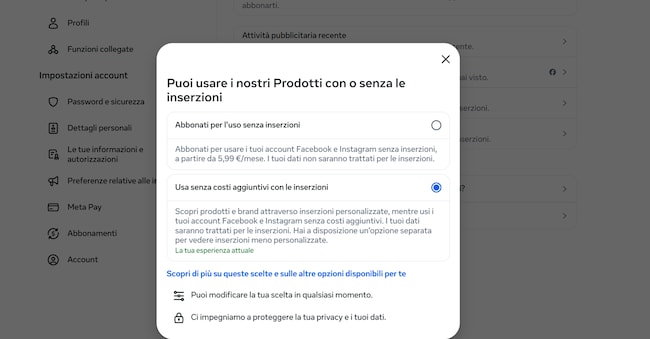
The choice screen appears when opening the app or site and temporarily blocks access to content until the user makes a selection

by Alessandro Longo

3' min read

3' min read

Meta is launching a new barrage of messages on Facebook and Instagram, asking users to choose between two usage models: continue to use the platforms for free by accepting personalised advertising, or subscribe monthly to remove ads and data profiling completely. The choice screen appears when opening the app or site and temporarily blocks access to the content until the user makes a selection.

What to do? And what exactly does this choice mean for our data? Many users are confused these days. And few know that there is actually a third choice, hidden in the settings of Facebook and Instagram: free but with much less invasive advertising.

Loading...

Let's see: we counted no less than six clicks to get to the most important privacy setting on advertising.
How much does the Meta subscription cost

?

The monthly subscription to use Facebook and Instagram without advertisements was introduced at the end of 2023, but as of November 2024 prices have been reduced. Today in Italy, use via a web browser costs EUR 5.99 per month for the first account, with an additional EUR 4 per month for each linked profile. On mobile devices, on the other hand, the subscription costs EUR 7.99 for the first account and EUR 5 for each additional account, to cover the fees imposed by digital stores.

If we pay, there will be no Meta advertising, but we can continue to see branded content, i.e. posts, videos or other types of content published by a creator or influencer on behalf of a brand, with the aim of promoting products or services.

At any time, users can access their Account Management Centre and change their advertising preferences. Subscriptions can be activated or deactivated.

Subscription remains optional: those who do not pay can continue to use social for free.

Personalised or non-personalised advertising

.

Those who choose not to subscribe accept that their data - interests, activities on apps, interactions and online behaviour - will be used to propose personalised advertising.

At this point, however, we can do better than passively suffer Meta's option: let's rummage through Facebook and Instagram's settings, until we get to the 'account management centre' (unique between the two socials), accessible via web or app, under privacy-center settings. Yes, it takes a few clicks to get there. Will it be by chance? According to Beuc (the European consumer association) no, Meta doesn't care about making us configure these privacy-enhancing options.

So be it: once we get to the account management centre, no one can stop us.

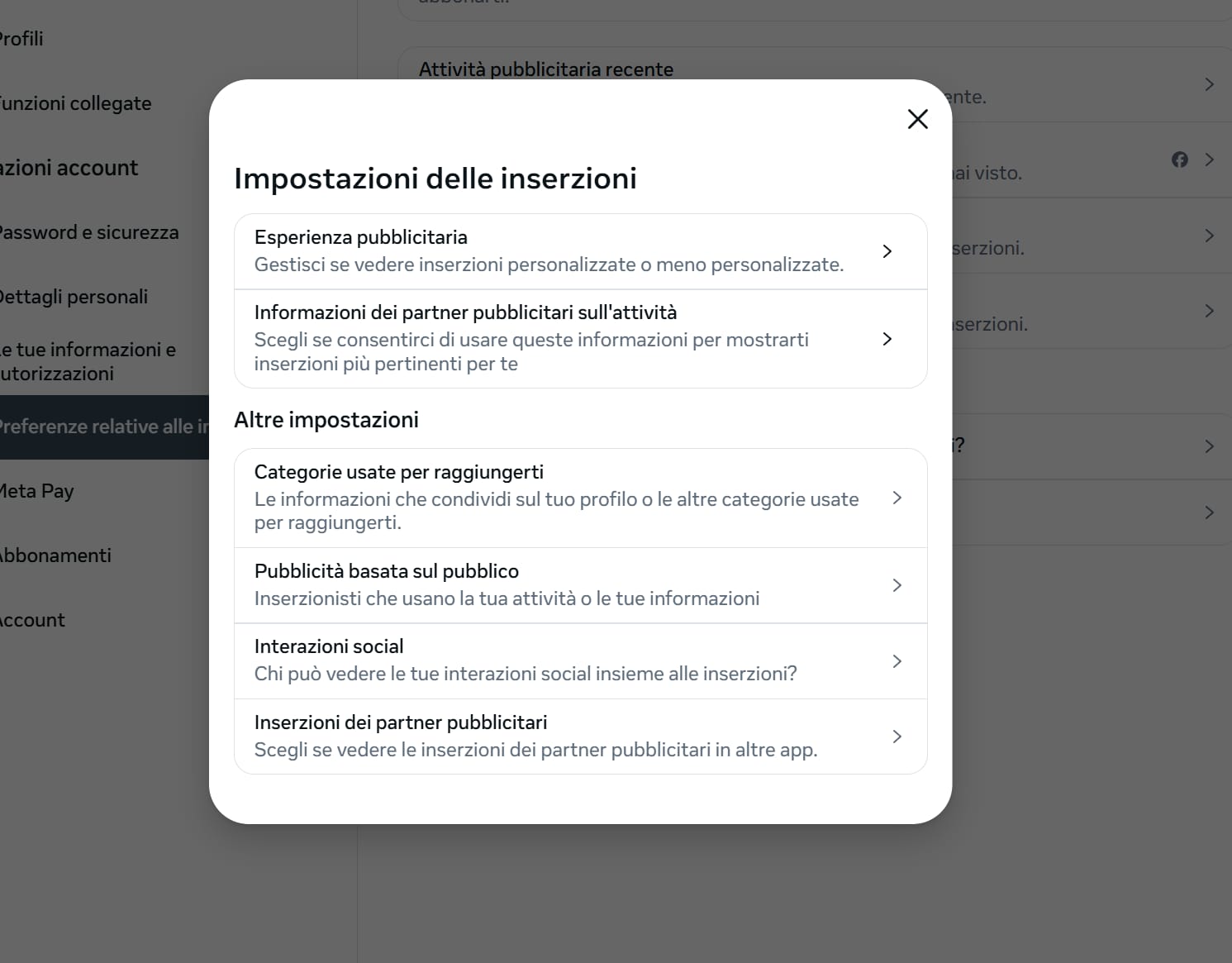
Here, the most important option is found under 'manage your accounts', 'ad preferences', ad settings, and finally, after six clicks from the start, 'ad experience'.

Here we can choose 'less customised advertisements' instead of 'customised advertisements'.

Ads are selected based on a narrow set of data, such as age, gender, geographic area and behaviour in the current session. Ads are thus less relevant to the user, but Meta retains the possibility of monetising visibility through short, non-ignoreable ad breaks inserted during app use.

That's not all: by 'advertising partner information on activity' we can protect our privacy even more. Meta explains: 'in order to be able to show you advertisements that help you discover new things, it is useful for us to know what you like. When you visit an advertising partner's website or app or buy something in its shops, the partner may send us information about that activity and the actions you have taken. This helps us to show you advertisements that are relevant to you and just as interesting as the content you usually see. However, if you wish, we will only use this information for this purpose'. Here, we choose 'not to make my advertisements more relevant by using this information'.

From categories used to reach you, we can surgically limit the data about us that can be used (title, job...) for advertising.

We go back to 'ad preferences' and from 'advertisers you have seen' we can delete some advertisements we no longer want to see. Also useful is 'ad topics', to delete those that we do not want to be used for our advertising, based on our interests.

Regulatory pressures

.

All these options, starting with the option to subscribe and remove advertising, is Meta's response to the European authorities, which have repeatedly pointed out the inadequacy of the 'pay or consent' model (to have you profiled for advertising) with respect to the principles of the Gdpr (privacy regulation) and the Digital Markets Act.

Europe remains critical of Meta, despite the latest adjustments.

The European Commission asked Meta to provide a free service that uses less personal data and at the same time is effectively equivalent in quality and functionality to the service with personalised advertising.

Copyright reserved ©
Loading...

Brand connect

Loading...

Newsletter

Notizie e approfondimenti sugli avvenimenti politici, economici e finanziari.

Iscriviti