Automotive

Metalworkers in the streets to defend the Cassino factory

The Stellantis plant has only had 16 working days since the beginning of the year - Unindustria leaders were also present at the event

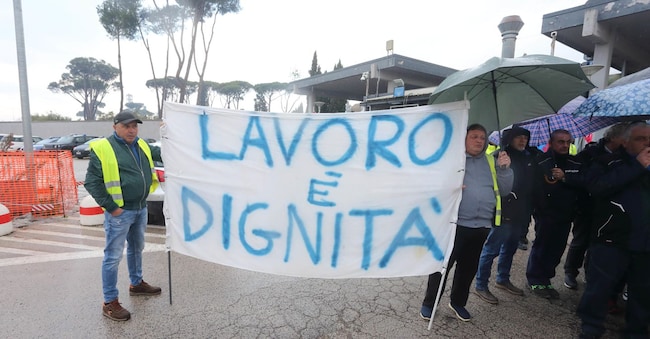
by Filomena Greco

Operai dei servizi bloccano l'ingresso merci allo stabilimento Stellantis di Cassino.  (ANSA / Antonio Nardelli)

3' min read

Translated by AI
Versione italiana

3' min read

Translated by AI
Versione italiana

A complicated situation, which is getting worse by the week. And which has seen production volumes worsen in the first three months of this year compared to the first quarter of 2025, already a black year for the Stellantis plant in Lazio. The Cassino factory was the focus of the metalworking unions' initiative to issue a further alert on the automotive industry in Italia.

The event

Participants in the united demonstration organised by all the metalworkers' unions - Fim, Fiom and Uilm along with Ugl, Fismic and Quadri - included politicians, Unindustria leaders and entrepreneurs from the automotive industry.

Loading...

"Our goal is to secure the plant, both in terms of employment and prospects," emphasises Ferdinando Uliano, secretary general of Fim Cisl. "The situation in terms of employment is dramatic: we are down to 2,000 direct employees compared to 4,300 eight years ago. On average, 70% of the workers work five or six days a month, on the other days it is total closure. In 2025 about 19,000 were produced, in 2026 an estimated 13,000, compared to 135,000 in 2017'.

"We are there because it is a proposal event," says President Vittorio Celletti, who emphasises the added value of the automotive district. "Stellantis has an important role,' Celletti explains, 'but equally important is the role of an allied industry that is suffering today. The manufacturer puts together a complex system, but within that system a large part of the innovation is guaranteed by the supply chain. And the ability to innovate guaranteed by the Cassino supply chain is as undeniable as it is strategic'.

The situation

There have been only 16 working days since the beginning of the year, working a single shift, from 6 a.m. to 2 p.m., with a daily production of 170 cars on three models, Alfa Romeo Giulia and Stelvio and the Maserati Grecale. "The Stellantis plant in Cassino risks paying the highest price of the automotive crisis in Italia,' says Fiom secretary Michele De Palma, who speaks of a 'closure risk' for the site.

Last year, production fell by more than 27 per cent - the worst year ever - to 19 thousand units and since the beginning of the year there have been only 16 working days, with a forecast for 2026 of 13 thousand cars, a tenth of what was produced in 2017. "Without new models for Cassino, the territory risks industrial desertification,' underlines Rocco Palombella secretary of Uilm.

'On 25 April, the social shock absorbers will expire,' analyses Mirko marsella, secretary of the Fim Cisl of Frosinone, 'and we will probably move towards an extension of the social shock absorbers. We have no visibility of new investments and we look to the presentation of the industrial plan, on 21 May, to get an idea of possible industrial developments for Cassino'.

The bet, for those who work in Cassino and for the unions representing the workers in the Stellantis factory and its allied industries, is that new production and volumes will be assigned to Cassino in the future. 'What concerns us instead,' summarises Marsella, 'is that the Cassino factory has never produced new models since the merger between FCA and Peugeot. Of the models assigned by the old industrial plan, in fact, none went into production'.

The new Stelvio and Giulia, scheduled for 2025, never actually got off the ground. This was one of the choices made by former CEO Carlos Tavares who, in order to cut costs and buy time on the market, had decided to postpone any choice until 2028. A series of factors has therefore generated a real paradox: models from Sergio Marchionne's old industrial plan from ten years ago are still being produced in Cassino.

A worrying situation, then. Whether one looks at volumes - last year 19,364 cars left the factory, -27.9% compared to the year before, almost ten times less than the 2017 peak - or at the timing. 'If 2028 remains the reference period for the start of new production, the risk is really that the situation will degenerate,' points out Secretary Marsella.

The Outlook

The new industrial plan that CEO Filosa will present in May will have to untangle the knot of production volumes and the industrial destiny of the Cassino factory, a pole that fits into a much broader picture, that of the future fate of the Maserati and Alfa Romeo marques.

Total employment at the plant fell to 2,200. Cassino, in particular, has been assigned the new STLA Large Bev platform, on which the future Alfa Romeo Stelvio and Giulia are to be produced, including in hybrid versions, as provided for in the commitments made at the ministerial meeting. However, the unions recall, Cassino is the only plant where the plan announced in December 2024 at the ministry has not been implemented.

Copyright reserved ©
Loading...

Brand connect

Loading...

Newsletter

Notizie e approfondimenti sugli avvenimenti politici, economici e finanziari.

Iscriviti