
The Metamorphoses eternalise Palazzo Te
The exhibition, which opens the celebrations of the 500th anniversary of the building in Mantua, dialogues with Giulio Romano's path, inspired by Ovid's poem
5' min read
5' min read
"Distat enim quae sydera te excipiant", what makes the difference are the stars that welcome you [at birth] admonishes the architrave of the Camera dei Venti in Palazzo Te. Whose stars were Federico II Gonzaga, who, at the age of 25, decided to promote the construction of the building after a golden exile at the court of Pope Julius II where he had discovered the masterpieces of Raphael and Michelangelo, and Giulio Romano, then 30 years old prefect of the Gonzaga's factories and working from 1525 to 1535 at Palazzo Te. When you say, the enfant prodige, without artificial intelligence or autocad, but with the stars as their horizon.
Here we are at the half-millennium that the Fondazione Palazzo Te, directed by Stefano Baia Curioni, is celebrating with a year of events, starting with the exhibition "From chaos to cosmos. Metamorphosis at Palazzo Te". The dwelling is all-encompassing, immersive long before this adjective took hold of us: myth and astrology, painting and natural sciences. Palazzo Te is a labyrinth of gods and heroes, of horses and giants, a Wunderkammer where the repertoire of Ovid's Metamorphoses deals with the eternal themes of life, passions and unhappiness, myth and poetry, where everything changes and exalts the epic of becoming. It was the poem of the cultured public of the Augustan age, it has spanned the centuries, from Dante to Shakespeare, up to Italo Calvino who entrusted it to the third millennium. And curator Claudia Cieri Via does just that: bringing that wonder up to date by placing Giulio Romano's frescoes in dialogue with works by Tintoretto, Correggio, Rubens, Nicolas Poussin, up to contemporary Giuseppe Penone and his Daphne. With the effect of a dazzling experience of wonder, almost like a Grand Tour, in which we better understand the palace's story and also our living, amid hopes and utopias.
Already the entrance is disconcerting because the ticket office has been moved outside: one enters the palace as it was for Frederick II and Julius. In the Chamber of Ovid and the Chamber of the Enterprises, the first of the itinerary, a series of inks by Romano from the Louvre and the Albertina tell how the Latin poet's fables were reworked to make Palazzo Te almost a stage machine. It is a whirlwind of bodies, from Bacchus to Ariadne to Maenads and Satyrs. All of them, gods and humans, intertwine their existences with the time, the one represented in the Chamber of the Sun and the Moon, and the foreshortening commissioned by Giulio Romano is so daring that the Sun and the Moon seem to move and fly in the blue: "The palace of the Sun stood tall with its immense columns all glittering with gold". And perhaps Giulio was inspired by the Metamorphoses in the vernacular by Niccolò degli Agostini, a version published that 1522 and brought back to Mantua from Rome, where it is preserved.
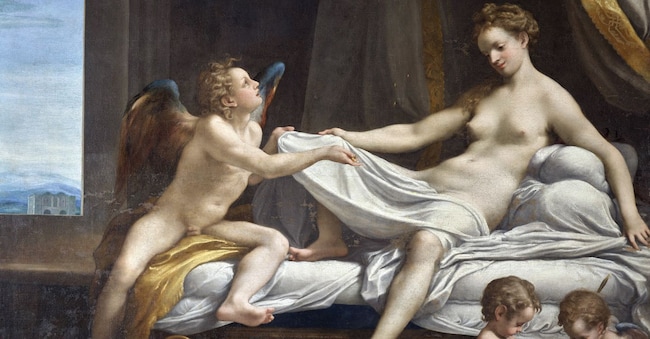
Time and myths create a parallel world that becomes fullness in the Hall of Horses. These were the ancient stables of the Gonzaga family and with Julius became a reception venue. Here Frederick II welcomed illustrious guests, even Charles V in 1530. Precisely to pay homage to the emperor, the duke, inspired by the Jupiter's Loves, sung by Ovid, commissioned four paintings from Correggio with the rape of Ganymede, the fable of Leda, the metamorphosis of Jupiter into a rain of gold that fertilises Danae imprisoned in a tower by her father Acrisius. The dialogue is evident between the ancient and the exhibition's setting, which brings back Correggio's Danae, just as, through myth, there is a direct connection between divinities, animals and human beings: "We are all of one life, this is the eternal message of Palazzo Te and the Metamorphoses," explains the curator. As eternal is Ovid's choice: he is on the side of the young Arachne, who challenges Minerva, patroness of the art of weaving, and Tintoretto's masterpiece from the Uffizi recalls this choice of humanity.
Other correspondences of amorous senses in the Chamber of Cupid and Psyche. Ovid's and Apuleius' narratives dialogue; the frescoes on the vault, with marked foreshortenings of transgressions and punishments, are counterbalanced by Jacopo Zucchi's Love and Psyche, from the Galleria Borghese, which depicts Psyche in the guise of Justice. The joy is in the nuptial banquet on the walls, which recalls the features and compositional richness of the Loggias of Agostino Chigi's Villa and Villa Madama and still speaks of hybridity, with that swirl of female and satirical figures.


