
Methane on the dwarf planet Makemake, at the edge of the solar system
The Webb telescope revealed that methane is also present in the gas phase above the surface, a discovery that makes Makemake even more fascinating.

2' min read
2' min read
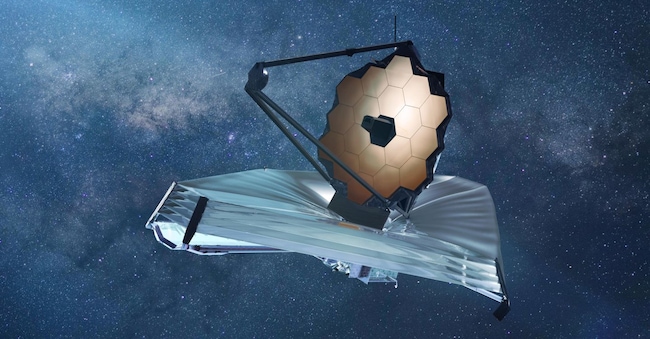
There is methane on a small icy world at the edge of the solar system, the dwarf planet Makamake. The discovery, based on data from the James Webb Space Telescope is due to online research on the arXiv platform and being published in The Astrophysical Journal Letters. Discovered in 2016, Makemake "is one of the largest and brightest icy worlds beyond Neptune, and its surface is dominated by icy methane," notes Silvia Protopapa of the Southwest Research Institute and first author of the research.
"The Webb telescope," he continues, "has revealed that methane is also present in the gas phase above the surface, a discovery that makes Makemake even more fascinating. It shows that the dwarf planet is not an inactive remnant of the outer solar system, but a dynamic body in which the methane ice is still evolving'. After Pluto, Makamake is the second dwarf planet beyond the orbit of Neptune on which gas is detected. The traces of methane are particularly interesting because they could indicate the presence of an atmosphere, albeit a very tenuous one. However, this is currently still a hypothesis that will have to be verified.
"Future Webb observations at higher spectral resolution will help determine whether the methane comes from a thin bound atmosphere or from plume outgassing," notes another author of the research, Ian Wong of the Space Telescope Science Institute.
"This discovery raises the possibility that Makemake has a very tenuous atmosphere sustained by methane sublimation," notes another author of the research, Emmanuel Lellouch of the Paris Observatory.
"Our best models," he adds, "indicate a gas temperature of around minus 233 degrees Celsius and a surface pressure of only about 10 picobars, which is 100 billion times lower than Earth's atmospheric pressure and a million times milder than Pluto's. If this scenario is confirmed, Makemake would join the small circle of outer solar system celestial bodies where surface-atmosphere exchanges are still active today.

