
Mexico, candidate killed within hours of voting. Women's challenge for the presidency: Sheinbaum versus Galvez
On 2 June 99 million voters will choose the woman to succeed President Amlo

4' min read
Key points
- Economy grows and Mexico overtakes China as a partner of the US
- Security is the weak point in the country's governance. The narcos are uncontainable
- The migration drama remains high on the next government's agenda
4' min read
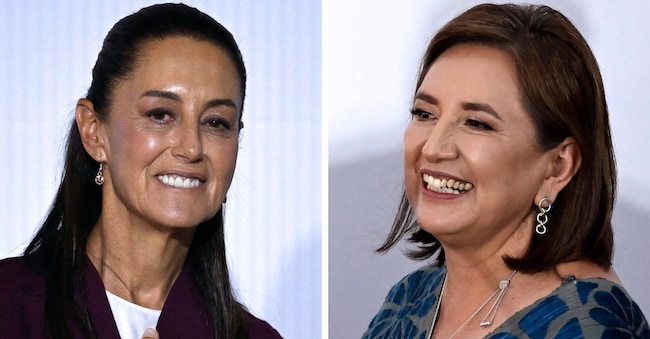
The Apaches called the Mexicans 'nakaiye', 'those who come and go'. The last American Indians, who still live on reservations in Arizona and New Mexico, are great-grandchildren of skilled and fearless warriors, who also possessed excellent analytical skills, at least in the field of sociology. Mexicans come and go, and the migration theme, 300 years later, remains dominant in today's presidential election in Mexico. Where, come what may, it will be a woman who will occupy the 'president' seat and lead Latin America's second largest economy (the first being Brazil): the two candidates in the running are Claudia Sheinbaum, former mayor of the capital, progressive of the Morena Party, and Xochitl Galvez, candidate of a centre-right grouping. Both 61 years old, both engineers. On the other hand, the polls do not assign any probability of victory to Jorge Alvarez Maynez, who leads the Movimiento Ciudadano, a more centrist list.
Two 61-year-olds, both engineers
Sheinbaum is credited as the likely winner, not least for being the 'dauphine' of incumbent President Andres Manuel Lopez Obrador (Amlo). The Mexican economy is growing fairly well, certainly more than other Latin American countries. The GDP in 2023 grew by 3.1 per cent and this year, although declining, it should approach 2.4 per cent. Amlo's Mexico has benefited from US nearshoring, i.e. the re-location close to Washington's business interests. The Biden Administration has reshaped its trade policy by favouring the countries of the American continent, to the disadvantage of China. As a result, Mexico has become the US's number one trading partner in 2023, bypassing China. Not only that, with a very low unemployment rate (2.6 per cent) and a 100 per cent increase in real wages (from 2018 to date), and with USD 36 billion in foreign direct investment, Amlo cashes in on results that please the establishment of the entire continent.
The Inter-Oceanic Railway
.Another point in favour of outgoing president Amlo is the Corredor Transistimico, a gigantic infrastructure project that is to connect the two oceans, Atlantic and Pacific. A railway that could become competitive, according to the project's backers, with the Panama Canal, which Amlo describes as 'saturated', and in any case in difficulty due to the scarcity of water necessary for its full use. A first section was already inaugurated last December and Amlo glorified it as follows: 'A project dreamt of for centuries by presidents, kings, politicians and governors'. Along the route of the railway, 12 industrial poles, strategic for Mexico's economy, will be built. Yet the Mexican emergency is the violence that grips the country and has caused 180,000 deaths in six years, a dramatic record that generates, for a left-wing president, the most painful of consequences: some Mexican jurists configure the problem as a 'tottering pillar' that casts doubt on the very existence of a 'rule of law'.
The 'security' emergency. Candidate killed a few hours before the vote
The security crisis and the increasingly pervasive power of Narcos are a key point.
A local election candidate was murdered in western Mexico, just hours before voting was due to begin. He was Israel Delgado, 35, who was killed on Saturday night near his home. Delgado aspired to be in charge of finance and internal control of the Cutzeo municipal council. This was stated by the Michoacan State Prosecutor's Office.

