
miart, successes and challenges in an evolving market
The fair offers a space for reconciliation between economic uncertainties in an environment marked by high costs

4' min read
Key points
4' min read
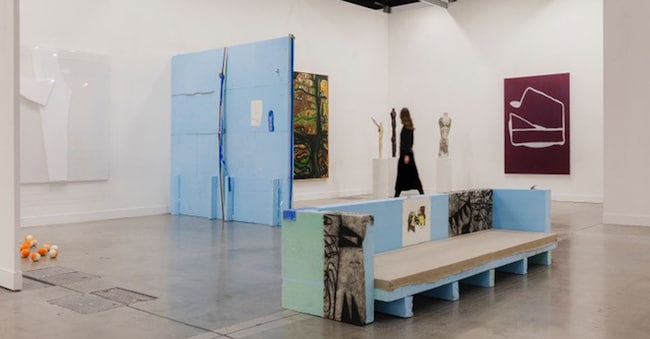
The 29th edition of miart (4 to 6 April) ended in a context marked by tensions and uncertainties. The decision to launch a countercurrent message, 'among Friends' - inspired by the latest retrospective dedicated to Robert Rauschenberg, to whom the fair paid tribute on the centenary of his birth - also became a declaration of intent. Art, today more than ever, is proposed as a space of reconciliation, a neutral and fertile ground where to meet without filters, to dialogue without barriers. With a balance between local specificity and the internationality of the proposals, miart 2025 hosted 179 galleries from 31 countries and 5 continents, divided into three sections: Established, Emergent and Portal, and confirmed itself, as every year, as a fundamental appointment for galleries, collectors and sector operators. However, its nature as an exhibition event is not immune to global economic tensions and market uncertainties. The growing difficulty in sustaining investments in works and artists risks pushing the system towards a hardening of the offer, with a focus increasingly concentrated on consolidated and safe names, to the detriment of research and experimentation, but it is also reflected in a growing caution towards medium-high-end purchases, marking a market that is proceeding "with a pulled brake".
With regard to the sales results of this edition, the picture inevitably appears uneven: some galleries closed with satisfaction, others less so. However, if we want to identify a trend, we can say that there were sales, but at lower prices than usual. Some gallery owners sold out, but the largest transactions took place before the fair opened. On the other hand, an increasingly recurring, almost choral theme is that of the high costs of participating in fairs. This is becoming a critical issue for many gallery owners, especially small and medium-sized ones, who often struggle to cover their expenses with revenues from sales. Between space rental, transport costs, set-up and ancillary expenses, fair presence today represents a significant investment, which does not always find a proportionate return. This imbalance risks discouraging the participation of many independent realities, reducing the diversity of the offer and weakening the vitality of the entire art ecosystem. For some galleries, the decision to share a project and space at the fair, as in the case of Portugal's Madragoa (Lisbon) and Poland's Galeria Dawid Radziszewski (Warsaw, PL) "has led to a different spectrum of attention," says Madragoa's Matteo Consonni, "international and Italian, and we have both benefited from it; we are happy, we have managed to cover the costs of this project, which was ambitious in a difficult context, but the true collaboration between the galleries has helped to expand the potential of both. Support from the Mondrian Fund was crucial for the participation of the Dutch Lang Gallery with a ceramic project byDanielle Hoogendoorn (1990)". In Those Flowers, Infinity's Infinity' in collaboration with Chiara Guidi, focused on the export of Dutch flowers, especially tulips, which today exceeds 11.5 billion and causes an increasing impact on the environment (sales success for flowers and ceramic vases from EUR 1,750 to 3,750).
Focus on sales
.As a counterpoint to the more established dynamics of the market, the Emergent section, curated by Attilia Fattori Franchini, is back again this year, right at the entrance to the fair, looking increasingly at the crucial role of the new generation of gallery owners. With 25 mostly international galleries, Emergent brought fresh, experimental and daring contemporary practices to the stage. An energy that did not go unnoticed: visitors' interest was tangible, turning into new contacts, promising dialogues and - above all - concrete sales. A result that confirms how curiosity and the desire for discovery, when well directed, can really make a difference. London-based Brunette Coleman presented the works of two artists, Oscar Enberg and BriannaLeatherbury. By the latter artist, born in 1995, with an interesting CV, some copper works from the 'Insider's Grave' series were exhibited and sold, works that the artist considers to be premature artefacts of contemporary capitalism, residual fragments of an economy based on financial abstraction and speculation (prices from 3,000 euro). Also from London was Ilenia, founded in 2023 by Italian Ilenia Rossi with a focus on emerging and mid-career artists, many of whom have not yet exhibited in the UK. The stand featured abstract paintings on aluminium byAmerican artist and musician Nate Boyce (€ 6,500-7,500). Other successful sales were the series of 10 tempera and oil paintings of apple portions by Edward Kay from the Roland Ross Gallery in Margate (EUR 3,600), one painting entered the collection of Fondazione Fiera Milano.
In the Established section, satisfaction for the likes of Chert Lüdde with a group show that presented an overview of Contemporary art in the five continents and among the artists the latest addition to the gallery, Selma Selman much appreciated and in demand by collectors (prices from 5,000 to 10,000 euros). Among the new entries was Document (Chicago, Lisbon) with an interesting proposal ranging from the artist Julien Creuzet to the work of the American artist Kiah Celeste (Ripple, 2024 a sculpture for sale at 5,500 dollars) whose sculptures will be on show at Milan Design Week, with an unprecedented performance that weaves together nomadic objects and recycled materials in collaboration with Kindof Furniture that translates into a research on the tension between otherness and familiarity, between the sculptural and the functional. First participation for Podbielski Contemporary with the solo show of Florence di Benedetto who presented photographs from the series 'a private affair' and the installation 'Life before me' (some photos sold at prices from 2,800 to 6,100 euro). Success for the proposal of the Ex-Electrophonic Gallery that attracted the public's attention with the work 'Pasticceria Italia' by Gabriele Picco, a refrigerated display case of memory that through the contrast of the sweetness of the cake proposes the massacres, dramatic moments of our past, and with the paintings by Arianna Marcolin (Schio, 1998). One large work by the young artist was sold (works from 800 to 6 thousand euro).
Finally, the Portal section, curated for the first time by Alessio Antoniolli, director of TriangleNetwork in London and curator of the Fondazione Memmo in Rome, brought together ten galleries for as many monographic projects, all very interesting. Too bad the unfavourable location in a completely hidden part of the pavilion did not favour the fruition of the curatorial project.

