
Michele Mari’s novel, the most literary of those in the competition, has won
Already a favourite with young people, the book least influenced by current affairs has won the competition

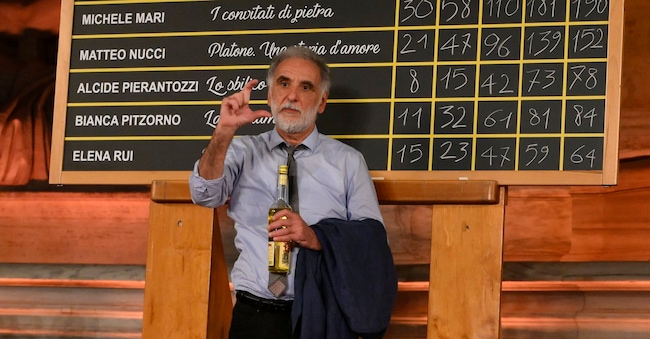
It was by no means a foregone conclusion that the favourite would win; on the contrary, it almost seemed to have become a hindrance to him, a crushing burden. However, Michele Mari’s *I convitati di pietra* (Einaudi) won the 80th edition of the Strega Prize with 190 votes, followed by *Platone. Una storia d’amore’ (Feltrinelli) by Matteo Nucci with 152, followed in third place by ‘La sonnambula’ (Bompiani) by Bianca Pitzorno with 84, followed by *Lo sbilico* (Einaudi) by Alcide Pierantozzi with 78, *Donnaregina* (Mondadori) by Teresa Ciabatti with 75, and *Vedove di Camus* (L’orma) by Elena Rui with 64.
It was by no means a foregone conclusion that he would come out on top, as the pitiful row over his alleged – and most unfortunate – snide remark about Michela Murgia’s appearance, made whilst the troubled sextet were on the move, seemed to have sealed his fate. And this was despite the numerous denials and the apologies offered by Mari to Ciabatti for the misunderstanding, as she had no wish to offend a person who had passed away – not to mention her dear friend – and a fearless and tenacious intellectual. A comment amplified and exploited by the media, fuelled by a cultural climate in which only gender disputes and ideological relics seem worthy of attention. And not buried beneath a tedious, numbing monotony.
A matter of style
Last night, in Piazza del Campidoglio in the capital, the subject of scandal was ‘off limits’, and the rumours circulating before the RAI cameras arrived suggested that Mari was opposed by most people, as well as being a sure target for the mavericks of *Domenica*, so that a learned writer, “a writer for the discerning tastes of writers” rather than for the common folk – as he has repeatedly been described – might be given a resounding lesson. Yet they were mistaken, for *I convitati di pietra* – which, in the darkness towards the end, stages a wager between ageing former classmates as to who among them would live the longest – was particularly appreciated by young people, having already won the Strega Giovani prize. In fact, the novel that prevailed was the one with the greatest stylistic density and the most recognisable authorial voice, yet at the same time the least accessible. Perhaps this was a reaction to a climate that has recently favoured the testimonial, autobiographical and civic dimensions of storytelling. Be that as it may, Nucci’s *Platone* emerged stronger from the contest, remaining until the very end as Mari’s main rival and winning over a substantial proportion of the voters, even though philosophical fiction is as ambitious as it is uncompromising. Those who believed the evening might cement Bianca Pitzorno’s career were left disappointed.

