Microsoft brings Copilot together in a single super-app: Code and Autopilot are on their way
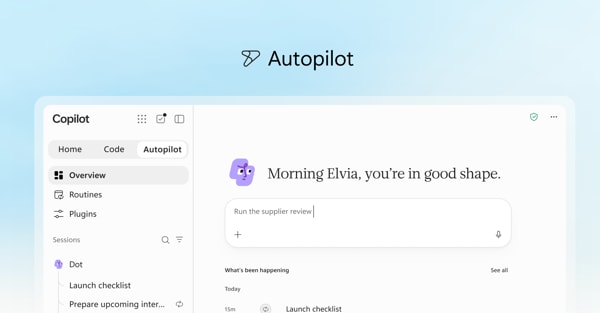
Microsoft’s aim is to make Copilot the gateway to day-to-day work, software development and agents that carry out tasks over time.

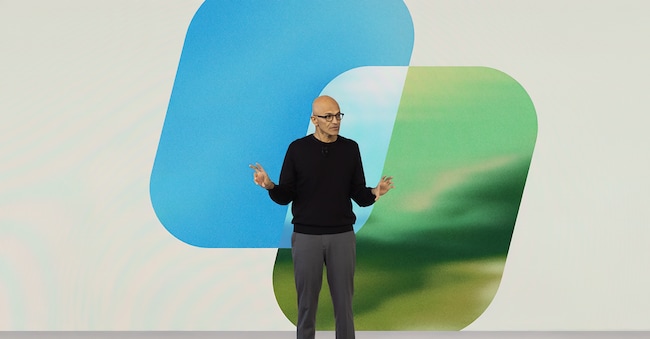
Copilot is moving beyond being merely a responsive assistant and is aiming to become a software factory. The unified app is simply called Copilot. In practice, the user doesn’t stop at text or a summary: they move from an idea to a working app, without leaving the environment in which they are working. “Artificial intelligence,” said Microsoft CEO Satya Nadella, “must work for your business, helping it to create and retain more knowledge. It must not reveal what lies at the heart of the company.” ‘Every agent,’ he went on to explain in a lengthy post, ‘must have an identity. Everything it does must be observable. And what we observe must be governable through rules.’
With these announcements, Microsoft is saying that the AI model is no longer the product: it is a component. The value lies in what surrounds it: where the AI-created apps run, who manages them, and who bills for them. Microsoft is playing to its strengths: identity (Entra), business data (Graph and Microsoft 365), IT administration and Azure billing.
Why this change?
Let’s start with the example presented by Microsoft. An employee asks Copilot to create an app to coordinate a product launch. The app works. At this point, the less glamorous work begins: deciding where to run it, what data it can access, who can use it and who will keep it up to date. Microsoft’s aim is to make Copilot the gateway to day-to-day work, to software development and to agents that carry out tasks over time.
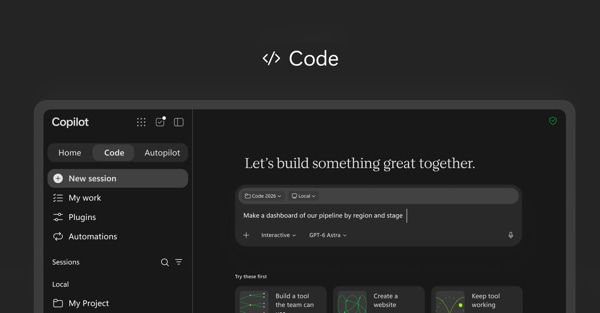
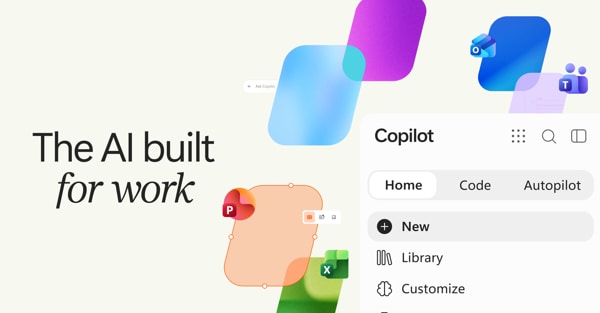
What do Home, Code and Autopilot do?
Home brings together chats, recent activity and suggestions for picking up where you left off. Microsoft plans to add a control centre for email, calendar, conversations and to-do lists.
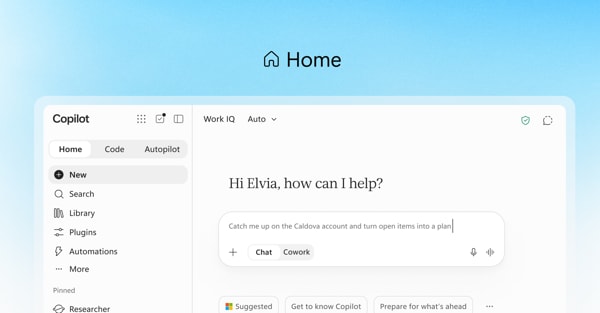
Code is also aimed at those who do not code. An employee will be able to describe a requirement and ask Copilot to build a small application or a workflow. Microsoft says the feature will use GitHub technology, an isolated environment for running code and an IT-managed infrastructure for sharing it within the organisation. One practical issue remains: before entrusting these tools with real data and processes, organisations will need to test how they work.