Asia and Oceania

Pakistan sends troops to Saudi Arabia to defend Riyadh from Houthi attacks

According to Islamabad, ‘the deployment will help strengthen the Kingdom’s defensive capabilities against the backdrop of new security concerns’

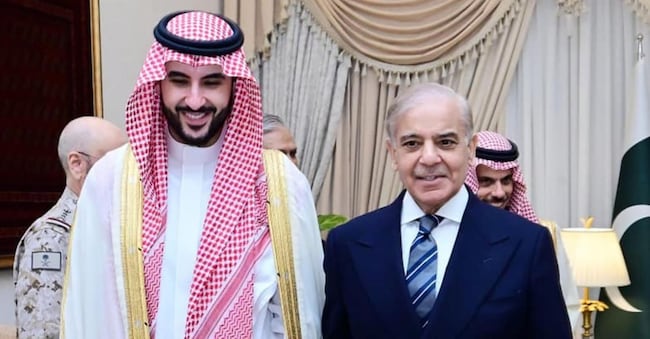
Il primo ministro pakistano Shehbaz Sharif, a destra, con il ministro della Difesa saudita Khalid bin Salman bin Abdulaziz Al Saud  EPA

3' min read

Translated by AI
Versione italiana

3' min read

Translated by AI
Versione italiana

NEW DELHI – Just over fourteen months after the signing of the Strategic Mutual Defence Agreement between Pakistan and Saudi Arabia, and less than four months after the Mecca Pact – to which Turkey is also a signatory – Islamabad’s armed forces have announced that they will send troops to Saudi Arabia to help bolster its defences against attacks by the pro-Iranian Yemeni Houthi militias.

The announcement came two days after a meeting in Islamabad between defence officials and military representatives from the three countries, who reaffirmed their support for Riyadh under a trilateral agreement stipulating that an attack against one member is to be regarded as an attack against all. The summit participants condemned the Houthis’ ‘atrocious and ongoing’ attacks on civilians and civilian infrastructure in Saudi Arabia.

Loading...

What we know about the deployment

In a statement issued on Sunday, the Pakistani Armed Forces clarified that the military would carry out its duties within the allied country, but did not disclose the number of soldiers, their specific roles, the duration of the deployment, or when the troops are due to arrive in Saudi Arabia.

Although Riyadh has been hosting Pakistani military personnel since 1982, it is undeniable that Sunday’s decision marks a significant step forward in the alliance between the two countries. The Strategic Mutual Defence Agreement was signed several months before the Israeli-American attack on Iran, but despite the increasingly frequent attacks on Saudi Arabia, the mutual defence clause has never been triggered.

Sunday’s statement reaffirmed Pakistan’s commitment to protecting Islam’s two holiest mosques, located in the Saudi cities of Mecca and Medina, and added that ‘the troops will carry out their assigned tasks within Saudi territory, in accordance with the agreed commitments and the established framework for defence cooperation’.

‘New security concerns’

In a clear reference to the recent attacks, the statement also states that ‘this deployment will help to further strengthen the Kingdom’s defensive capabilities against the backdrop of new security concerns’. On 10 October, a Houthi attack on King Khalid International Airport in Riyadh, 700 kilometres from the border with Yemen, left 14 people dead and over 300 injured: it was the deadliest attack carried out on Saudi soil in years.

Islamabad has always preferred to regard the Houthi attacks on Riyadh as a response to Saudi incursions into Yemen rather than outright aggression, so as to avoid the risk of being drawn into a regional conflict on the opposite side to that of a neighbouring country such as Iran. A civil war has been raging in Yemen for 12 years, pitting the Iran-backed Houthi militias against a government supported by Riyadh and the international community, which, however, does not control the capital, Sana’a.

Another factor that may have influenced Islamabad’s decision not to intervene in recent months is the fact that Pakistan is already embroiled in an intermittent conflict with neighbouring Afghanistan, as well as having to contend with attacks launched by various militant groups in the provinces of Khyber Pakhtunkhwa and Balochistan.

The financial issues behind the agreement

Speaking on Sunday in Islamabad at a workshop on national security, Pakistani Prime Minister Shehbaz Sharif spoke of the “long-standing relations based on mutual trust and respect” with Riyadh, emphasising that the Mecca Pact “is not directed against any country and has absolutely no aggressive purpose”.

“This partnership,” said the Pakistani Prime Minister, “will now safeguard not only our security interests in the region, but also our progress and prosperity.” In recent months, the two countries have extended the repayment deadlines for debts totalling 8 billion dollars, thereby enabling Islamabad to avert a balance of payments crisis, bolster its foreign exchange reserves and meet the financing guarantees required by the International Monetary Fund’s programmes.

Copyright reserved ©
Loading...
Loading...

Brand connect

Loading...

Newsletter

Notizie e approfondimenti sugli avvenimenti politici, economici e finanziari.

Iscriviti