
Migrants: row between Meloni and Sánchez. Italia proposes European hubs in third countries
A letter from 19 leaders revives the ‘Albanian model’. Merz and Macron distance themselves

Key points
At a European Council meeting that began on the back of the G7’s positive momentum, Giorgia Meloni is forced to weather the storm of new, scathing insults from Donald Trump, which have overshadowed the other issues the leader has been discussing with her European allies. First and foremost, the one on immigration.
This is because yesterday’s Brussels summit had opened with yet another preliminary meeting of the informal working group co-chaired by the Italian Prime Minister alongside her Danish counterpart, Mette Frederiksen, and the Dutch Prime Minister, Rob Jetten. At this meeting, as reported by Palazzo Chigi, Meloni emphasised the need to move swiftly from defining the new European rules on migration and asylum to their practical implementation, starting with the Return Regulation.
Letter from 19 leaders revives the ‘Albanian model’
Referring to the joint letter sent on Thursday alongside Frederiksen and 17 other EU heads of state and government (with Germany and France absent), the Prime Minister emphasised the importance of immediately launching concrete and replicable pilot projects. This is the way to officially launch the ‘Albania model’, given that the discussion among leaders ‘has revealed an interest in also assessing the possibility of joint return centres in third countries’. European hubs, not just national ones, which the French President has strongly criticised: “I have never seen a return centre in a third country that actually works.”
The hardline approach towards irregular migrants
Alongside Italia, Denmark, the Netherlands and the European Commission, Austria, Belgium, Bulgaria, Germany, Greece, Poland, Malta, the Czech Republic, Slovenia, Sweden and Hungary took part in the summit. Those advocating a hard line on irregular migrants welcomed the results achieved in recent months, including the establishment of the European list of ‘safe’ countries of origin, the concept of a ‘safe’ third country, the adoption of the Chisinau Declaration, the political agreement on the new Return Regulation, and the inclusion of a reference to EU financial support for ‘innovative solutions’ on migration within the negotiations on the next Multiannual Financial Framework for 2028–2034. The 14 countries once again emphasised their concern about the potential migration implications arising from the unfolding crisis in the Middle East and the need for initiatives to ensure an effective and timely European response.
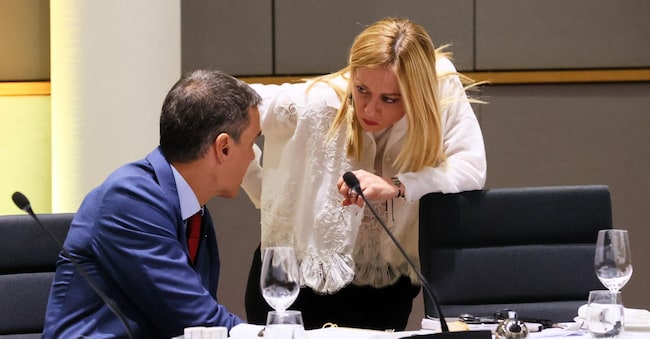
But there was no shortage of objections in the Council. During Thursday evening’s debate on the issue amongst all 27 Member States, a clash unfolded between Meloni and the Spanish Prime Minister, Pedro Sánchez, just a few hours after the two heads of government had forged an alliance to defend Cohesion Funds. ‘A discussion, not a clash,’ clarified diplomatic sources from Southern Europe, during which Sánchez contrasted the Italian example with the Spanish one: policies characterised by the regularisation of migrants, deemed ‘positive’ for the national economy: “Last year, irregular arrivals in Spain fell by 27 per cent.” Sánchez also sought to clarify that this is a “matter of national competence”.


