
Migrants, Meloni and Sanchez's similarities on 'regular' flows
From the most diverse assumptions, the two premiers end up overlapping on certain models. Starting with the insistence on 'regular' migration
by Alberto Magnani (Il Sole 24 Ore, Italy), Lola García-Ajofrín (El Confidencial, Spain)
 Aggiungi Il Sole 24 Ore
ai preferiti su Google
7' min read
7' min read
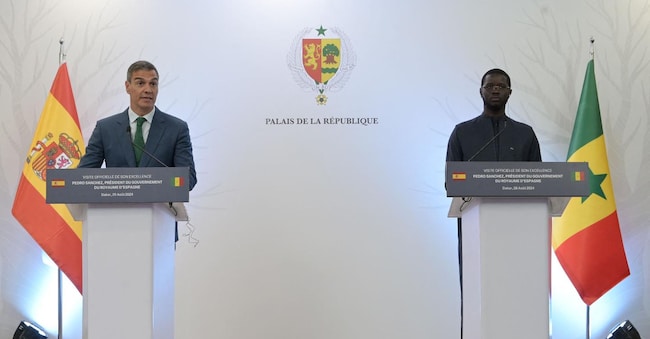
Comparisons between leaders can be idle. Spanish Prime Minister Pedro Sanchez's latest trip, a tour de force between Mauritania, Gambia and Senegal, has brought up a striking one: that between Sanchez himself and his Italian counterpart Giorgia Meloni. On paper the similarities are nil, starting with the antithesis between a face of EU social democracy and that of the Conservatives and Reformists in Brussels.
In essence, the policies of the two find some similarities in one of the areas of open conflict between progressive and conservative forces on an EU scale, the management of migration flows. Sanchez is renewing his agenda of agreements with countries of origin, expulsions and stimulating 'regular' migration, with the result that he finds himself on a similar wavelength to his Italian counterpart. The theoretical assumptions could not be more different, between the defence of the right to migrate reiterated by Sanchez and the line of rejections ridden for years by Meloni. The policies implemented are less so, especially when it comes to an approach to the 'regular' entry of migrants.
The migration chapter is one of the pillars of the political strategy of Giorgia Meloni, the Italian premier at the head of a right-wing coalition since the autumn of 2022. At the time of the election campaign and the pre-government season, Meloni insisted on the more ordinary tones and rhetoric of the ultra-c0nservative forces: from alarms about the 'invasion' to accusations of incompetence levelled at 'left-wing' governments in the management of landings, passing through the ideological battle against governmental organisations engaged in rescue operations in the Mediterranean. With his arrival in government, the mood and the bottom line have remained the same. But the approach has changed, adapting to the 'complications' that have emerged in the leap from the political polemics of the opposition years to the administration of public affairs from Palazzo Chigi. Looking at the numbers of landings, the most media-driven thermometer on the phenomenon, the first eight months of 2024 recorded 41,181 arrivals: a sharp drop from the 113,877 of 2023, in the first full year of the Mel0ni government, but smaller than the 56,458 of 2022. A fluctuating budget, like the government's own plans on the subject. Originally, the proposal reaffirmed by Meloni and her Fratelli d'Italia party was that of a tout court 'naval blockade': an initiative that would have consisted of a total barrage of flows, which quickly faded after Meloni's rise to government.
"When it was not realised, because it was impossible, the government implemented strategies similar to those of the executives - even left-wing ones! - that preceded it,' points out Matteo Villa, researcher at the Italian research centre Ispi. In detail, Villa explains, the guidelines of the government's migration strategy are three: the externalisation of borders, with collaboration agreements in the departure destinations similar to the one signed with Kais Saied's Tunisia and extended to an EU agreement; the contrast to the operations of the NGOs in the Mediterranean, accused of acting as a pull factor for the departure of landings and limited with ad hoc interventions; the externalisation of arrivals, a model attempted in agreements such as the one signed with Albania: the creation of centres outside the Italian perimeter for the 'stay' of migrants awaiting repatriation.
The 'Tunisian' approach and the decline of migrants in Italy
.The only one that seems to have really affected the drop in numbers is the first model, that of departure border control, in a déjà-vu compared to the arrangement already broken by centre-left minister Marco Minniti in 2017 with Libya. "It is effective (cooperation, ed.) when the partners have an incentive in cooperating, as in the case of the Libyan militias or Tunisian President Saied," Villa points out, underlining the most obvious backlash of the understandings: the "brutality" imputed to the Libyan militias in the understanding with Tripoli and the cases of "deportation" contested to the Tunisian authorities after the last understanding with the EU, starting with migrants transported and abandoned on the country's desert borders.
In a video, posted by the Libyan Interior Ministry on its Facebook page, a group of exhausted young people can be seen being abandoned in the middle of the desert. There are also children. One of the testimonies states that they stayed for two days until they were found; another that they were beaten by Tunisian soldiers and taken to the desert, where they were told to cross into Libya. In July 2023, the EU signed with the stroke of a pen an agreement with the Tunisian government, backed by Italian Prime Minister Giorgia Meloni, for Tunisia to block the sea crossings and speed up the return of those trying to reach Europe from its territory.


