
Milan: all acquitted in the first ruling on town planning
The decision was taken by Judge Paola Braggion of the Seventh Criminal Division

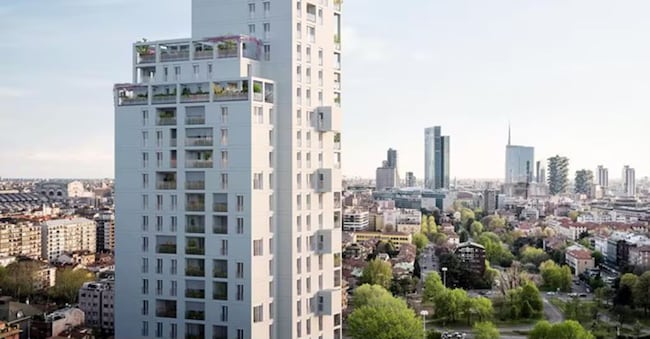
All eight defendants charged with building regulations offences and unauthorised land subdivision have been acquitted on the grounds that the act does not constitute a criminal offence. This is the first verdict to be handed down following one of the many investigations launched by the Milan Public Prosecutor’s Office into town planning management, namely the case of the Torre Milano skyscraper in Via Stresa. The decision was made by Judge Paola Braggion of the Seventh Criminal Division. Prosecutor Marina Petruzzella had sought eight convictions and the confiscation of the tower.
The major investigations into urban planning that have characterised – and cast a shadow over – Milan over the last two years thus appear to have come to a halt. Last year, the corruption-related strand of the case had already been dismissed by the Review Court, which, one month after the suspects were remanded in custody, had released them (including the former Councillor for Urban Planning, Giancarlo Tancredi, and the CEO of Coima, Manfredi Catella); today’s verdict acquits all of them of the offence of building regulations abuse.
It should be borne in mind that this is the first and only case to have reached a verdict, and that we are still only at the first instance: there is still a long way to go in the legal proceedings. However, one cannot help but regard this development as a halt to the process, given that Milan was looking to this very ruling for regulatory guidance to replace what the political sphere has failed to deliver. The so-called ‘Salva Milano’ bill, for example, was shelved during parliamentary debate a year and a half ago – precisely as a result of the investigation into alleged corruption, which prevented a calm debate from taking place.
Let’s look at the case. According to the Milan Public Prosecutor’s Office, supported in its investigations by the Financial and Economic Crime Unit of the Guardia di Finanza, the construction of Torre Milano on Via Stresa – an 80-metre-high, 24-storey building – was carried out using a ‘SCIA with a binding undertaking’, that is, a self-certification, rather than an Implementation Plan with an urban planning agreement, which would have taken into account the ancillary services to be provided in the area. According to Public Prosecutor Marina Petruzzella, a new building was falsely passed off as a renovation.
This approach, which had led to charges being brought for various offences, was rejected by the court, which – pending the publication of the grounds for the decision – issued a statement signed by its president, Fabio Roia. For all the defendants – the statement reads – «the subjective element of the offence is lacking, whether intentional or negligent, given that only in recent years have criminal case law, administrative case law and even the most recent rulings of the Constitutional Court offered various interpretations of the concept of ‘restructuring’ arising from the notion of ‘restructuring’ referred to in Article 3(d) of Presidential Decree 380/2001, in force in 2018, and on the validity and applicability of Article 41-quinquies, paragraph 6, of Law 1150/42’.”


