
Milan and the challenge of the London model to regain the middle class
Giulio Centemero analyses the crisis and the new paradigms of global cities. On the horizon, the challenge of innovative housing and cultural policies

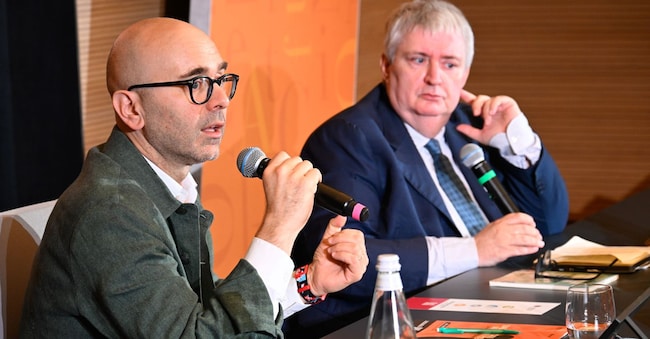
A book written in the first person. From Brianza - from Arcore - who now works and lives in Milan. As a Lombard - with a degree in economics and commerce from the University of Bergamo - who completed his training at Bocconi's SDA and at the Brussels branch of Boston University. "Even the Rich Cry. La crisi del modello Milano e delle Global Cities' (Baldini e Castoldi) is the small volume - agile and amusing, neither boringly professorial nor uselessly accusatory - written by Giulio Centemero, an accountant and exponent of the League, Member of Parliament and member of the Finance Commission.
Centemero, who presented it in a crowded hall of the Palazzo Sardagna at the Festival dell'Economia di Trento, describes the mechanisms of intimate connection between global cities, a symbol of the globalisation that is today undergoing profound remodelling, well exemplified by the story of the informal group of friends interested in economic and entrepreneurial issues that, between Milan and London, he helped found. We read in the book: 'It is February and the sky is cast iron in Milan. I have just taken my son to school and come home to close my backpack. I am satisfied. The Sandwich Club, the little supper club that my friends and I have been organising for a few years now, is about to inaugurate its first foreign chapter: London. I leave the house, do some pedalling and fold my bike to enter the M4 station of Santa Sofia. Home-gate in twenty minutes flat. Not bad. And then it's off to Heathrow and the Elizabeth Line. From there to Paddington (yes, like the teddy bear) Station and then to the hotel. The sky is cast iron even across the Channel. From home to the hotel in London took three hours: just enough time to pull up for an early lunch at a local bistro'.
The reality - albeit subject to the shocks of a globalisation now shaped by the silent rise of China and now traumatised by the effects of wars and energy crises - is precisely that of a connection between western global cities that has changed their traditional face. In people, in connections, in old wealth and new criticalities. Milan today lacks a common code. The city's disbandment has several origins, both endogenous and exogenous. First of all, the impossibility for middle-class people to live as they once did in this city. 'London,' Centemero explains, 'has managed to bring the middle class back to the centre. We must try to do the same in Milan. The first is housing. We need economic measures that would allow teachers and policemen, to say those with little money but a central social role, to return to live in Milan. This reshuffling would induce a natural deflation in economic behaviour. And, therefore, it would also activate a positive mechanism on the general level of prices which, today, is unsustainable'.
Milan is a rich city that has always been happy to be so. But it has precisely lost its dimension as a popular city. There is a problem of disappearance and concealment - even in the folds of globalisation - of the children and grandchildren and great-grandchildren of the great industrialists of the 20th century who became rich in Milan and through Milan. And there is a theme of the (failed) emergence of the new rich of finance and technology. Who are totally detached from the idea of giving back to their communities what they have received. 'The new big entrepreneurs of cryptocurrencies and blockchain,' Centemero notes, 'have not yet developed a civilised political attitude. But it is also true that, from the Italia system, they are kept at a distance. There is a sort of cultural prejudice and regulatory hyper-rigidity towards them. It becomes normal that they are still uninvolved in the composition of the new DNA of a complex city like Milan'.
Milan and Italia, therefore, need a new organic vision. To attract and generate wealth, but also to avoid vertical splits between those who have and those who, despite having, are at constant risk of perceptive and real impoverishment.


