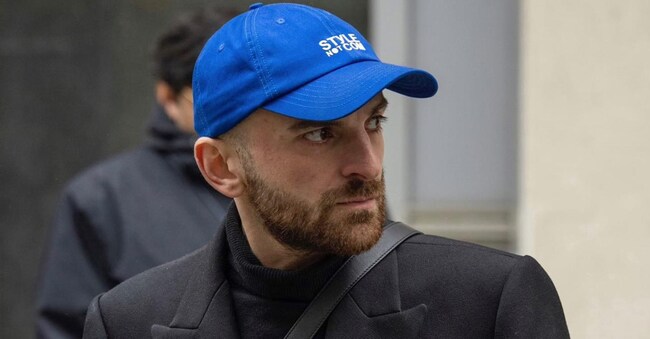
The first post goes online in July 2021: 'Chanel is a French brand'. "I was amused by the idea of writing something that is so obvious to us that it almost seems stupid, but is not necessarily so for everyone," he says. Attention to details that make a difference, puns, allusions that can only be picked up by those who really follow fashion. Like when he wrote about Proenza Schouler by putting an accent on the 'e' to refer to the criticism that the brand was referring too much to old Celine collections. Or when he reconstructed the number of kilometres Louis Vuitton walked when arriving in Paris as a young boy. 'I like to highlight the absurd side of this wonderful world that takes itself too seriously'. Beka Gvishiani is a true enthusiast. Struck by the spell of fashion at 17, when he discovered the existence of a magazine called Vogue (in its Russian edition), he shows no signs of wanting to break it. He speaks freewheeling, without the distinctive blue cap, and a small cross waves in his left ear. He says that such jolting exuberance could be a legacy of the earthquake that struck the country in the hours of his birth. It was late April 1991: two weeks earlier, Georgia had proclaimed independence from the USSR. It took years, however, for the great abundance of Western capitalist goods to reach the Caucasus. To young Beka and his peers, only its echoes reached them: unable to see or touch it, they were forced to dream about it. "That is why in Georgia, although it is so small, there is so much creativity: it was trained in the years when you could only imagine things". Gvishiani is sure that the fashion industry will soon need new creative minds and that many will come from the East. "Demna was revolutionary. Thanks to him, many Georgians realised that aiming high is not impossible'. The reference is to Demna Gvasalia, who became artistic director of Balenciaga in 2015. "But you have to understand that to work at levels of excellence you have to be willing to leave your comfort zone. To leave. I was fine in Georgia, but I wanted more. So last May I made my decision,' he says.
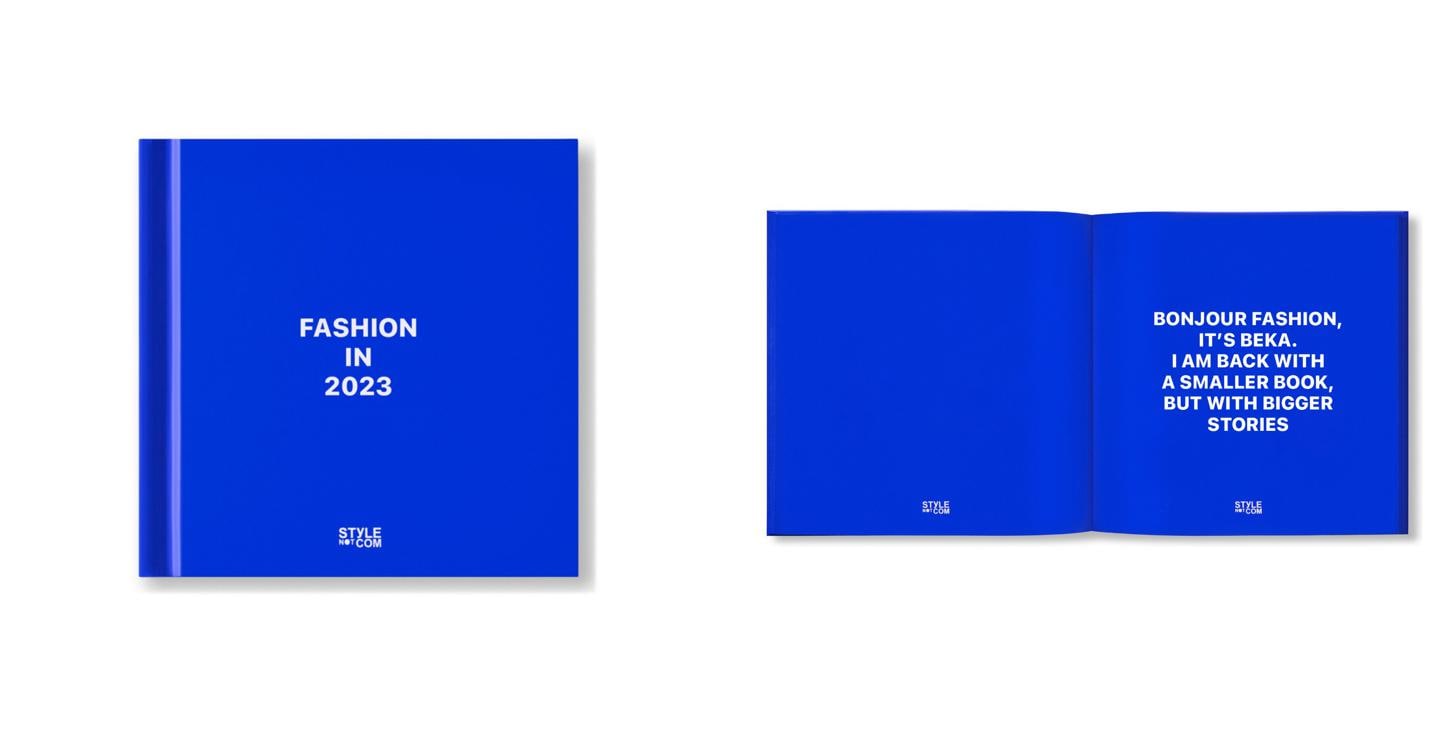
La copertina e due pagine interne del nuovo libro di Beka “Fashion in 2023” (in vendita da Selfridges a Londra e da 0fr a Parigi)
In fact, he does not live in Tbilisi, but in Paris. Long undecided between the French capital and Milan (which he loves and imagines as his final destination), he finally chose France because it had something more to offer him: the Passeport Talent, a renewable visa that people working in the arts and culture can obtain. "Moving here helped me a lot with contacts, as almost all the important brands have their headquarters in Paris. Of course, there are also some in Italy, but Italians are very open, it is easy to work with them from a distance. With the French, it is better to be present, to be seen, to attend events. And then living in the fashion capital has always been my dream, ever since I was a child'. I ask if it makes sense, in 2024, to point out a hierarchy between the Big Four, the cities where the best of world production goes on the catwalk twice a year. "Well, Paris still holds the most fashion shows, including those of the brands that are strongest in terms of business. That said, for me the four cities are like the pieces of a jigsaw puzzle: take one away and the picture is incomplete. Each one represents a different energy, as in the life cycle of a person. New York is adolescence full of energy and the desire to experiment, but also insecure and confused. London is experimental but in a mature way: what it proposes may seem excessive and crazy, but behind it there is awareness, authenticity. Milan is like a middle-aged woman with a good budget: she only wants to wear things of excellent quality and workmanship, she has a chic air and an unmistakably Italian style. Paris is not just fashion, it is a wider concept: it is a lifestyle, a way of being in the world. I have to say that Milan is getting stronger and stronger and last September it definitely beat Paris, which completely lacked the wow effect. In the past, however, it has already happened that it had peaks of excellence and failed to maintain them. It would be a shame if it happened again.
I ask him whether, in general, certain up-and-downs might be due to the fact that fashion, besides being an expression of creative genius, is also a (huge) business. Heart and mind: two organs that do not always work in harmony. "When a brand experiences a moment of success, it can happen that the management puts pressure on the production to stay on the track, so as not to take risks. Then the creative director is at a crossroads: accept or leave. And often he leaves: it is no coincidence that last year there were something like fifteen changes. There are, however, cases of excellent harmony between creative freedom and business idea. I'm thinking of Hedi Slimane: entering a Celine store you immediately realise that there is a precise business orientation. But it is natural, not forced. Hedi is one of the creative minds I admire most, I love his uncompromising vision, the framework of coherence within which he works. Another example, Tom Ford. In an interview he said: 'Everyone thinks it's wrong to be commercial, but look at me: I'm the most commercial designer of my generation'. It is true, and it undoubtedly works. What about Karl Lagerfeld with Chanel? He was not only a designer, but one of the greatest marketing geniuses in history. Finally, I think of Comme des Garçons. Together, Rei and Adrian (Kawakubo and Joffe, ndr) exemplify how the entrepreneurial mindset can profitably channel brilliant creativity. The result is that thousands of people are willing to pay to wear a red heart with black eyes in order to feel part of the Comme des Garçons universe.
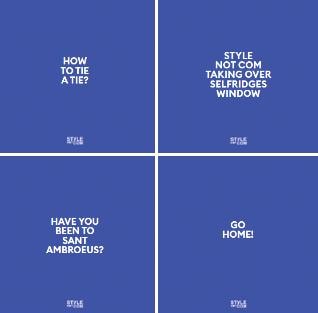
Una selezione di post Instagram usciti sull’account di Stylenotcom.
The fashion world has never enjoyed a great reputation in terms of friendliness. When the film The Devil Wears Prada came out in 2006, nobody, least of all those working in the industry, found it hard to consider certain scenes exposing cynicism and fierce competitiveness realistic. Perhaps this is why Stylenotcom's enthusiastic tone surprises and amuses. It also arouses suspicion. Not infrequently under a post one reads comments like: 'How much does such a brand pay you to speak well of it?' Before addressing the inescapable question, I ask Gvishiani if he doesn't hide somewhere pink lenses through which to look at the (fashion) world. He takes off his thin metal-rimmed glasses and waves them in front of the webcam, laughing: 'These are the only ones I own'. Then he turns serious: 'There are two reasons why I chose positivity as editorial content. The first is that I was tired of the widespread tendency to judge any business with negativity. The second is that I wanted to publicly acknowledge the work of the thousands of people behind the scenes. Although on a small scale, I was one of them. When I worked for the Anouki brand in Georgia, I did everything from designing an advertising campaign to cleaning muddy shoes after a photo shoot; from arranging chairs for a fashion show to going to trade fairs or choosing music for a show. When the public applauds a designer, they don't think about the great collective effort behind it. I do. But back to positivity: you only have to read my posts carefully to see that in most cases they are simply descriptive. I tell what I see. They often also contain veiled parodies of certain aspects of our environment, which not everyone grasps. In any case, whenever one of my posts has been pointed out as being paid for being particularly positive, it was not. This is because, when they pay me, they do it to get my narrative, not my condescension'.
So they pay? It can happen. But Gvishiani assures that the content is always under his complete control. "The first was a French brand. She asked me to share teasers of a fashion show on the page. I was with a friend, she looked at me and said: 'Beka, if you accept, get paid'. She was right, I hadn't thought of that. Then another brand invited me to a fashion show and asked me to write about it. I specified that I would not talk about the collection, but about small curiosities, and was told that I could do what I wanted: there were already many people writing about the collections. Nowadays I'm mainly writing about advertising campaigns. So yes: sometimes there is a financial deal behind the posts. But I also happened to say important no's when I was asked to agree and control the content of the posts. In general, however, there is trust in me and the only thing that brands - and increasingly also hotels and restaurants - are interested in is appearing in my blue square'. Because Stylenotcom is becoming a brand itself. Not only that. For those who value quality more than quantity (his followers are not record-breaking in numbers, but they are the right ones), Gvishiani is the ideal man to entrust with the organisation of an event: last year, for example, he did so for Havaianas during the Paris Music Festival. At the moment he is also devoting himself to promoting the Fashion in 2023 book, which has just come out thanks to a collaboration with System Magazine: it contains 365 posts (one for each fashion show) chosen from the 1,500 published last year.