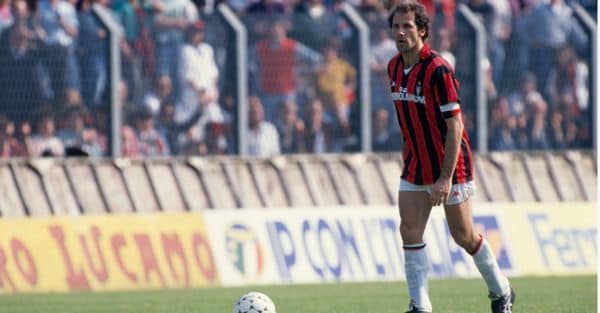
Farewell to Franco Baresi, the last great sweeper and a Milan legend
The Rossoneri club mourns the passing of its long-serving icon

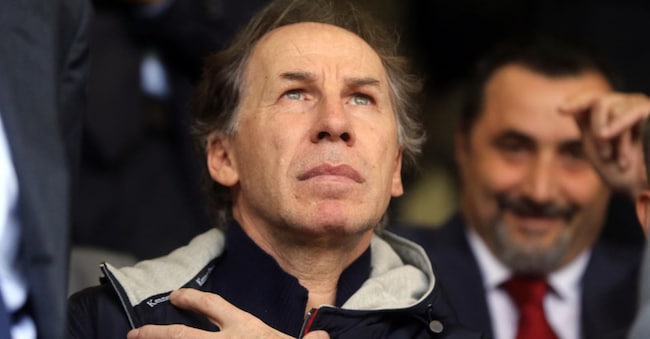
After all the unbearable buzz on social media, he has finally passed away. He was tired; he’d had enough. Franco Baresi, aged 66, the unforgettable captain of Milan and regarded as one of the finest defenders in the history of football, died during the night at the Humanitas hospital in Rozzano, on the outskirts of Milan, following a further deterioration in his condition. Almost a year ago, Baresi had undergone surgery to remove a lung tumour. He seemed to have recovered, so much so that last February, alongside Beppe Bergomi – his rival in countless derbies – he carried the Olympic torch for the Milan-Cortina Winter Games into San Siro. Thinner than before, with that slightly wistful smile that had always been his trademark, he had moved everyone. You could see he was suffering, but he was holding on, just as he had always done throughout his life, ever since he was orphaned as a teenager.
Life’s relentless trials were to repeat themselves in 1981: already a first-team regular at Milan, he was struck down by a serious blood infection that forced him into a long hospital stay and confined him to a wheelchair. But after four months, he returned to the pitch, fully recovered. The Rossoneri fans, who called him “Piscinin” (a nickname coined by Gianni Brera, because as a young man he didn’t have the physique of a grenadier), hailed him as a veteran. They had already realised that he would become the symbol – the symbol of devotion to the shirt. ‘Il Capitano’ who, when Milan were relegated in 1980 (due to the Totonero scandal), decided to follow the club into Serie B. An unshakeable loyalty that was put to the test once again when, in 1982, the Rossoneri were relegated again on sporting grounds. But Baresi, already a World Cup winner with Italia in 1982, chose to stay despite countless offers. It was a dark and turbulent period for Milan; Berlusconi was still a long way off, but it was precisely during that time that ‘Piscinin’ became the Captain, a role he would go on to fulfil for fifteen seasons. When he retired in 1997, having won everything there was to win, Milan also retired the number 6 shirt – an honour reserved for the most charismatic players who have left their mark on the club’s history.
Born in Travagliato, a town in the province of Brescia, on 8 May 1960, Baresi spent his entire life at Milan. Like Gianni Rivera, another club legend with whom he shared the 1979 league title – the ‘Stella’ title – Franco could not even imagine going anywhere else. He was cut from a different cloth – ‘captain’s cloth’, as the fans used to joke – a kind of cloth no longer to be found. Milan was his home. Having grown up with his aunt and uncle, just like his brother Beppe (who, incidentally, went on to join Inter), Baresi had found his centre of gravity, his roots and his future within the Rossoneri family.
Leaders of the 'Invincibles' Milan
And his loyalty was rewarded because when, in 1986, Silvio Berlusconi took over from Giusy Farina and turned Milan into the ‘Invincibles’, Baresi became its undisputed leader, even though that squad included such memorable players as the three Dutchmen (Gullit, Van Basten, Rijkaard), Roberto Donadoni, Carlo Ancelotti, Paolo Maldini, Mauro Tassotti, Filippo Galli, Daniele Massaro, Pietro Paolo Virdis and many others who helped make Milan one of the most successful and renowned clubs in the world. A powerhouse led by Arrigo Sacchi and then by Fabio Capello that swept away the old vices of Italian football. A forceful wind that turned the tables: ‘It is not we who must adapt to our opponents, but our opponents who must adapt to us,’ Sacchi would hammer home. It doesn’t matter who they are. We must dominate the pitch, close down the spaces, and impose our style of play. Arrigo took Liedholm’s Milan defensive line – already organised on a zonal basis – and turned it into a wall which, by pushing up, rendered the opposition ineffective. And Baresi, despite Sacchi having given him a telling-off at the start, became the undisputed leader of that defence. “You must do as Signorini does,” Arrigo would say, showing him a video of the Genoa sweeper’s movements. These skirmishes soon came to an end because the Captain, however humble, was the Captain. At his signal – all he had to do was raise an arm – the entire defence would surge forward. Many didn’t like it. “He influences the referees into calling offside straight away,” said their opponents. But that Milan side was a tsunami, and this was evident when, on 19 April 1989, they crushed Real Madrid 5–0 at San Siro in the European Cup semi-final. A watershed match that marked a clear before and after. It was the first time an Italian side had so brazenly humiliated a formidable opponent like Real Madrid. No tactical manoeuvring, no counter-attacks: total dominance that signalled the end of one mindset (first and foremost, don’t concede) and ushered in a completely new one with a single objective: to play well and win. Whatever the cost. Not everything went according to plan, however; there were defeats too, Sacchi’s departure and Capello’s arrival, but with that Milan side, Baresi won six Italian league titles, three European Cups/Champions League titles, two UEFA Super Cups, four Italian Super Cups and two Intercontinental Cups.
Physically, the Captain was no giant. And for many years, the story went that he’d been turned down by Inter because he was ‘too frail’. Baresi later explained that he hadn’t actually been rejected after a trial, but that an Inter scout, due to illness, hadn’t called him up. And so Franco was instead taken on by the Rossoneri’s youth team. In any case, it was true: he was no giant, unlike the lanky defenders of today. Yet Baresi possessed a fighting spirit and tactical intelligence, combined with excellent technique, which saw him become an absolute champion as well as the finest exponent of zonal marking.