Milan has its Fifth Avenue: the new face of Montenapoleone
A Picasso from 1954, a table designed by Julian Schnabel. And then Michelangelo Pistoletto, Urs Fischer, Daniel Arsham. What if the future of retail was an art gallery 'inclusive and open to all'?
by Alba Solaro
7' min read
7' min read
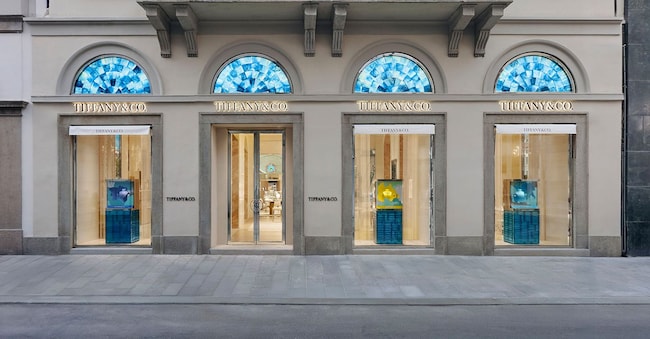
Nothing bad can happen at Tiffany's: Audrey Hepburn-Holly Golightly would today go for her Breakfast at Tiffany's in an evening dress, black satin gloves and dark glasses not on 5th Avenue, but on Via Montenapoleone. Whereas in Milan until recently there was the shop on Via della Spiga, now there are three bright floors and the largest boutique in Europe, second only to the ten floors of the New York Landmark. 'We used to have a consulate, now we also have an embassy,' likes to sum up Anthony Ledru, president and ceo of Tiffany & Co. And the embassy is a triumph of flowers, crystal, pink marble, works of art, sofas, lamps, jewellery, light, air, history. Why here? Firstly, because of the symbolic need of the parent company (the Lvmh group bought the brand in 2021 with an investment of 16 billion) to add a prestigious address to the mapping of Tiffany's around the world, "and not in just any old building, but in the Palazzo Taverna, a neoclassical mansion dating back to 1835". Then there is 'the special relationship between Tiffany and Italy'. Surprise: Italians "are at the top of the list of tourists who visit the Landmark", we are the ones who, if they go to New York, want to experience the thrill of feeling like Audrey-Holly and wander among diamonds, sapphires and heart-shaped locks.
And since in New York one always walks around looking upwards, the same happens in the Milanese boutique, mesmerised by the ceilings and the stained glass clock at the top of a corridor, a faithful reproduction, explains Ledru, 'of the one in NY's Grand Central Station. It was one of the first public clocks in the city'. Tiffany is something 'more than just a jewellery company, it is a cultural catalyst in the United States. A kind of national myth, embodying the dream, the possibility, that has intersected with cinema, its divas, the history of the country. Not only diamonds and the invention of the solitaire: the design of the seal reproduced on one-dollar notes is also Tiffany's; the letters NY, superimposed on the Yankees baseball team jersey, are signed Tiffany, often attributed to Louis Comfort Tiffany, son of Charles Lewis Tiffany, the jeweller who, starting from a stationery store, founded the house in 1837.
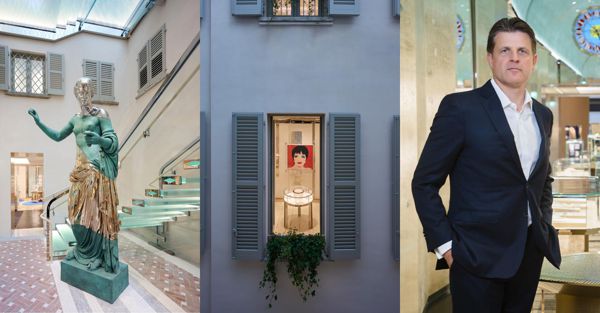
Upward glances also in front of the heart of the Milanese embassy, which is a tribute to the loner: a large crystal staircase that from the courtyard with the bar and the armchairs reproduced from a Gio Ponti design traverses all three floors of the building in height. "It was a real challenge," says Ledru. "We had it built in Vienna and then worked with the Italian authorities to get it approved, bring it here and put it up all the way to the top, right up to the skylight that shines like a diamond in the sun. Hugh Dutton, who also designed the Hôtel de la Marine in Paris, designed it'. An all-transparent staircase. Ledru likes to use the term lighthouse because shop is reductive, but the word space does not give the sense of the place, as a jewellery or art gallery. As a tribute to Italy, the shop windows are inspired by Michelangelo Pistoletto, and at the entrance one of his works takes up the iconic colour, robin's egg blue, from the robin's egg that has that magical hue. When Donald Trump first took office in the White House in January 2017, Melania brought the outgoing first lady, Michelle Obama, a large Blue Tiffany box as a gift that literally stole the show; for months there was speculation about what was in the blue box, until Michelle revealed in a television interview that it was "a lovely picture frame".
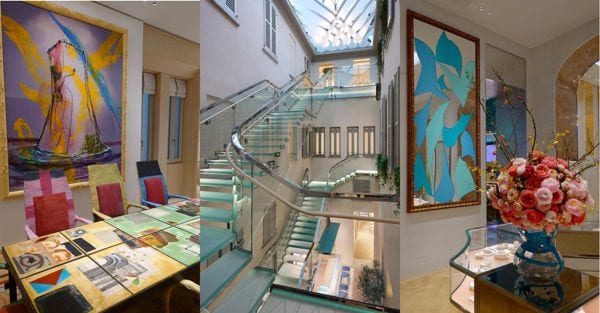
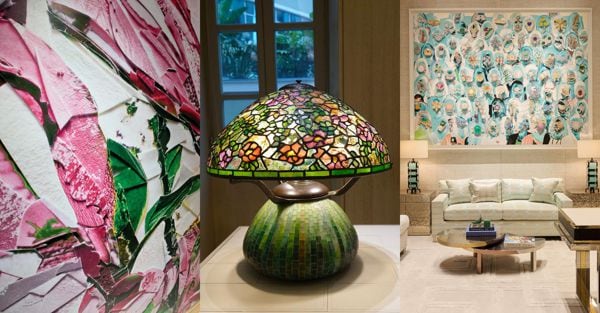
At the far end of the room dedicated to the home - plates, vases, silverware - there is a fireplace that an Italian stonemason recreated with pieces taken from the fireplace that Louis Comfort Tiffany - who also designed the historic floral Art Nouveau Tiffany lamps - had in Cleveland. The centrepiece is Julian Schnabel's tile table. It is inspired by the real or imaginary guests at his ideal dinner party: that evening, the painter Artemisia Gentileschi would be seated next to Franco Nero, Monica Vitti and Louis Buñuel - and we would want to be there too, listening to the conversations. Schnabel, who has arrived for the opening with his wife and children ('This is the first time in 74 years that I have moved for the opening of a shop'), invites us to try out the imposing, colourful wax and plaster chairs, 'I put wheels on them because they are too heavy to move by hand'. On the sides hang the two pictures painted with the location of the film The Hand of Dante, shot last year in Sicily, in San Vito Lo Capo. "It gives me a sense of optimism to be here with this table and these chairs, because the things we make have a human value, and in these chilling times preserving our humanity is everything," he says.
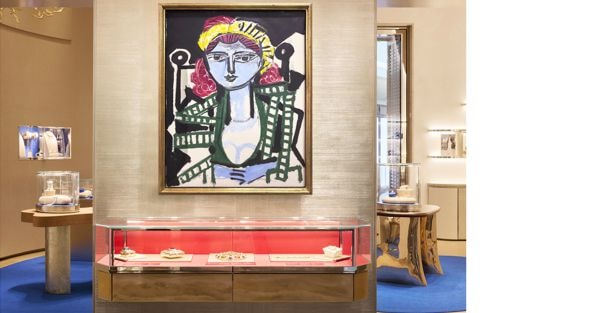
Art helps, because art, Ledru goes on to explain, 'is inclusive', even if the term does not currently enjoy good press in America. There is plenty of it in the boutique, works by Urs Fischer, Hilary Pecis. A three-metre-high Venus of Milo sculpted by Daniel Arsham 'covered in a blue, silver and bronze patina in homage to Milan. "In New York we have a Basquiat, here an authentic Picasso from 1954 thanks to his daughter Paloma - a historical collaborator of the house jewellery". It will remain in the shop for six months: before being installed among Paloma's own creations, the canvas arrived in Italy for 'a period of acclimatisation'. A few steps away is the room dedicated to the legendary Elsa Peretti, with some iconic pieces such as the Bone bracelets and others borrowed from the collection of best friend Liza Minnelli. In the wild days of Studio 54 she, Liza and Peter Marino (the architect of the project, perpetually dressed as a biker) were called the three musketeers.