
Milan looks up to the mountain of small villages

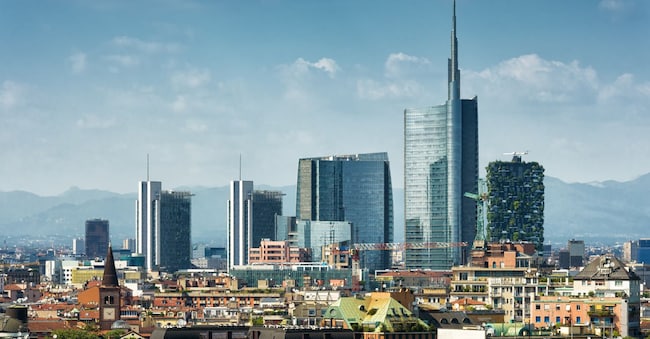
Rethinking the local to rethink the global also applies to cities that are hubs of networks in that interweaving of proximity and simultaneity of living and dwelling. It is also true for Milan, which perhaps today would do well to lift its gaze from its navel and look towards the mountains, if only to follow the torrent of its inhabitants who have made their way up Alpine valleys in their weekday escape from the metropolitan hood. So the presentation of the mountain report by Uncem, the union of mountain municipalities and communities, in Milan at Acli does not seem irreverent. Certainly, places of horizontal proximity of short networks that are often invisible compared to the spectacular verticality of the Sky Line with long networks of the metropolis in the making. They are there to remind us in these times of thundering negativism, that following the torrent of tourism we will see the rise of the vineyard and the olive tree, the fading of the glaciers in the liquid winter, and that there, memento Covid, lie our rare lands: air, green and water. Resources quoted in those alpine fortress dams of white energy multiutilities in metamorphosis from municipalism to network capitalism. Milan changes as the municipal Aem changes into A2A, which illuminates businesses, housing and the city of events. And here, starting from the margins, we have arrived at the centre of a reflection necessary for the premium city that reasons on how to straighten the crooked wood of post-Expo eventology, preparing to launch and host the Milan-Cortina Winter Olympics in the year to come.
Raising its gaze serves the city of events to mitigate and change its posture from a European and global city-state, the most critical would say, to a city-region or city in the region by looking at the territory. Assuming, Dematteis would say, 'a metro-mountain geography as a reasoned description of possible virtuous relations between metropolitan centres and mountain territories'. Looking to the mountains can also be a trace of a possible path of repositioning, as long as one does not assume as a space to be travelled only a connecting route for leaps from the metropolis to the premium resorts where the Olympic snow remains high up and with great artifice. To get to Bormio and Livigno, one has to cross the Brianze of manufacturing in metamorphosis, then Lecco in that branch of Lake Como that makes lake district from over-tourism up to the Rhaetian city Valtellina and Valchiavenna of villages and small towns up to the slopes and dams up high. A questioning path not only for train and car logistics, but also to understand what 'possible virtuous relationships' the great Milan can weave, to which economies look to, from manufacturing to tourism to living mountain villages and towns. The pendulum of the metro-mountain beats the sounds of change, beating out the time of the ancient adage between town and country.
Which speeds up a lot going from Milan to Cortina. Bergamo, Brescia, Verona, junction cities to get to that north-east where the Lombardy and Veneto production platforms meet, which together with the one in Emilia draw the new industrial triangle. Which once had its Fordist epicentre in Turin, to which even today we must look both for the industrial transition, but also taking on the metro-mountain category that was born and experimented there at the time of the previous Snow Olympics to understand what remained of that event for the city and the mountains. The report also follows that ridge of the Apennines that acts as a sickening reservoir for the plain that stretches from Milan to Bologna, the land of logistics of a swarm of companies in metamorphosis, in a cycle of transition where reasoning about the transition of the car cycle has no small implications for the Po Valley hood that can be seen from the highlands. As he recounts numbers and tales of the 'tiny lives' that make up 'mountain communities' with institutional presumption, he reminds Milan and beyond that 55% of our territory is mountainous. From the common dust of abandonment we arrive at the metropolitan discomfort by following the fundamental economies of living, dwelling, working, questioning the making of cities and towns, districts and medium-sized towns in the regional urban. Pendulum of a margin that becomes the centre in its being the vanguard of the climatic crisis and depopulation questioning the neo-population of territories and cities. Looking up at the metro-mountain centre, one wonders about the common destiny and the ancient relationship between city and countryside, which in hypermodernity seems to tell Milan that there is no smart city without smart land. Milan, a hub city in the Alpine macro-region where the Europe of butter and the Europe of oil meet, takes this into account.
bonomi@aaster.it


