
Milan, taxi emergency. New cars only at the end of the year
Long queues at key points such as railway stations and long waits on the phone
by Sara Monaci
3' min read
3' min read
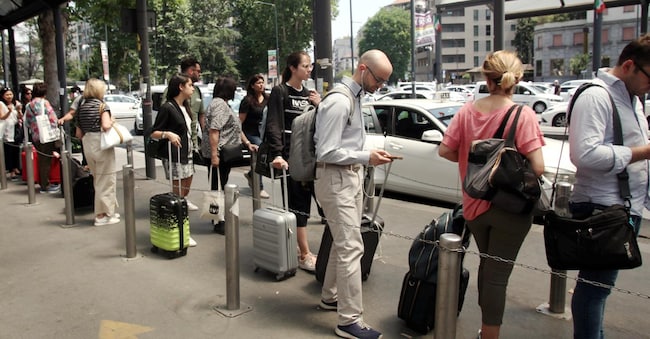
The lack of taxis continues to make itself felt in Milan, especially in summer. While waiting for the new municipal concessions to start up, the situation is always the same, already denounced at the beginning of the year: long queues in the nerve centres, such as railway stations, long waits on the phone, which in the evening hours become even useless as finding a car between 7pm and 9pm is highly unlikely. All this is made more complicated by a reduction in public transport services, which shrink significantly during the summer due to a lack of staff. The result is that in the city that aspires to halve the number of private cars in the name of a hoped-for environmental transition, having your own vehicle is currently the only certainty.
Just try. In the morning time slot, it is difficult to find a taxi between 8 and 9: if we are lucky the wait is about 20 minutes, but you may have to try longer with several companies. It gets better as the hours pass, obviously because there is less need. But the insuperable problem is in the evening, at the central station. The queue that forms on an anonymous weekday can exceed an hour, and there is no guarantee that the taxi will arrive. If it is called, it cannot be found. And if you try public transport around the various entrances to the station, the bus shelters of the public transport company Atm can indicate a wait of between 20 and 30 minutes, around 8 p.m. A problem for tourists, but also for Italians who stay in the city to work.
Loading...
The municipality is trying to resolve the situation with a call for applications that was opened in the spring and will yield its first results at the end of the year. An extra 450 licences will be issued, and the first written tests for aspiring taxi drivers will be held in September. Over 700 have applied, a sign that if they wanted the new cars, they could be found. The timeframe, however, is dictated by law, and at least a half year passes from when the competitions open to when the new cars are seen.
The real political issue is the lack of choices over the last 20 years: it is since the days of Mayor Gabriele Albertini that no more licences have been granted, so we are stuck with those 4,885 taxis of the early 2000s, for a total of 5,404 in the airport basin.
In Milan, the only case in Italy, the authorisation to expand the car park was issued by the Region, and the two institutions have never agreed in recent years. Now the Milan municipality has managed to expand the fleet thanks to the Asset dl, which has allowed the municipality to create new licences as well, overcoming the obstacle of the regional authorisation, following a slightly different procedure: 100 % of the value of the licences must be redistributed to the taxi drivers as compensation for the competition they will suffer (the ordinary law would instead provide for 80 % to the taxi drivers and 20 % to the municipality for the improvement of parking spaces).


Brand connect
Loading...
