
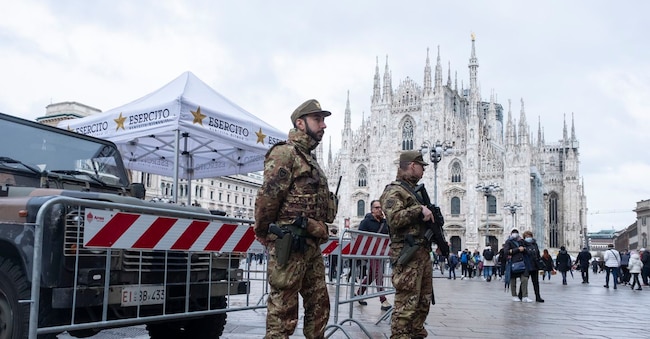
Soldiers on the streets: the paratroopers are arriving in Milan. Here are the numbers of soldiers in the cities and what they will be able to do
Military personnel act in the capacity of public security officers: they may carry out the immediate identification and search of persons and vehicles, including for the purpose of preventing or stopping behaviour that may endanger the safety of persons or the security of the areas under their surveillance. However, for any further investigations and to carry out all judicial police procedures, recourse must be made to the offices or headquarters of the State Police or the Carabinieri.

Key points
The 500 military personnel who will be deployed to Milan as part of Operation ‘Strade Sicure’ following the serious accidents on 18 October are paratroopers from the ‘Folgore’ brigade. They may carry out surveillance, patrolling and prevention duties, but do not have the same general powers as a police officer or a Carabiniere. Essentially, they operate in support of the police forces, with specific powers provided for by law (Article 7-bis of Decree-Law 92/2008, converted into Law 125/2008), and by the regulations applicable to military personnel deployed on duty.
Overall, there are currently 6,800 military personnel deployed as part of the ‘Strade Sicure’ operation. The vast majority are from the Army (6,630; the rest are from the Navy and the Air Force). They help to protect the country and its citizens through shifts, patrols, checks and the guarding of sensitive sites. The soldiers are deployed across 58 provinces and divided into 11 groups. The largest group covers Lazio, Umbria, Abruzzo and Marche: this comprises 1,680 military personnel; of these, over 90 per cent are stationed in Rome and its province. There are 950 soldiers assigned to the Lombardy, Trentino and South Tyrol group (to which a further 500 will be added by the end of the year, who will be stationed solely in Milan); 960 are stationed in Campania alone, 620 in the Veneto–Friuli Venezia Giulia group, and 600 are operating in Sicily.
What does the law say?
Article 7-bis governs the involvement of the Armed Forces in the policing of the territory. There are two key passages in the text to consider. The first: “For specific and exceptional crime prevention requirements,” the provision states, “where increased territorial control is deemed appropriate, a plan may be authorised for the deployment of a contingent of military personnel belonging to the Armed Forces, preferably Carabinieri deployed on military duties or, in any case, volunteers from the Armed Forces specifically trained for the tasks to be carried out. Such personnel shall be placed at the disposal of the prefects of provinces comprising metropolitan areas and, in any case, densely populated areas, pursuant to Article 13 of Law No. 121 of 1 April 1981, for the purpose of guarding sensitive sites and targets, as well as conducting patrols and surveillance in cooperation with and alongside the police forces. The plan may be authorised for a period of six months, renewable once, for a contingent not exceeding 3,000 personnel.”
The deployment plan
The second paragraph of the Act provides that the plan for the deployment of Armed Forces personnel “shall be adopted by decree of the Minister of the Interior, in consultation with the Minister of Defence, after consulting the National Committee for Public Order and Security – which includes the Chief of the Defence Staff – and after informing the Prime Minister. The Minister of the Interior shall report on this matter to the relevant parliamentary committees”. Furthermore, the provision clarifies that, whilst carrying out their duties, “Armed Forces personnel who are not members of the Carabinieri shall act in the capacity of public security officers and may carry out on-the-spot identification and immediate searches of persons and means of transport in accordance withArticle 4 of Law No. 152 of 22 May 1975, including for the purpose of preventing or stopping behaviour that may endanger the safety of persons or the security of the areas under surveillance, with the exception of judicial police functions. For the purposes of identification, to complete investigations and to carry out all judicial police procedures, Armed Forces personnel shall escort the persons in question to the nearest offices or headquarters of the State Police or the Carabinieri. The provisions of Article 349 of the Code of Criminal Procedure shall apply to the persons escorted.”
In carrying out their duties, therefore, military personnel act in the capacity of public security officers: they may carry out the immediate identification and search of persons and vehicles, including for the purpose of preventing or stopping behaviour that may endanger the safety of persons or the security of the areas under their surveillance. However, for any further investigations and to carry out all judicial police procedures, recourse must be made to the offices or headquarters of the State Police or the Carabinieri.


