
Minimalism between gravity and lightness
The exhibition at the Bourse de Commerce Paris runs until 19 January 2026

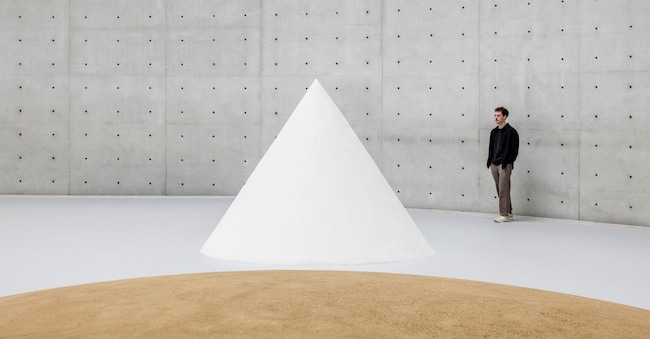
In a city like Paris, where noise meets reflection, the Minimal exhibition - on show at the Bourse de Commerce until 19 January - does not simply celebrate an artistic movement, but a form of thought, not minimalism as a style, but as a discipline of the gaze. It is about concentration instead of subtraction, measure instead of redundancy, silence as a cognitive medium. An exhibition that is an exercise in lucidity, a silent lesson in the value of discernment.
Curated by Jessica Morgan, director of the Dia Art Foundation, it brings together over one hundred works that from the 1960s to the present day have interrogated the relationship between space, matter and the viewer. The seven sections - Light, Mono-ha, Balance, Surface, Grid, Monochromy and Materialism - do not follow chronological linearity, but a conceptual order, a topography of attention.
Here, the work does not show itself, but allows itself to be perceived as an experience. From Agnes Martin to Richard Serra, from Dan Flavin to Eva Esse, from David Lamelas to Enzo Mari, the artists in the Pinault Collection challenge the idea of the work as an accomplished object, transforming artistic practice into a meditative, almost musical act. The central hall of the Bourse de Commerce, whose 19th-century rotunda is modelled on Tadao Ando's ascetic geometry, hosts Meg Webster's installations. Matter and space dialogue with architectural purity, creating a counterpoint between gravity and lightness.
"This exhibition," the artist explains, "is an invitation to escape the inflation of meaning and to practise a silence that is more necessary today than ever before. Indeed, Flavin's neon light, Martin's suspended lines and Mari's sober geometry do not propose absence, but a restrained fullness, a contemplative rigour that recalls, in aesthetic terms, the philosophy of emptiness in Eastern thought and Mies van der Rohe's notion of 'less is more'.
Minimalism here is configured as a measure of the spirit and the viewer becomes an interlocutor, completing the work with his own perception. Echoes of Lee Ufan's ideas intertwine with Donald Judd's structures, suggesting a dialogue between East and West, between the energy of nothingness and geometric precision. Ando's circular architecture then transforms the rotunda into a machine of light and silence, making the entire space part of the artistic gesture. Minimal - contrary to what one might think - is not coldness, but composed intensity; it is not renunciation, but discipline; it is not noise, but eloquence of emptiness. Subtraction becomes knowledge, simplicity becomes measure and the creative gesture becomes an ethical act, restoring to silence its right to be experience and to calmness the privilege of becoming knowledge.

