
Minor Hotels is stepping up its expansion in Italia: 100 hotels by 2030 and the opening of the Tivoli President Milano
The group’s strategy focuses on an asset-light model, the conversion of historic buildings and the development of the luxury segment. The search for new opportunities in Italy’s main destinations continues

Key points
Minor Hotels, a global group with over 640 properties in 63 countries, is focusing on Italia by setting out a clear expansion strategy. The stated objective is ambitious, as Marco Gilardi, Senior Vice President for Italy – Operations, Southern Europe at Minor Hotels Europe & Americas: “To grow the Italia portfolio from the current 60 properties to 100 by 2030”, as part of a global growth plan that aims to reach 850 hotels over the same period.
The Tivoli brand and its Milan debut
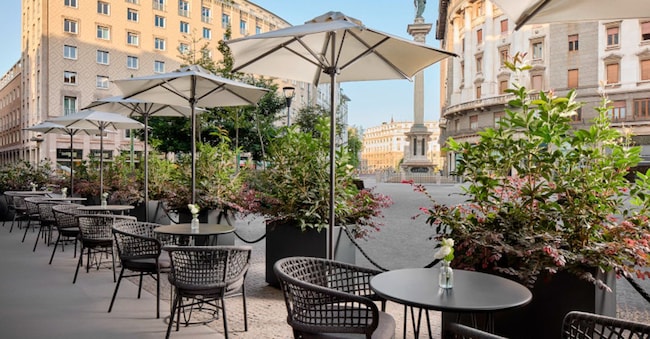
One of the jewels in the crown of this strategy to position the group in the high-end market is the Tivoli Hotels & Resorts brand, a Portuguese brand founded in 1933, whose hallmarks are timeless elegance and a connection to the local area. The focal point of the recent consolidation in the luxury segment is Milan, a key hub for international business and leisure travel. The recent transformation of the former NH Collection Milano President into the new five-star Tivoli President Milano, situated in Largo Augusto a short distance from the Duomo, represents a significant investment in terms of repositioning and restyling. “The idea,” comments the manager, “was not to deprive guests of their Milanese home. We managed to handle the flow without any disruption, carrying out a year and a half of works without closing the hotel and making use of buffer floors.” The building, designed in the 1960s by the rationalist architects Luigi Figini and Gino Pollini, has been reinterpreted by interior designer Rodrigo Izquierdo.
The hotel is currently in a soft-opening phase, which has not disrupted its day-to-day operations. It boasts 239 rooms, including 60 suites, a wellness programme focused on rejuvenation, a high-end food and beverage offering, and the City Milano restaurant, which is set to officially launch in September in collaboration with chef Natale Giunta. The centrepiece is the new 150-square-metre presidential suite, designed for exclusive stays and high-profile private events, and enhanced by an adjoining panoramic rooftop terrace overlooking the Duomo. “The spa has also been completed,” emphasises Gilardi. The hotel thus aims to blend into Milan’s urban fabric, presenting itself as a living room open to the city. “Customer feedback has been positive; guests have also appreciated the style of the lobby and rooms for their connection to the building’s history, and we are satisfied with the average price,” he adds.
Asset-light expansion
Minor Hotels’ growth in Italia follows precise financial and operational guidelines. The group favours an approach based on capital flexibility, reducing its exposure to directly owned properties. “At present, we have a lean portfolio,” explains the manager. “Eighty per cent of our new brands operate under management contracts, alongside a few franchising arrangements. It is an asset-light policy that promotes rapid growth. We do not own any properties in Italia; the others are either managed or leased.”
Particular attention is paid to the conversion of historic buildings, a choice that is in keeping with the brand’s identity and is also driven by high construction costs, which are pushing developers towards the regeneration of existing properties. “The historic character makes the conversion process smoother, once the necessary planning permissions have been obtained,” notes the manager. As for the minimum size required to ensure the economic viability of projects, Gilardi explains: “For us, properties are profitable from 40 rooms upwards, but it depends very much on the location. In historic centres, smaller properties work well, but it all depends on the context. To date, the group’s acquisition campaign has got off to a good start, and contracts have already been signed for 40 hotels by 2025; in Italia, three hotels are set to be announced and will soon be operational.”
Brand connect


Newsletter RealEstate+
La newsletter premium dedicata al mondo del mercato immobiliare con inchieste esclusive, notizie, analisi ed approfondimenti
Abbonati