
Mobility, Milan first for the use of public transport. Bari focuses on bicycles
This emerges from the Will Media report produced in collaboration with 70 organisations and NGOs. The top 10 Italian cities analysed
by Niccolò Gramigni
3' min read
3' min read
In the era of sustainable mobility and invitations to use means such as bicycles and scooters, it turns out that in Italy there is still a widespread, widespread habit of using private cars, except in a few virtuous cities. Outlining the scenario is the report published by Will Media, produced thanks to the collaboration of over 70 entities including NGOs, environmental associations and civil society organisations (Data source: Rafaci Preto-Curiel, Juan P. Ospina, The Abc of mobility, Environmental international and cities moving). 10 cities in Italy were considered: Milan, Genoa, Rome, Turin, Naples, Florence, Bari, Bologna, Catania and Palermo.
Milan and Rome, how many differences
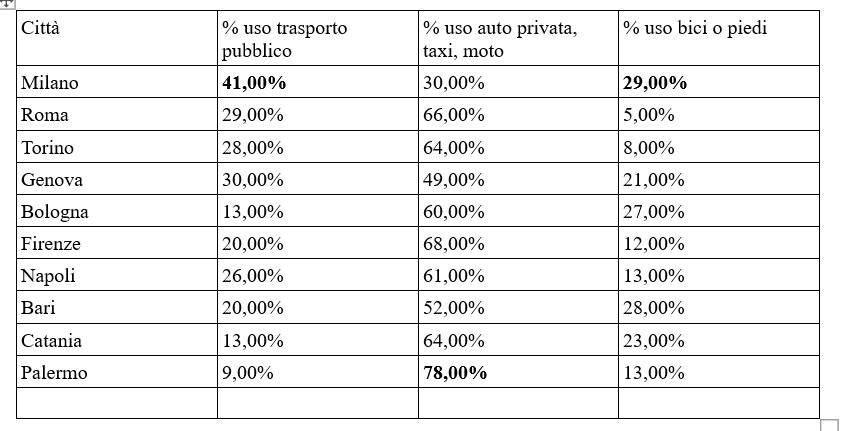
Milan to Rome. From north to south, the trend changes. Take the example of Milan. Local public transport works here and this is why people, in addition to having a European mentality and an eagerness to combat climate pollution, use public transport more: 41% take public transport, the preferred means over private cars, taxis, motorbikes (30%) and cycling or walking (29%). If Milan is therefore virtuous from this point of view, the same cannot be said of Rome where the situation is totally different. And here the mistrust that Romans have in public transport evidently weighs heavily. Only 29% use public transport (-12% compared to Milan) and the percentage of those who say they only move around by private car, taxi and motorbike is worrying: a good 66% (+36% compared to the Lombard capital). Only 5% move around on foot or use bicycles.
The excesses
.The report published by Will Media shows some excesses to highlight. In Italy, the highest percentage of those who move around using private cars, taxis and motorbikes is found in the city of Palermo, an impressive 78%. This means that public transport in this city is practically considered absent by the people of Palermo (only 9% use it) and there is no custom of walking or taking a bicycle, perhaps also due to the characteristics of the territory (13%).
In Florence, first the former mayor Dario Nardella and now the current first citizen Sara Funaro have pushed and are pushing hard for tramway lines. They work and people like them. But the fact that the territory is still not completely covered (there are construction sites underway to extend the lines to a large part of the city) leads people to choose private cars, taxis and motorbikes much more (68%, the highest percentage after Palermo): since the city is not large and the arteries are not enormous, the result is that traffic is often blocked. Here the goal must be to increase as much as possible that 20% who use public transport: if the tramways can increase this percentage, improvements are expected in local public transport by road (which in Tuscany has only one manager for the entire region, Autolinee Toscane). The percentage of those who use bicycles or go on foot is still low (12%) and here work needs to be done to implement cycle paths.
In Turin too, people use cars, taxis or motorbikes a lot (64%) and walk or cycle very little (8%), as do Catania (also 64%) and Naples (61%). In addition to Palermo, public transport is not liked in Bologna (13%) and Catania (13%).

