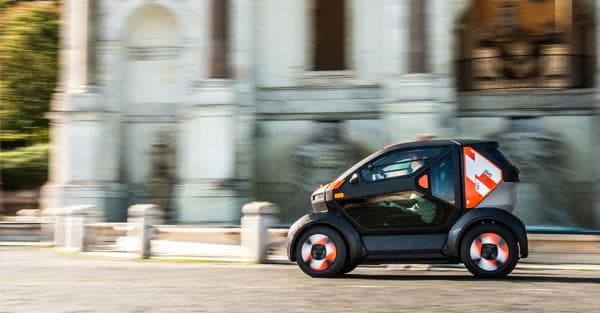
Mobilize Duo on test: what the new French electric microcar looks and feels like
Renault's mobility brand introduces a quadricycle, heir to the Twizy, with L6 (6 kW and 45 km/h) homologation that can be driven by 14-year-olds or L7 (12 kW and 80 km/h) that can be driven by 16-year-olds
4' min read
4' min read
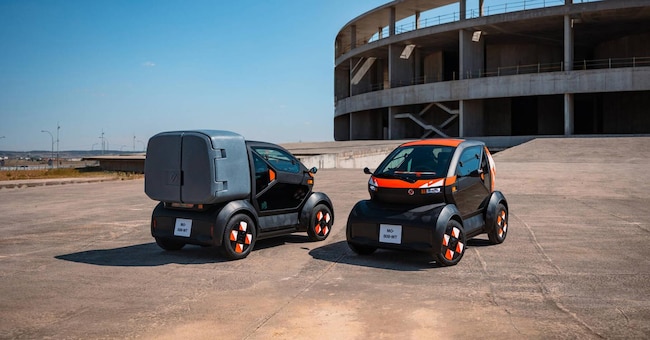
A city car does not have to be a city car. It can also be a quadricycle, a mode of transport that is becoming increasingly popular due to three factors: the almost total disappearance of small cars from the price lists, the rise in prices, and the realisation that for the city, often travelling alone, you don't need vehicles over-equipped with accessories, electronics and safety devices. Renault is aiming to intercept this clientele with the Mobilize mobility brand and the Duo, which can be considered the heir to the Twizy and which debuts together with its sister Bento, a small commercial vehicle intended for urban micrology.
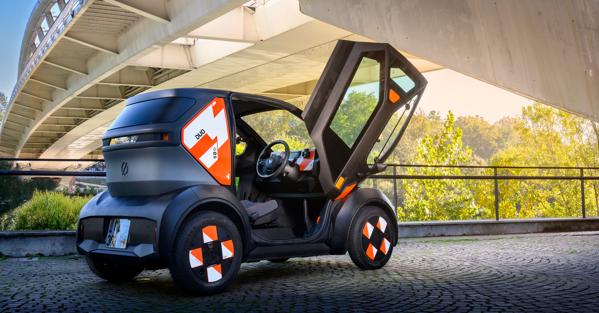
The Mobilize Duo is an electric quadricycle with an undoubtedly eye-catching and colourful style, offered with both L6 (6 kW and 45 km/h) homologation that can be driven by 14 year olds, and L7 (12 kW and 80 km/h) that can be driven by 16 year olds. It is 2.43 metres long and has a two-seater passenger compartment accessed through two doors that open upwards at the front, with an assured scenic effect and the possibility of getting in and out in spaces slightly wider than its 1.3 metres width. This solution allows ample access, but the fact that the seat is in the middle and away from the edges does not make getting in and out of the vehicle any easier. For those who have to climb into the back, the front seat can be advanced by unlocking it via a webbing on the back of the backrest.
Again, the ease of getting in and out is not the best and, once seated, your knees remain wide around the seat. In short, one feels a bit like a passenger on board a motorbike, but there is a seatbelt and there is also a seatbelt in the front, indeed it has a pre-tensioner with restraint limiter and there is also an airbag, a combination in favour of safety that is almost unique in its category. The Bento, on the other hand, is a single-seater with a load compartment that increases its length by 9 cm to an impressive 649 litres, ideal for small city deliveries. The Duo, on the other hand, lacks a compartment for carrying small items, as there are no door pockets and no hooks for shopping bags either. The materials appear basic but robust and are also washable.
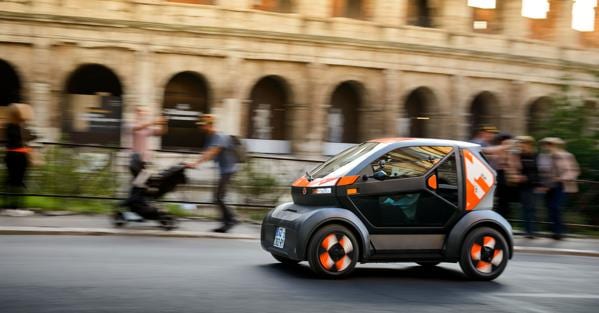
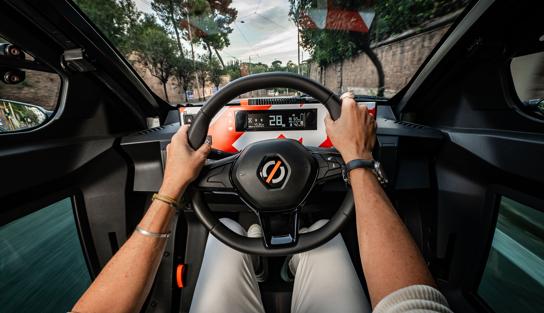
Other interesting atout are the heated windscreen and seat and the air conditioning system that makes use of an original rotating diffuser at the base of the windscreen. Equally original are the audio system that makes use of a transducer and the dashboard that resembles that of a work vehicle. It is a pity, however, that the white and orange stripes are reflected annoyingly in the windscreen. The telematics part is interesting, however, with the possibility of using the smartphone as a Bluetooth key and being able to do the same with five other relatives or friends by sending them the virtual key on their device. Through an app, it is also possible to obtain information or control certain functions remotely, and there are also management systems for fleets or car sharing that allow use to be restricted to predefined geographical areas or inhibit recharging in the event of theft.
In this regard, the cable is attached to the vehicle and housed in a small compartment on the front: as standard there is a Schuko type socket, but on request it is possible to have a type 2 one, the same one used for electric cars. The battery is 10.3 kWh net and is a module of the one in the new Renault 5 composed of four modules, so it has high-quality NMC cells, expensive and certainly oversized for this type of use, but a guarantee of reliability and durability. The autonomy is 160 km for the Duo and 149 km for the Bento. As far as recharging speed is concerned, 25 km are recovered per hour, to go from 20 to 80 per cent it takes 3 hours and 25 minutes.