
Benefit societies, a model for a stronger economy
In Brindisi the second stage of the Competition promoted by MIMIT

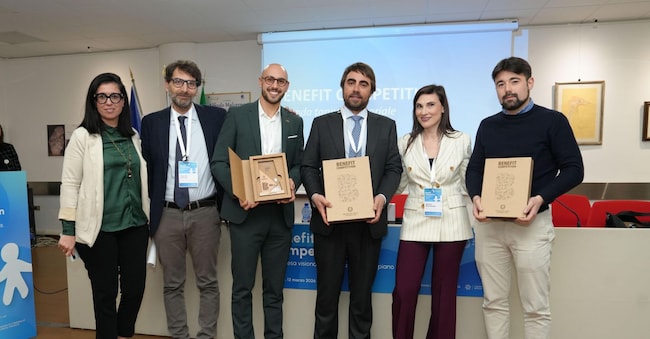
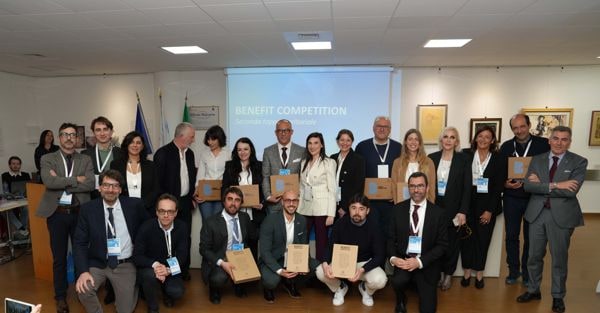
The second stage of the Benefit Competition was held in Brindisi on 12 March, 'representing a significant step in the commitment of the Ministry of Enterprise and Made in Italy to promote entrepreneurial models oriented towards innovativeness, sustainability, and above all the creation of common benefit,' as Azzurra Marchesano of MIMIT explained, introducing the day. The stage winner was GenomeUp, an innovative SME from Bari that develops advanced digital solutions for genetic diagnostics. Also on the podium were BeNewtral, a Milan-based company that develops and markets an innovative low-emission binder as an alternative to traditional cement, and N&B Natural is Better, a company from Martano, in the province of Lecce, which develops natural and organic cosmetics in a sustainable and responsible manner, based on aloe vera from Salento. The other finalists were: Alimentiamoci, Apogeo, Breaders, Capua 1880, Cobalto, Open Building and Planetek Italia.
Positive Benefit Model also for credit
"The 'Benefit model presents one of the most interesting trajectories in the evolution of our production system,' Marchesano continued, emphasising how this 'evolution is also consistent with the development of European Union regulations, which have introduced sustainability reporting obligations for various categories of companies and, above all, have emphasised the value of the ESG criteria,' which 'are also very important from the point of view of the credit system's assessment of companies. In fact, we are moving towards an increasingly strong integration "of credit rating models with the ESG criteria," stressed Marchesano, also speaking of a "benefit model that reinterprets the company's own role within the economic system.
With benefit companies stronger economy
Francesco Cirillo of Assobenefit also insisted on this point, explaining that - 10 years after the introduction of the legislation for the birth of benefit companies - today, thanks to the growth of these enterprises, we can no longer speak of 'a theoretical experiment' but we are facing 'a real piece of the Italian economy'. There are more than 5,000 benefit companies in Italia, still a small number out of the total, but 'the real change is not in the numbers but in the way we tell the story of the company,' Cirillo specified, explaining that this business model is proving that 'economic value and social value can be designed together'. Making a profit goes hand in hand with creating benefits for the community, people, and the environment. "A business community has grown up around benefit companies, not just a legal model," Cirillo continued, pointing out that an important result of these 10 years is that the imagination of businesses, the narrative, has also changed, with the fact that "when profit meets common benefit, the economy becomes stronger" firmly in mind.
In Ancona, the next stage of the Benefit Competition
The next stage of the Benefit Competition, the third after Milan and Brindisi, will be held in Ancona on 26 June. Applications will be open from 23 March in the dedicated section on the website of the Ministry of Enterprise and Made in Italy. As in the case of the first two events, companies already established as a benefit or intending to embrace this model from all over Italy will be able to apply. This is because the competition wants to remain open to companies of all geographical origins, even if, it should not be forgotten that "the territory is very important, especially the entities that are present in the territory are important, precisely, like the virtuous case of the Apulia Region, which with policy actions, targeted interventions, favour in some way the creation of an ecosystem that is fertile for the birth and development of this type of business model," explained Marchesano.
What the Apulia Region has done
"We believe that the choice of combining profit and collective welfare is a winning one. We have guided the writing of our business facilitation instruments managed with the FSC and ERDF towards this choice," stressed Giuseppe Pastore, manager of the Competitiveness Section of the Apulia Region Economic Development Department. "The number of benefit companies in Apulia grew in 2025 at a much higher rate than the national average. We therefore wanted to promote and try to make it even easier for them to set up and register as benefit companies by creating the regional register, a platform where companies can register without too much red tape and with this they can also aspire to an increase in the intensity of subsidies with respect to the incentives granted by the regional instruments,' he continued, explaining that to promote this model, 'occasions like today's day are certainly a useful flywheel in the region. We will strengthen communication, information and training actions on the subject even more this year, because many companies are not aware that they are benefit companies, but they already are because they have the interests of the community and the territory in which they operate at heart".


