
Moldova chooses its president. At the crossroads between the EU or pro-Russian line
The pro-European candidate, now in office, Maia Sandu, is favourite in the run-off against the Moscow-sponsored socialist Stoianoglo. A vote that will condition the country's geopolitics
by our correspondent Roberto Da Rin
 Aggiungi Il Sole 24 Ore
ai preferiti su Google
2' min read
2' min read
One of the city's most beautiful parks, dedicated to Ștefan III, Stephen the Great, Moldavian ruler, voivode (governor) of Moldavia from 1457 to 1504, is fenced off with wrought iron worked in Odessa. Not many years ago, before the fences, there were fences to keep cows and sheep out. The tree-lined streets adjacent to the park alternate between different architectural styles, Gothic, neoclassical and, of course, Soviet modernism. A pleasant capital of a small country, ignored - until two years ago - by the international community. Still undecided whether to call it Moldova or Moldova.
Now everything has changed. Geopolitics has entered the homes of Moldovans and all Europeans. The war in Ukraine has amplified their interest. Today, the presidential elections are being voted on. A crucial election, strongly connected to the referendum (a fortnight ago) on Moldova's gradual entry into Europe, where the 'yes' vote won, by a whisker: 50.5%, against the 'no' vote at 49.5%. The next president of Moldova will either accelerate or obstruct European membership.
In today's presidential runoff, polls give an advantage to incumbent Maia Sandu. Centre-right, pro-European, she won the first round with 42% of the vote, ahead of the socialist, Moscow-backed Alexandr Stoianoglo, with 26%. A seemingly wide gap. However, the advantage did not dampen the controversy: in the hours following the first round ballot, Sandu attacked his opponent Stoianoglo, denouncing fraud and vote buying, especially in the referendum vote. In this hinge country, squeezed between East and West, the social strabismus between those who look to Moscow and those who look to Brussels is evident. A real social split: the nostalgics reaffirm a strong linguistic and cultural link with Russia, they feel embodied in a Russian soul, which does not coincide with political affiliation to President Putin, but which is not attracted by the European magnet.
A Country Divided in Two
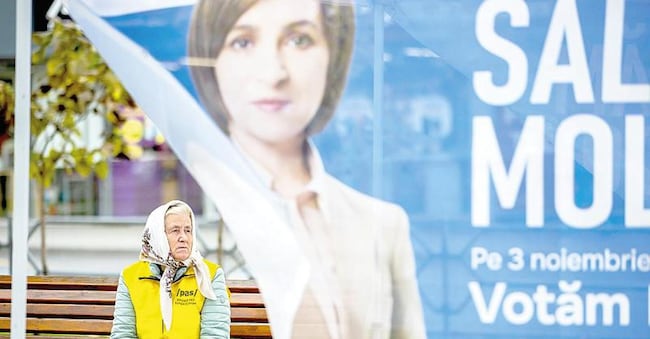
.The other electorate looks instead to Brussels, to Romania's great homeland, and yearns for EU membership. The only way to permanently escape the Russian orbit. Between Mrs Liuba, who counts leu at the Central Market to buy a few things to eat, and Ruslan, who works in an IT company and drives a suv, there is a sidereal distance. Of incommunicability.
The contrast between the two political and economic models has an anagraphic and economic connotation. Among the elderly nostalgia for Russia prevails, among the young the attraction to the West wins out. Inflation at 34% and the real estate bubble in Chișinău have strengthened the anti-European electorate with the hope that Soviet welfarism, who knows, will be able to protect the poorer social classes.

