
Elections, head-to-head in Moldova: pro-Russians in slight lead
In economic difficulties, pro-Russian parties undermine President Sandu's Pas

3' min read
3' min read
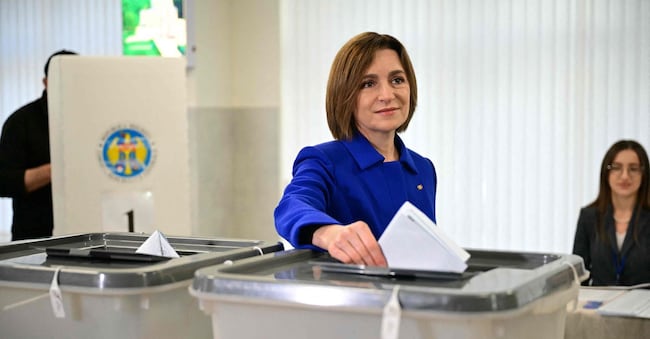
It is neck-and-neck in Moldova between pro-Europeans and pro-Russians. According to the first results, with 10% of the ballots counted, the Patriotic Bloc led by former president Igor Dodon, close to the Kremlin, is ahead with 38% of the votes. The pro-European Action and Solidarity Party (Pas) of President Maia Sandu follows at 34%. Counting has just begun and will continue throughout the evening, and the votes of the diaspora, traditionally oriented towards Europe, will also be decisive. The turnout, according to data released by the Central Electoral Commission, was 51.9%.
Moscow attempts a new foray into Europe
.The Arch of Triumph in Chișinău, the capital of Moldova, also called the 'Arch of Victory', will see thousands of people converge in the coming hours, either celebrating or protesting. Today's vote is for the renewal of parliament, 101 deputies will be elected in a country of 2.4 million inhabitants. The outcome of this election is really difficult to predict: the pro-Europeans and the pro-Russians are competing for the vote in a border-country, an outpost of either the European Union or Russia. Depending on the geographical position of the observer. Moldova plays a strategic role, squeezed between Romania and Ukraine; Kiev's grain exports are a major issue in the Ukrainian resistance.
"Yesterday and today, the infrastructure related to the electoral process was the target of several attempted cyber attacks," Moldova's Prime Minister Dorin Recean denounced on Facebook on Sunday, explaining that hackers targeted the official portal of the Central Election Commission and several polling stations abroad. Recean added that the attacks had been neutralised.
The polls, which almost always disagree with each other, only agree on the high volatility of the number of undecided voters and the country's constant political instability, over which Brussels and Moscow vie for influence. There are two blocs: the Pas (Action and Solidarity Party), pro-European; and the Bep, (Patriotic Electoral Bloc), a pro-Russian front, a coalition of four parties, one of which was excluded by the Electoral Commission.
The country is also split linguistically, both Romanian and Russian idioms being official; Chișinău's economic crisis, (with GDP growing by only 0.1% in 2024), rising inflation and widespread poverty determine pockets of discontent that pro-Russian parties have long been riding on. However, the European message is struggling to gain support in a country suffering the consequences of the war in Ukraine, first and foremost for Russian gas supplies.

