
Mole Urbana, Made in Italy microcars for a breakthrough on electrics
Interview with the company's founder and president, Umberto Palermo. The company, participated by Cdp Venture Capital, has opened a factory in Orbassano. It aims to produce 5 thousand pieces per year
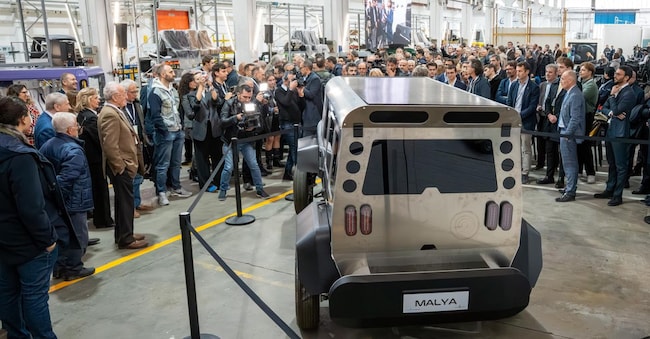
(Il Sole 24 Ore Radiocor) With the inauguration of the new Mole Urbana factory in Orbassano, in the province of Turin, the project conceived and launched by designer and entrepreneur Umberto Palermo takes a decisive step from idea to production reality. The group of electric quadricycles and microcars designed for urban transport, has given the official start to a 'light' factory, to produce with low energy consumption and great efficiency. "After years of research, a new, all-Italian car manufacturer is born. As a design house, we have managed to evolve and understand the needs of the new generations on electrification. Here we are talking about the tree, not just the fruit. And of an ecosystem, industrial, social and creative, in the sign of Made in Italy," said Umberto Palermo, founder and president of Mole Urbana, in an interview with Radiocor, emphasising that "the entire production comes from a national supply chain between Piedmont and Marche, rebuilding Italian industrial skills in sectors where they had almost disappeared". The start-up of the Orbassano site is a necessary step towards the production of 12 new modular electric models designed for city mobility, to which will be added in the future the Malya, an Italian keicar for extra-urban use, now still in concept and which 'if we find the funding within 10-15 months could be on the road'.
Open for new members
In order to realise the ambitious vision of Mole Urbana, which is participated by Cassa Depositi e Prestiti through Cdp Venture Capital, however, funds and, potentially, new partners are needed: "we are open to the entry of new partners because my objective is not to go into debt, so not to borrow money, but to have partners who can make an important contribution. We were lucky with CdP, because it understood that we need to nurture small and medium-sized enterprises, where there is creativity and where there is manufacturing," said Palermo, explaining that soon "there will be a second round of investment. The first collection was 3.5 million, the second will not exceed that figure, for us it is enough'.
The idea on which Mole Urbana is based starts from doing, focusing on concreteness: 'I did not go around asking for investments by showing projects still on paper. I asked Mise for the factory, an industrial site from the 1960s, brought back to life after years of inactivity, and I obtained it by winning a tender, but I already had the prototypes. I asked Cdp Venture Capital to support us, but I had already spent more than EUR 2 million of my own money. I think this is an approach that investors really like,' Palermo said.
Industrial plan starts with an investment of 7 million
The foundations on which the project rests, therefore, are more than solid and the path appears to be marked out: 'the objective is to produce around 5,000 units per year at full capacity, we have agreements with some twenty dealers with a total network of around seventy points of sale. Today there are 30 workers, but at full capacity they will become 80," said Palermo, explaining that "the industrial plan is solid, starting with an iinvestment of 7 million euro. We want to remain in a niche market, we don't need the exorbitant figures that the automotive sector has accustomed us to'. A market that, however, could also be foreign in the future: 'would we also take our models out of Italy? Absolutely yes. Italy is in third place for sales of electric city cars, behind France and Germany. Our product could go very well anywhere, even to Brazil or India, because I don't need to make giant factories. And then to super-roboticisation I prefer many arms, the work of many people, which also has a positive impact on the territories,' exactly as happens at the Orbassano site. "We are in a condition where we need to change paradigms.
Encouraging companies that use fewer robots and more arms
Globalisation, technology, innovation are certainly good but we need to get the arms working again. "We must incentivise companies that use fewer robots and many arms," said Palermo. Mole Urbana focuses on the idea that Italian design must return to observation, responsibility and concreteness, and that the car of the future is not just a technological object, but a cultural gesture: a way of thinking about work, territory and sustainability. "I would like them to remember me in these terms one day, saying that at least I tried to create change in a sector that I know very well, which is the automotive sector," Palermo concludes.


