
Rival groups, Molotov cocktails and terrorism in Bari. One hundred searches carried out across Italia
Digos units in 18 cities on the eve of the demonstrations; 51 of those under investigation are minors. The Bari Anti-Mafia Directorate (DDA) has charged the Telegram group ‘23 October Bari Uprising’ with vandalism and looting for terrorist purposes. In the ‘17 October Movement’ chat groups, the French model is cited: ‘Roadblocks everywhere, destruction of banks’

Key points
- The 17 October Movement, Telegram chats and the French model
- Digos raids: 100 people under investigation, 51 minors, 18 towns
- Bari, the Anti-Mafia Directorate and the Telegram group ‘23 October Bari Uprising’
- Turin: twelve measures announced by the Chief of Police: urban stadium bans and verbal warnings
- Padua, looting planned on Instagram: 11 young people, eight of whom are under-18s
- Naples: firecrackers and a glass-breaking hammer at student marches
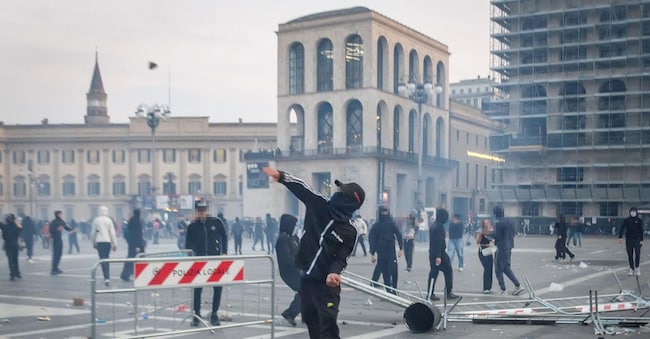
Inciting others to commit criminal offences, vandalism and looting, for the purposes of terrorism. Notices of investigation are being served across Italia to groups of protesters, the day before the major demonstrations scheduled to take place in Milan, Bologna, Turin, Florence, Padua, Bari and Genoa. In Bari, the District Anti-Mafia Directorate is charging them with ‘inciting’ clashes, including through ‘the use of Molotov cocktails’. Tension is mounting everywhere. And across the country, the Digos is carrying out a hundred searches whilst serving notices of investigation.
The 17 October Movement, Telegram chats and the French model
Blockades, destruction, unpredictable gatherings in public squares. That’s the French model. In the Telegram chat groups of the 17 October Movement, there are those who want to adopt it: ‘We must do as they do in France. Over there, they’re well organised and, above all, active.’ The group is growing: the number of participants is rising, and the number of channels adopting its name and calling for a showdown with the Meloni government is multiplying. From Rome to Milan, from Bologna to Florence, right through to Turin, Genoa and Padua. A movement that appears spontaneous and diverse. It is unclear who is behind it. The schedule, however, is already set out in the chats: ‘permanent’ demonstrations from Saturday 24 October in Rome and, on the same day, new protests in Milan, Bologna, Turin, Florence, Padua, Bari and Genoa.
The Prevention Police, a unit coordinated by the Department of Public Security within the Ministry of the Interior, is investigating the emergence of these groups.
The main cause for concern is the risk of others following suit. France, which is experiencing severe tensions, keeps cropping up in conversations. And there are those who point to the strategy to be followed: there, ‘the protests are unstructured’; ‘the secret is precisely that they are widespread, unpredictable and cause chaos where it is least expected. Roadblocks everywhere, the destruction of banks, luxury shop windows and town halls’.
Practical advice is also circulating: a widely shared leaflet, a guide to demonstrations explaining how to behave in marches and during clashes with the police. It is another piece of the puzzle, alongside the messages calling for ‘we must occupy Parliament’.

