
MOMENTUM 13 combines art, sound and ambience

5' min read
5' min read
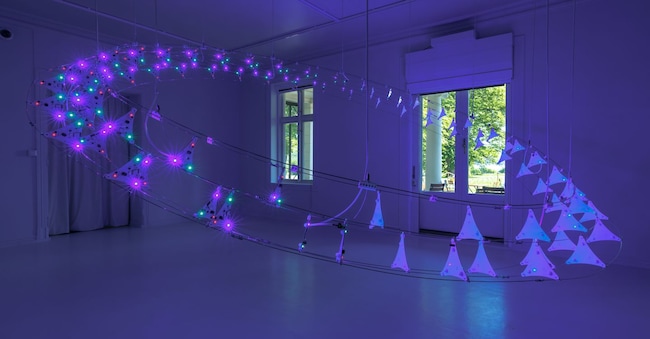
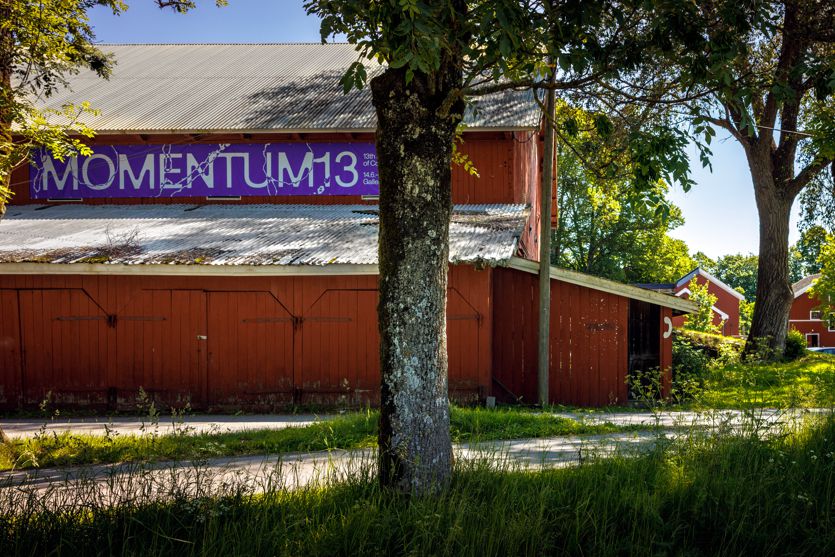
The biennial MOMENTUM opened its 13th edition on 14 June in Moss, an hour south on the fjord that connects it to the Norwegian capital. For the first time, the kermesse sees director Lise Pennington at the helm of Galleri F15, organiser and main venue of the event. After the last edition led by an artists' collective, there is a return to a more classical approach under the responsibility of Morten Sondergaard, Danish curator and professor specialising in the relationship between sound and art, the prevailing media of the exhibition "Between/Worlds: Resonant Ecologies" involving 39 artists, predominantly Nordic but with international presences. For four months until 12 October, i.e. throughout the summer period, international and local visitors can freely experience the works, almost half of which are installed in the natural landscape in the vicinity of the gallery.
Resources
.The Nordic biennial makes use of important public and private resources, with a particular emphasis on social issues and less developed art forms on the market (performance, video, sound,..). The Danish curator of this edition proposes to listen and internalise the problems of the relationship between man and nature, overcoming what he calls the 'listening deficit' that characterises us today. The starting point is in the post-industrial town of Moss, and leads to the forest and nature of Galleri F15 in the agricultural area of Visby. The aim is to increase the viewers' 'ecological awareness' through works of art and sound. The biennial is an important opportunity to commission works from emerging artists, and the field of 'sound art' is particularly difficult and dependent on commissions, in a context where the market goes as far as video art.
Video art and sound
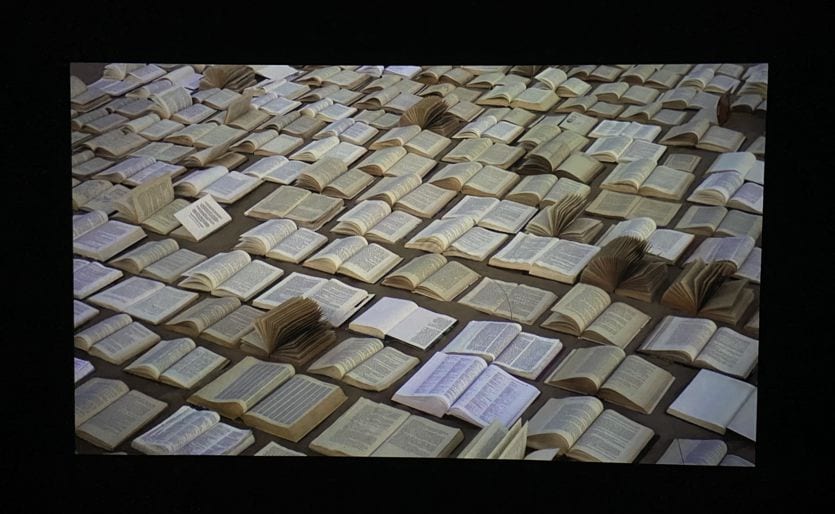
.The proposed video art section is particularly significant, with a studied juxtaposition of works commissioned for the biennial from emerging artists and historical works by established artists. They are all works in which the sound element prevails over the visual element that accompanies it. Prominent among the 'youngsters' is William Kudahl, a 34-year-old Danish artist who offers two separate works; the poetic video 'The Wind is Reading' accompanies the rustling of the pages of dozens of books moved by the wind. From visual poetry, the artist moves on to written poetry with the book 'Reading the Wind', which lists the hundreds of names that the wind takes on in different cultures around the world, reminding us of its importance for life and the spiritual dimension associated with it. Also among the emerging artists, Melia Roger, a French artist not yet 30 years old, one of the youngest artists at the biennial, studies the sounds of nature using small tactile microphones: 'Intimacy of lichens / Intimacy of stones' is an installation of two videos from 2021 that visually clarify the process of interaction with nature, aimed at developing an awareness of the vitality of plants, the basis of the ecological system.
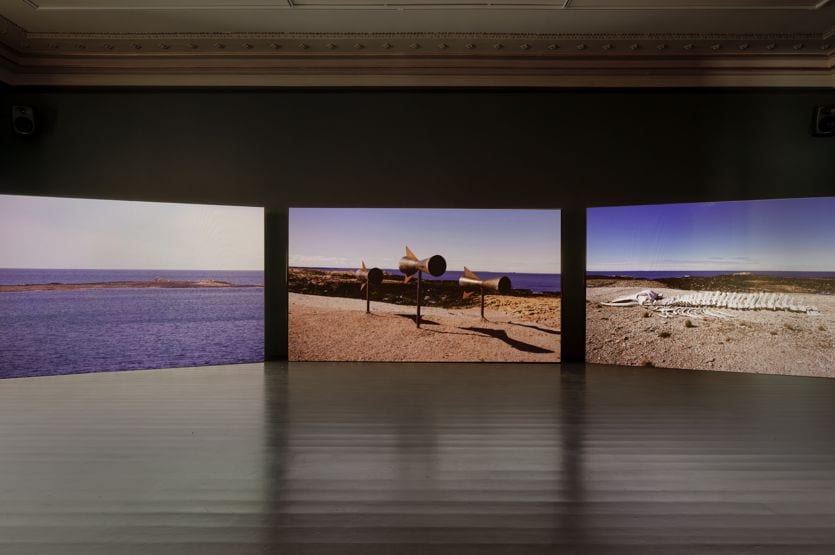
The entire biennial is a hymn to nature and a reminder of the need for balance and respect in human interaction with it. Even the non-commissioned works of two established artists speak to us of this interaction: Christian Boltanski with 'Misterios' from 2017, a triptych video shot in Patagonia lasting 12 hours (edition of 3) in which three separate still cameras record respectively the sound of the wind generated by special instruments, the waves of the ocean shore and the skeleton of a whale whistling motionless on it. Carsten Nicolai, the 60-year-old Berliner represented by Pace, is present with 'Future past perfect pt. 04 (stratus)' from 2013, a work that records images and sounds of clouds at high altitude. Among the big names on offer is a now 30-year-old video by 70-year-old Christian Marclay, one of the 'fathers' of the fusion of art and sound, paid tribute with the presence of 'Telephones' from 1995 (in an edition of 250), taken from themed film images. Although more traditional and close to the visual arts, the presence of video complements the site-specific installations that take place in the park of Gallerie F15, the forest and ploughed fields sloping down towards the bay: a century ago it was one of Munch's favourite places and is present in several of his works.
Art and Noise in Nature
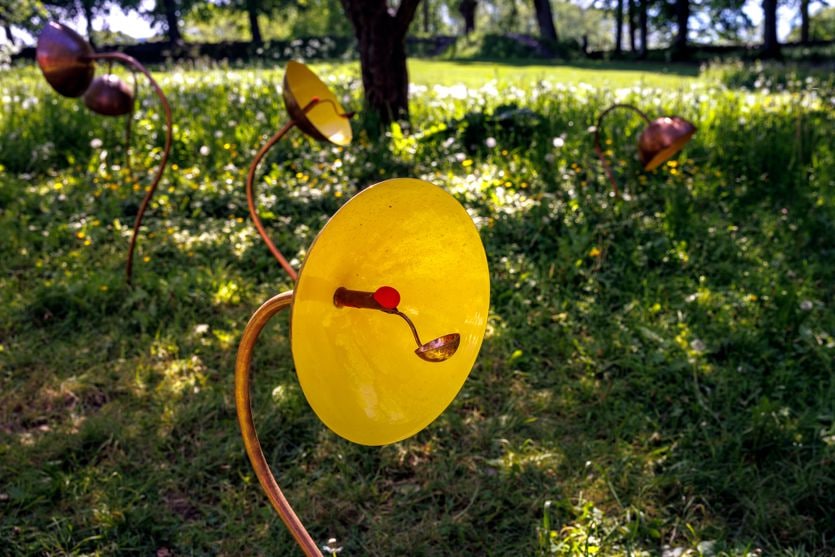
As soon as you arrive at the Biennale, you cannot fail to come to terms with the installation occupying a large lawn by 45-year-old Danish Christian Skjodt Hasselstrom. One encounters, in fact, at regular intervals, as in a chessboard, 120 metal half-spheres from which comes a random croaking sound, in reality a manifestation of cosmic rays and particles (muons and bosons) that hit a special membrane inside the sphere, studied with the Danish university to obtain a detector of them, thus making their presence manifest. The spectator is thus invited to become aware of the cosmic invisible with which we interact at all times. Experiencing and interacting with the hidden is a recurring theme: Kalle Aldis Laar, a 70-year-old Latvian/Estonian artist, re-proposes a work that has involved more than 50,000 visitors since the 2007 Venice Biennale: 'Calling the Glacier' allows one to communicate by telephone with the dying glaciers of the Alps, listening to their eerie sound thanks to microphones operated by scientists who increasingly need the support of the people to counter these phenomena. It is difficult to remain indifferent after this aural experience.

