
Monogram Vuitton: 130 years of tradition, magic and charm

Legend has it that in 1997 Bernard Arnault made a request to Marc Jacobs when he chose him, together with the then CEO of the maison Yves Carcelle, as creative director of Louis Vuitton. The founder of the LVMH group, today the world's largest high-end group, is said to have granted the American designer complete and absolute creative autonomy, on the condition "only" that he would not "overdo" the Monogram. The hypnotic combination of initials and flowers created by Georges Vuitton, the son of the founder of the maison, in 1896 had remained in fact identical for the hundred years preceding the turnaround conceived by Arnault and Carcelle for Vuitton, which from a maison that was born and became famous for travel trunks could aspire to become a leading brand of clothing and accessories.
A year before Jacobs' arrival, for the centenary in 1996, designers such as Vivienne Westwood, Azzedine Alaïa and Manolo Blahnik had indeed reinterpreted the Monogram, but it is likely that a revolution, rather than a mere reinterpretation, was to be expected from Jacobs. In retrospect, we can say that it was a gentle revolution: Marc Jacobs, unsurprisingly, made head and heart his own, and from his first Louis Vuitton ready-to-wear show in Paris in March 1998, he let it be known that he was going to play with the Monogram (but also with the even older Damier motif). In the years that followed, the flowers and letters designed by Georges Vuitton (also) to protect his trunks from imitations were reinterpreted by Jacobs himself and many artists, and the designer's approach repaid Arnault for the doubts he might have had at first. That rebellious, almost revolutionary act actually demonstrated the strength of the Monogram: however much it was enlarged, shrunk, distorted in colour and shape, 'contaminated' by creative forces that had grown up far from France, fashion and luxury, the Monogram always remained recognisable. Indeed, perhaps it became even more so: a separate discourse would merit imitations, which, as with so many other brands and logos, have in some become - if only at a first glance or touch - increasingly similar to the original (see also the article on this page). Returning to the positive notes, one thinks of Takashi Murakami, who with his 2003 Colourful Monogram transformed the motif into a pop mosaic; of Yayoi Kusama, who in 2012 - a year before Jacobs left Vuitton - covered it with her famous polka dots. Which the Japanese artist did again in 2023, the year in which the Italian manager Pietro Beccari became ceo of the maison, demonstrating that the evolution of the Monogram is a sort of eternal return between art and fashion, linked by the creativity and craftsmanship of their respective acts and fields.
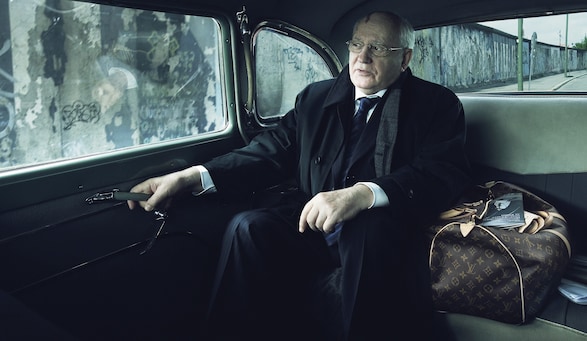
Then there is Jeff Koons, who in 2017 converted the Monogram into a tribute to art history with the Masters collection, superimposing masterpieces by Leonardo da Vinci and Monet, while in 2021 Urs Fischer distorted its rhythm into a dreamlike abstraction. And again: in 2014, for the Celebrating Monogram project, Frank Gehry sculpted the Twisted Box bag, Rei Kawakubo radically deconstructed the tote, and Cindy Sherman, Karl Lagerfeld, Christian Louboutin and Marc Newson devised visionary shapes. The evolution of the Monogram is punctuated by communication campaigns that are themselves revolutionary and one that stands out above all others, in the opinion of this writer, is the 2007 campaign starring Mikhail Gorbachev. The former president of the USSR was photographed by Annie Leibovitz in a car driving past what remained of the Berlin Wall, the first breach of which had been opened in November 1989. On the back seat, next to Gorbachev, who asked to donate his fee to the International Red Cross, was a Keepall, Vuitton's most famous travel bag. An image that perhaps not even the most 'diabolical' AI-driven software could create today. Only human intelligences, all too human, could think of associating the enigmatic gaze of a person who had changed the world with a high-end brand. Leibovitz's sensitivity and the inherent power of those images - the Berlin Wall, Gorbachev's melancholic pride - succeeded in showing a product by making it seem part of the picture of the complexity of life.


