
Montezemolo: 'Italia and Europe weaker if deindustrialisation wins'
Luca Cordero di Montezemolo at the panel "Why we need a United States of Europe"

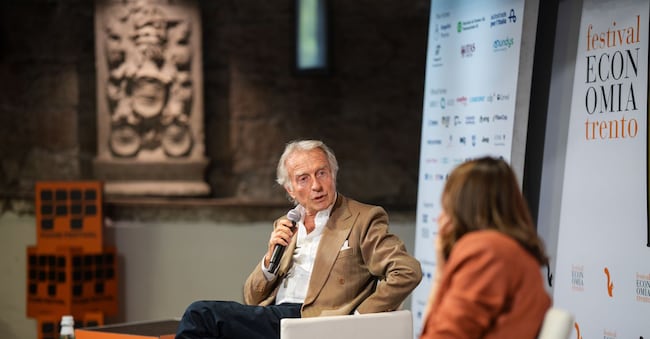
The Europe that Donald Trump treats like an extra in his Scottish resort when he receives the president of the EU Commission, Ursula von der Leyen, and the Europe that sees projects that, emblematically, seem to be trying to build a common rail market starting with trains. Two distant images, yet held together by Luca Cordero di Montezemolo in an argument that, at the Trento Festival of Economics, resembles less a lesson on Europeanism and more an industrial alarm, an alert on a diplomatic, economic, strategic risk.
There is a geopolitical point: 'I believe that there has never been a time in the world so delicate and so potentially dangerous'. For the former Ferrari chairman and now chairman of Italo, Fondazione Telethon and Manifatture Sigaro Toscano, the issue is also a productive one. It concerns factories, energy, technology, work. "In the silence we are witnessing a deindustrialisation of Italia that is frightening," he says when interviewed by Agnese Pini, director of Qn, Il Resto del Carlino, Il Giorno and La Nazione, during the meeting 'Why we need a United States of Europe'. And the list that follows is an x-ray of a national downsizing: 'We no longer have the automobile, we no longer have electronics, we risk no longer having steel'.
Montezemolo speaks with the lexicon of a capitalism that still has memory of production. And from there he comes to politics with a consideration valid for Italia as for the entire Old Continent: 'A Europe without industry is a very weak Europe'. Weak in the face of Trump's United States, which 'one day on and one day off shoots Europe down'. Weak in the face of China, 'today the manufacture of the world'. Weak because it is fragmented, incapable of transforming itself into a political subject while the world is once again organising itself into blocs.
"I would like that when Trump talks about Europe he can be confronted with a strong, united Europe, with investments in defence. The implicit target is the illusion that globalisation could hold without solid foundations. For years, Europe thought it could live on rules, finance, consumption and services while manufacturing moved elsewhere. Now comes the reckoning that, for Montezemolo, makes it necessary to head towards the United States of Europe, not as an idealistic dream, but as a strategic necessity. Comforting, in this context, is the fact that there is "a demand for Europe that had not been there before," he points out, citing a Swg survey according to which 40% of Italians, especially young people, would also like a European identity, thus perceiving that no European country, on its own, no longer has sufficient critical mass to compete.
The discourse that has Europe as its fulcrum cannot but fall on Italia. 'I,' Montezemolo says, 'may be a dreamer, but I have always thought in my working life that unity is strength, team spirit is strength, being together is strength'. And that the priorities have no flag: 'Security, health, school'. But what is missing, according to Montezemolo, is the thread: 'I do not hear talk of growth, I do not hear talk of development, I do not hear talk of tomorrow, I do not hear talk of a country project. Italia should do the opposite: 'I would go into the squares to mobilise people on this, on the theme of the United States of Europe'.


