
The Moon 'closer' to Earth, first data from the Italian-American Lugre mission arrive
The initiative is carried out by the Italian Space Agency with NASA. The information is now accessible to the international scientific community

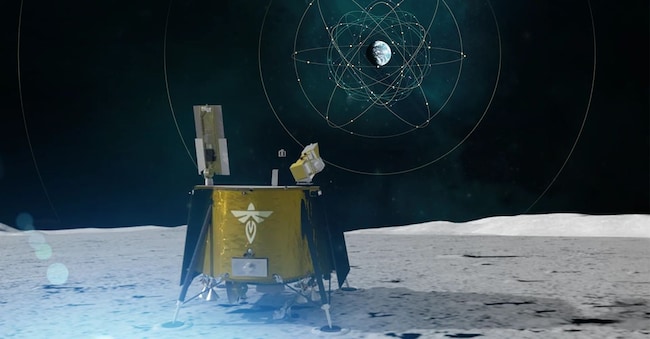
The Moon is 'closer', thanks to the Lugre mission carried out by the Italian Space Agency and NASA. From the Moon, in fact, come the first public satellite navigation data, collected and disseminated by NASA and Asi. The information, now accessible to the international scientific community, comes from the Italian-American Lunar GNSS Receiver Experiment mission, which 'demonstrated how the signals of the GPS and Galileo satellites can be used beyond the Earth's orbit and on the lunar surface'.
The Italian company
An important part was played by Italy, since it was Qascom, a company based in Bassano del Grappa, that developed Lugre, an all-Italian instrument made for Asi. It is an 'innovative instrument that allows the precise measurement of position in space, even in environments very distant from the Earth'. Not only that, the scientific part was taken care of by the Turin Polytechnic, which supported Asi with a specific centre for processing scientific data. 'The Software Defined Radio Receiver, designed to work in deep space, is very sensitive to GPS and Galileo signals,' reads the project specifications, 'thanks to a specific algorithm that picked up and then processed the very weak signals during the journey to the Moon and then from the lunar surface. The signals are 10,000 times weaker than those received on Earth and with the additional aggravation of prohibitive geometries.
Experts: "historic step"
For the experts of the Italian agency, this is a 'historic step for space science and technology'. 'For the first time, the navigation signals we use on Earth have been received and analysed on the Moon,' they write. 'An achievement that paves the way for new technologies for the Artemis missions, which will bring man back to our natural satellite.
Lugre was launched in January 2025 aboard Firefly Aerospace's Blue Ghost 1 lander, and received GNSS and Galileo signals, in dual frequency, both during the journey to the Moon and once it landed on the surface, "setting new distance records, up to 400,000 kilometres from Earth, and demonstrating that satellite navigation can become a key resource for future lunar missions".
For the scientific world, this is a new opportunity because 'these results pave the way for a future in which astronauts, rovers and spacecraft will be able to use the same satellite navigation systems that we use every day on Earth, greatly improving their ability to orient themselves and operate safely on the lunar surface'.

