Morad (Google Research): with AI Quests students learn how artificial intelligence works
According to the researcher, the goal is to prove that Ai is not a black box, but a human-designed tool.
by Luca Tremolada
 Aggiungi Il Sole 24 Ore
ai preferiti su Google
According to Google, artificial intelligence literacy should not start with the use of chatbots but with understanding how an AI system works. It is from this idea that AI Quests was born, an educational project developed by Google Research together with the Stanford Accelerator for Learning and presented in Italia for students aged between 11 and 14.
The goal is to turn learning artificial intelligence into an interactive experience. Students enter an educational video game and take on the role of researchers called upon to solve concrete problems using data, models and simulations. They do not just 'talk' to an AI assistant: they have to collect information, check the quality of datasets, train models and test the results. The system is built to show that AI is not statistical magic but a sequence of decisions, errors and verifications.

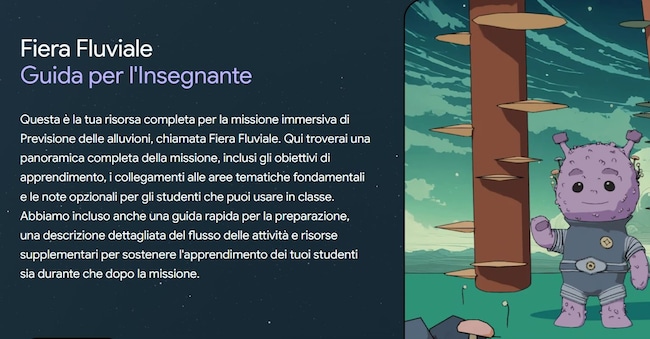
The first available experience is called 'River Fair' and is inspired by the flood forecasting systems developed by Google. In the game, students analyse data on rainfall and river flows to build a model capable of anticipating floods. It is a simplified version of one of the big problems of AI applied to climate: turning huge amounts of environmental data into early warning systems.
The second quest, 'Twilight Canyon', takes its cue from Google's research on diabetic retinopathy, a disease that can lead to blindness. Here the theme becomes the use of artificial intelligence in health and medical image analysis. Also coming in the next few months is 'Studio Sbellicoso', a course dedicated to connectomics, i.e. the mapping of connections in the human brain.
One of the most interesting aspects of the project is that the system not only tries to teach how to use AI but also how to doubt AI. Students can make mistakes, use incomplete datasets or make wrong decisions and see how these problems affect the final results. It is an approach that reflects a broader change in the educational debate: AI literacy is no longer presented as simply using generative tools but as understanding the limitations, biases and quality of data.