
Benefit Corporations: more attractive and with a better reputation
The third stage of the Benefit Competition, organised by MIMIT, is taking place in Ancona, providing an opportunity to share experiences and gain a better understanding of this model

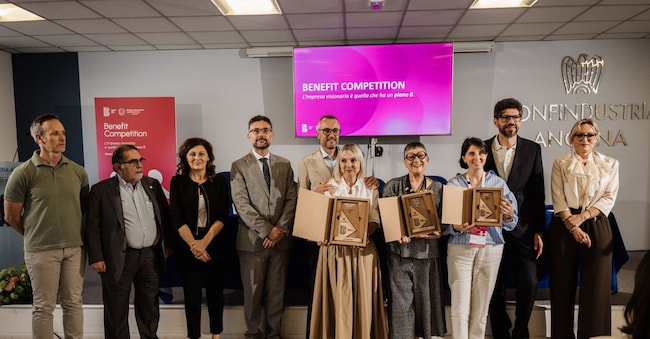
(Il Sole 24 Ore Radiocor) – The Benefit Competition has reached the halfway point; this initiative, promoted by the Ministry of Enterprise and Made in Italy, aims to support and raise awareness of and visibility for organisations that have adopted the benefit model or intend to do so. With the third stage in Ancona, held at the Confindustria Ancona headquarters, the initiative has reached the halfway point in its aim to demonstrate, through concrete examples, how it is possible to combine economic success with a positive social impact. ‘Since the start of the Benefit Competition, 235 applications have been received, 79 of which were for the Ancona stage. Of the applications received, 80% were from companies that are already Benefit organisations, 13% from businesses that have already internalised the Benefit principles even though they have not yet adopted this model, whilst the remaining 7% came from new businesses.” Azzurra Marchesano of MIMIT gives an initial assessment of the initiative. “It’s going very well. The Benefit Competition is the flagship of a broader promotional plan that includes various activities such as institutional communication through the Ministry’s channels and specific training events that we organise with the entire network of local Chambers of Commerce,” she emphasises. “We decided to hold this stage in Ancona because the Marche region exudes entrepreneurial dynamism and a focus on sustainability issues that deserved to be highlighted,” she continues, adding that of the “79 applications received, 33 per cent came from local businesses, with a significant proportion being micro-enterprises”. Ahead of the next stage – the fourth – in Padua, scheduled for 16 October, businesses are invited to explore this model, learn about it and reap its benefits. “I believe that, in terms of sustainable development, the benefit model is one that helps businesses improve their reputation as well. As a benefit corporation is closely aligned with sustainability issues, it generally presents itself more favourably not only to suppliers and customers, but also to the banking sector; therefore, I believe that reputation is a key consideration for anyone wishing to adopt this model,” explains Marchesano. So it is not just about the goal of making a profit – like all businesses – but also about paying specific attention to the well-being of all stakeholders, which indirectly translates into further benefits.
The three winners from Ancona
The panel of experts, tasked with assessing the 10 finalists from the Ancona stage, selected the top three from among them – all companies already established as Benefit corporations – plus one special mention, acknowledging the great difficulty in choosing the podium finishers, given the high calibre of all the initiatives and projects presented. First place went to Molino Agostini (a company based in the province of Ascoli Piceno), which specialises in milling organic cereals produced by over 100 local farms. The aim of this company is both to promote local produce, guaranteeing traceable, high-quality products, and to reduce the energy and environmental impact of its production processes. Second place went to Gaia Segattini Knotwear (province of Ancona), a company that develops and markets ‘Made in Italy’ knitwear in line with the principles of the circular economy, making use of regenerated and surplus yarns. The aim is to create more ethical garments, with lower consumption and less waste. Taking third place on the podium was Icma, a company based in the province of Lecco, which manufactures speciality papers and high-end packaging. In Ancona, it presented the ‘Rinascimento’ initiative, which enables the direct recovery of paper waste, thereby avoiding the production of new pulp and resulting in a reduction in the consumption of water, energy and chemicals.
Why the benefits model is worthwhile
A Benefit Corporation naturally enjoys a better ‘reputation’, as Azzurra Marchesano of MIMIT puts it, and is ‘more attractive’, as the president of Confindustria Ancona, Diego Mingarelli, who is himself a Benefit entrepreneur with his family-run company Diasen, one of the winners of the Milan leg of the Benefit Competition. ‘We believe in this model, even more so in our region, the Marche, which is a perfect example of widespread manufacturing, where the relationship between the factory and the local area is a deep-rooted one. We are one of the regions – if not the region – with the highest number of businesses per thousand inhabitants,” notes Mingarelli, emphasising that for “manufacturing SMEs, therefore, the Benefit model is one that is perfectly consistent with our industrial system”. The decision to host the third stage at the Confindustria Ancona headquarters is also aimed at ‘raising awareness of this model, sharing business stories, examples that can inspire other entrepreneurs, and to help people understand the value this brings both to the company and to the wider community through the implementation of benefit models, which can also act as a catalyst for enhancing the region’s appeal’. In fact, the entrepreneur explains, “the more companies there are that offer benefits which value their staff through welfare programmes designed to foster growth, the more attractive the region becomes” and “attractiveness is a major challenge for the Marche region and for Italia as a whole”.
“We are convinced that there is absolutely no conflict between making a profit and creating well-being. The two go hand in hand; they are linked; they are by no means at odds with one another; on the contrary, they run parallel,” adds the Councillor for Productive Activities for the Marche Region, Giacomo Bugaro, noting that the regional government has taken steps in this direction by signing, together with the social partners, a ‘Welfare Protocol’ – which we are currently in the process of renewing – that serves as a sign of commitment to a region and an ecosystem that views sustainability, well-being, the preservation of local areas and profitability all travelling in the same carriage, as if on a train that is moving forward without losing sight of the company’s ultimate goal: to conquer markets, whilst at the same time doing so in a sustainable manner and with a focus on people and places’.
Why take part in the Benefit Competition
Exchanging ideas, getting to know one another and sharing experiences, even if we come from different sectors. The companies taking part in the Benefit Competition are all on the same wavelength, despite having different histories and coming from different backgrounds. What prompted Molino Agostini to take part was the desire to ‘measure ourselves against others, because this comparison also allows us to understand whether this is the right path’, says Morena Marcaccio, who emphasises the importance of ‘listening to how other companies operate’, noting that these are opportunities to share experiences, as a benefit corporation can in turn be seen as ‘a coming together of people who share the same vision, namely respect for human dignity and the earth’ and “the clearest message is that in order to sustain the economy, especially the agricultural economy, we must create value, and value can only be created through a benefit corporation: profit on the one hand and the redistribution of wealth on the other”. The importance of sharing is also emphasised by Gaia Segattini, co-founder of the company of the same name: “I think that at this moment in time, seeing so many organisations which, each in their own way, are embarking on an important ethical journey finally gives the impression that a path of ethical entrepreneurship is not only possible, but probably also more flexible and better suited to the contemporary world, and this is something that helps a great deal in tackling daily challenges.” Lisa Baracchi, head of the press office at Icma, echoes this sentiment: “The Benefit Competition is an opportunity to engage with other companies and reflect on the principles of what it means to be a benefit corporation, and on what the future might hold for this responsibility and the choices we share. These are very different organisations that have been compared, yet together we have identified the values and needs that our region and the present moment demand of us.” A summary comes from the president of the Marche Chamber of Commerce, Gino Sabatini: “The Benefit Competition highlights the increasingly important role of businesses that are able to combine competitiveness, innovation and responsibility towards the community and the local area,” businesses that bring “added value, including for young people entering” the world of work.


