
More efficient and more technological: HVAC systems at the heart of the energy transition

In the energy balance of buildings, air conditioning (winter and summer) represents one of the most relevant items, both in terms of consumption and emissions. According to the International Energy Agency (IEA), in fact, the buildings sector is responsible for about 30% of energy requirements at global level. This share, according to recent estimates elaborated by the European Commission, reaches about 40% of consumption in our continent. The future of cooling and heating systems (which are still responsible for a considerable portion of this consumption) is therefore central to trying to reduce both energy use and therefore energy bills (both those of families and businesses but also the national bill), but also the emission of greenhouse gases into the atmosphere, the cause of global warming.
The EPBD (Energy Performance of Buildings Directive) aims at a zero-emission building stock by 2050, and therefore the lever of innovation in the HVAC (Heating, Ventilation and Air Conditioning) sector is considered an essential lever. Intervening on air conditioning consequently means acting on one of the main drivers of consumption and, at the same time, on one of the areas with the greatest potential for efficiency.
Samsung's role in the fight to save energy
Traditionally linked to continuous innovation, Samsung, the market leader in the HVAC sector, is progressively strengthening its position as a supplier of integrated solutions, capable of combining technology, connectivity and supply chain development. The vision outlined by the Korean company at MCE 2026 fits fully into the European dynamics of electrification and decarbonisation and specifically focuses on building a complete ecosystem that covers the entire value chain, from products to services, from design to plant management.
Heat pumps between regulation and technological innovation
Heat pumps are becoming the main asset in the energy transition: in Europe, according to estimates by the European Heat Pump Association (EHPA), the installed base of these devices would be in the order of 25 million units by the end of 2024, with an estimated cut of about 45 million tonnes of CO₂ and a significant reduction in natural gas consumption. The role of heat pumps, experts agree, is as central to reducing consumption as it is to progressive decarbonisation, thanks to the high efficiency of the systems and their ability to harness renewable sources such as the thermal energy contained in air, water and soil).
A mature, flexible and sustainable technology
Samsung brings together efficiency, sustainability and flexibility in a single technology, capable of integrating air-conditioning (heating, cooling) and domestic hot water production with much higher efficiencies than combustion systems.
The Korean manufacturer's offer of heat pump HVAC systems is comprehensive and ranges from residential to commercial. The heat pumps in the EHS range, in particular, meet the needs of the domestic and light commercial segment while the modular heat pump chiller solutions further expand the application possibilities, with scalable configurations suitable for commercial and industrial contexts. In the segment of complex systems, Samsung brings to the market evolved VRF (Variable Refrigerant Flow) systems with direct expansion thanks to the presence of native artificial intelligence and the use of refrigerants with a lower environmental impact, while the different types of indoor units come with the declared plus of flexible and customised design.
The role of Artificial Intelligence
The next big step, already a reality, is the digital evolution of the system. AI is transforming the way HVAC systems operate, transforming them from simple temperature control tools to intelligent platforms that can learn, adapt and optimise consumption in real time. Comfort thus becomes a dynamic, personalised and increasingly efficient experience in the wake of the ever-increasing convergence between sustainability, efficiency and digitalisation.
An interconnected ecosystem
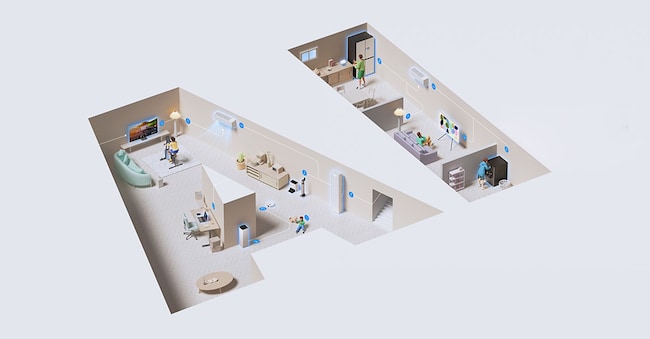
A distinctive element of Samsung's proposal is linked to the digital component. The SmartThings ecosystem, more specifically, enables the unified control of various devices at a residential level, while SmartThings Pro extends these functionalities to the business world, ensuring the benefits of multi-site management, pushed automation and advanced analytics. Artificial intelligence, in other words, becomes an operational component of the system, capable of learning users' habits and optimising their consumption, thus improving the level of comfort on a continuous cycle.
New solutions for wellbeing at home and in the office
Solutions such as WindFree Première+, which introduce a new standard of comfort by combining the absence of a direct air jet, an evolved design and the ability to adapt intelligently to environments, are also aimed at user comfort. Finally, Samsung's recipe for making (and sharing) innovation in the HVAC world is completed with a series of services aimed at the supply chain, with investment in training and support for professionals (designers and installers) working in the field. A strategy, as the company's managers confirm, that bets on the ever closer union between technology and skills to face a demanding market that needs cutting-edge, reliable and durable solutions.

