
More places in healthcare professions: +1,180 on three-year degree programmes, +251 on master’s degree programmes
In total, the number of places for scheduled admission has increased by 1,431. Entrance exams are scheduled for 15–16 September and 5–7 October

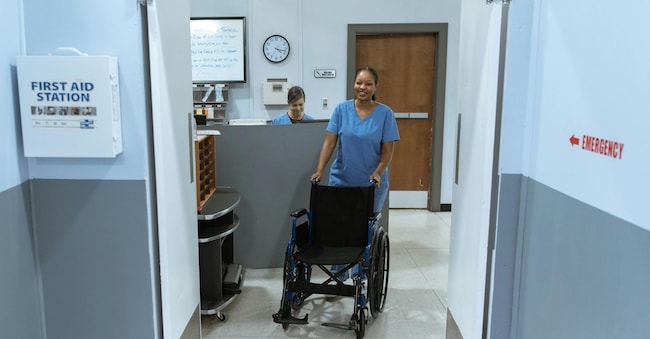
It is not just Medicine, with its 3,000 places over 12 months, that has expanded access for the coming academic year. The same applies to healthcare professions, which will see an increase of 1,431 places in 2026/27 compared with 2025/26, comprising three-year degrees (+1,180) and master’s degrees (+251). This is confirmed by the decrees and tables issued by the Ministry of University and Research (MUR), which provide a breakdown by course and university. And, under the ‘filter semester’ system, this is also good news for aspiring doctors. Last year, of the approximately 12,000 students who did not make the cut for Medicine and opted instead for a ‘related’ course in the healthcare, biomedical, pharmaceutical or veterinary fields, around 2,000 chose a course in Nursing and Midwifery.
Slight growth in nursing
Nursing, in particular, deserves closer examination. Not so much because of the scale of the increase – given that there are 20 additional places on the three-year degree programme (rising to 64 if we include midwifery, with which it shares the same degree classification, L/Snt1) and 338 on the master’s programmes – but rather because of the forthcoming changes to the degree regulations. As the Fnopi (National Federation of Nursing Professional Bodies) pointed out yesterday, alongside the confirmation of the existing master’s programme (which will have 369 fewer places available compared with 2025/26), there are three new clinical specialisations established by the Ministry of Health: primary care and family and community nursing, aimed at strengthening local care provision and the management of chronic conditions; intensive care and emergency nursing, which aims to develop advanced skills in critical care; and neonatal and paediatric nursing, for specialist care in paediatrics (which was previously provided under the three-year degree programme). Together, these account for 707 new places and make up the +338 increase mentioned above.
The trend for triennials
Bearing in mind that admission to both the three-year and master’s degree programmes is subject to passing the entrance exams scheduled for 16–17 September for the former and 5–7 October for the latter, let us return to the general figures. Well, the greatest increase in places is concentrated in the three-year degree programmes, which have risen from the ‘old’ figure of 38,444 to the ‘new’ figure of 39,624. The majority of the 1,180 additional places are in the L/Snt2 category, which is itself divided into eight different specialisations (ranging from Physiotherapy to Speech and Language Therapy to Psychiatric Rehabilitation), recording a significant increase of 859. Next comes L/Snt3, which offers nine degree programmes (including Medical Radiology, Imaging and Radiotherapy Techniques; Biomedical Laboratory Techniques; and Dental Hygiene, to name just the main ones) and 211 more places than the previous year. Rounding off the figures are the +64 for L/Snt1, as already noted, and the +46 for L/Snt4 and its three three-year degree programmes: Environmental and Workplace Prevention Techniques, Healthcare and Osteopathy.
Limited increase for master’s degree programmes
As for master’s programmes, the final figure of +251 (equivalent to +5.8 per cent) is arrived at by comparing the 4,572 places in the 2026–27 academic year with the 4,321 in the 2025–26 academic year. The key factor here is the increase of 338 places for aspiring nurses and midwives. Indeed, in the other three degree programmes, the net figure remains negative, with reductions of 34, 8 and 45 places respectively.

Brand connect


Newsletter Scuola+
La newsletter premium dedicata al mondo della scuola con approfondimenti normativi, analisi e guide operative
Abbonati