
More sustainable smartphones: new EU labels for energy efficiency and reparability arrive

4' min read
4' min read
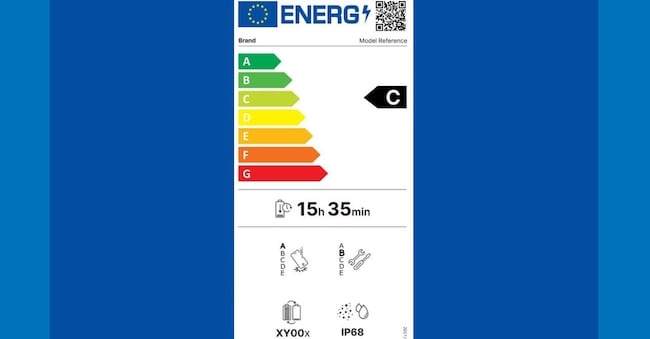
As of 20 June next, all new models of smartphones and tablets sold within the European Union, even from non-EU manufacturers (such as Samsung and Apple, just to give two examples) will have to display a new information label. The measure, set out in EU Regulation 2023/1669, is part of a broader strategy to make consumer electronics more transparent (in terms of communication to users) and more environmentally sustainable. The new labels will have to be presented in electronic and paper format and clearly visible on physical packaging and in online stores, and will contain very detailed information on the energy efficiency of the devices, the autonomy of the batteries, the degree of resistance and protection against dust, splashing water and accidental drops, and a rating on the 'repairability' of the device (highlighted with a scale from 0 to 10), and thus the level of ease with which the device can be repaired should it be damaged. Energy performance will be expressed through a classification system ranging from A to G, similar to that already in use today for household appliances, and particular attention will be paid to batteries: the label will include the number of complete recharging cycles before the battery falls below 80% of its original capacity (the minimum value required is 800 cycles), the time needed for a full recharge expressed in minutes and the remaining capacity of the battery after 500 cycles, the latter providing a more concrete indication of the device's real durability over time.
Consumption and more conscious shopping
The one decided by the Brussels Commission is not, however, an isolated intervention, albeit one of great substance, but rather a further step in a regulatory path that finds its foundation in the Ecodesign Directive (active since 2009 and extended in 2017), which has already imposed efficiency standards for numerous product categories, and in the simplification made in 2021 to the energy labelling system, with the elimination of "plus" classes (such as A++) in favour of a clearer evaluation scale. The new labels are part of Europe's green transition and circular economy policies, and the Commission's aim is to provide consumers with a set of objective and tangible tools to evaluate electronic devices, rewarding the most durable, repairable and resilient products at the purchase stage. Greater transparency on these aspects, this in brief is the purpose of the initiative, can reduce the amount of e-waste destined for disposal (where only a small proportion of devices are properly recycled) and the indirect emissions associated with this process, and lengthen the life cycle of products, today marked by commercial policies that incentivise replacement every 2-3 years, even when the device would be technically repairable or still usable.
The smartphone market and the ecodesign obligation
The EU's plan comes at a time when the consumer technology market is experiencing a brisk recovery after the conspicuous decline of recent years, starting in 2020 and ending in 2023, when around 130 million smartphones were sold in Europe. Last year, the overall volume growth (according to Canalys' findings) was 5% year-on-year due mainly to strong demand for high-end products, with more than 41 million devices purchased by consumers with a list price of EUR 800 or more, mainly under the Apple and Samsung brands. As for 2025, industry analysts agree that a particularly important factor in the economics of this market will be the requirement to comply with European eco-design regulations (EU Regulations 2024/1781 and 2023/1670), which shifts the centre of gravity of environmental responsibility directly onto manufacturers, who will be required to ensure that their devices are maintained, upgraded and disposed of properly in accordance with precise time and quality standards. The upturn in sales, as several insiders observe, must in fact come to terms with the rapid obsolescence of devices, which, added to the increasing difficulty of repairing them, contributes to a significant environmental impact. It is precisely in this area that the new EU regulation comes into play, establishing a series of minimum design requirements: manufacturers of smartphones and tablets, in particular, will have to make available spare parts considered critical and essential within a maximum of 10 working days and for up to seven years after the product's withdrawal from the market. This is, in fact, a first attempt to operationalise the so-called 'right to repair', which has been clamoured for by consumer associations and environmental groups, i.e. the possibility given to the user to provide for the replacement of defective components and parts of electronic devices on his or her own in a simple and inexpensive way, without necessarily having to turn to the assistance services offered by the manufacturers themselves.
To which devices it applies and from when
The new rules will apply to all mobile phones and tablets with screens up to 17.4 inches, including cordless and feature phones, while devices with a rollable display, which are not yet on the market, will be exempt (at least for now). Tablets with the Windows operating system will be regulated separately, under the rules for computers, while devices already on the market before the entry into force of the measure will be excluded.

