
Tolls, 1.8% increases on Autostrade per l'Italia network
The Mit: frozen tariffs for the other 22 concessionaires. From 1 January 2025 the Brenner funnel will be opened for work in Austria: traffic jams feared

3' min read
Key points
3' min read
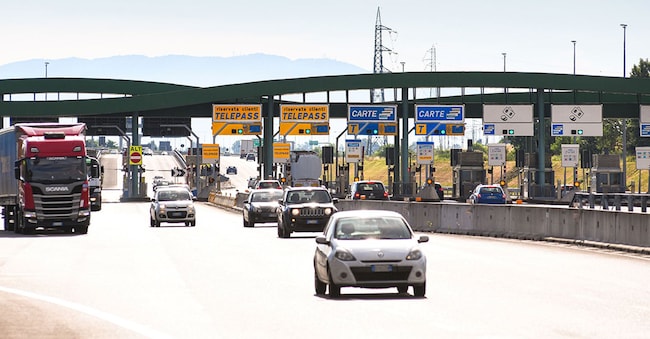
Toast in the middle for Italian motorway users. As of 1 January 2025, the feared tariff adjustments, i.e. the increase in tolls, will be limited to just under 50% of the national network: that managed by Autostrade per l'Italia (Aspi). On the remaining 50%, however, there will be no increase. This was announced by the Ministry of Infrastructure and Transport (MIT).
The MIT note
.A note from the ministry headed by Matteo Salvini explains: "As of 1 January 2025, tariffs on Italian motorways will remain unchanged for all 22 motorway concession companies involved in updating their Economic and Financial Plans (EFP). The decision, taken by the MIT in cooperation with the Ministry of the Economy (Mef), is in line with the orientation of the Transport Regulatory Authority. With regard to the network operated by Autostrade per l'Italia, which includes around 2,800 kilometres of motorways (out of a total of around 6,000, ed.), a tariff adjustment of 1.8% has been envisaged, corresponding to the planned inflation rate for 2025, as established by Law no. 193 of 16 December 2024. At the request of the Mit, Autostrade per l'Italia confirmed that the generalised discounts for users would be maintained. The suspension of these discounts would in fact have led to an overall increase in tariffs of around 3%. Lastly, a tariff increase of 1.677% was recognised for the Salerno-Pompei-Naples concession company".
The Brenner Funnel
.Also as of 1 January 2025, the dreaded bottleneck will begin, with the narrowing to one lane in each direction on the Austrian side of the Brenner motorway, due to the unavoidable work on the Lueg Bridge (about 6 kilometres from the Italian border, in Tyrolean territory). The rebuilding of the 1.8-kilometre-long viaduct will last until 2030 and will cost 390 million Euro. The Austrian motorway company Asfinag has repeatedly stated that there is no alternative to the complete reconstruction of the 50-year-old bridge. Long queues of cars and trucks are feared at the busiest pass in the Central Alps. An estimated 2.5 million heavy goods vehicles pass through each year. During the 180 red and black dot days (heavy traffic), traffic will still be allowed to pass on two lanes, but - in order to have less impact on the structure's statics - trucks will have to travel on the fast lane and cars on the normal lane. A very complex traffic management operation, but the tests carried out by Asfinag have proved positive. The final word will come in the coming months, from the field test. Moreover, the neighbouring villages, which are located along the motorway, fear the onslaught of smart drivers who leave the A13 to avoid the queues. As has already been the case in similar situations in Austria, it will be forbidden to bypass the motorway construction site on days when traffic is heavy in order to enter the secondary roads. From 2027, with work still in progress, the second lane should reopen for good anyway.
Also in 2025, the Austrian authorities will continue to apply the 'dosage' system, limiting the passage of trucks to a maximum of 300 vehicles per hour on certain days in order to avoid total blockades. This measure was severely criticised by Italian hauliers and the Ministry of Transport, which accused Austria of violating European regulations on free movement.


